

Government job eligibility is often reduced to two questions: “What is the age limit?” and “What qualification is required?” That is too narrow.
A recruitment can also depend on the exact crucial date, subject or branch studied, percentage or grade rule, experience, category certificate, nationality, domicile, local language, professional registration, licence, physical standards, medical standards, skill requirements, number of attempts or other post-specific conditions.
The safest approach is therefore not to ask, “Am I generally eligible for government jobs?”
Ask instead:
“Can I prove that I satisfy every essential condition for this exact post on the date and in the manner stated by the official recruitment notice?”
This guide gives you a repeatable method for answering that question before you spend time or money on an application.
Government job eligibility means satisfying all mandatory conditions for the exact post you want to apply for. Start with the latest official notification and check the post or post code, educational qualification, age on the stated crucial date, category or reservation conditions, nationality, domicile or language requirements, experience, professional registration or licence, physical or medical standards, and any skill or attempt rules. Do not assume that a successfully submitted form proves eligibility. Many recruiting systems accept applications provisionally and verify eligibility or documents later. Your final decision should come from the exact notification, later corrigenda and your own documentary proof.
- Government job eligibility is post-specific; there is no single age or qualification rule for every government job.
- Match the exact post name, post code, discipline, region and category before checking eligibility.
- Calculate age on the notification's stated crucial or cut-off date, not simply on today's date. Use the Government Job Age Calculator when you need an exact years-months-days result.
- Read educational qualification word for word, including subject, branch, recognition, percentage and equivalence conditions.
- A category benefit may depend on the exact recruitment, certificate type, status and documentary conditions.
- Nationality, domicile, residence and local-language requirements are separate concepts and should not be treated as interchangeable.
- Experience can depend on duration, field, employer type and whether it was gained after the qualifying degree. The Work Experience Calculator can help total multiple employment periods after you confirm which periods the notification accepts.
- Physical, medical, typing, driving, registration or professional-licence conditions can be essential eligibility requirements.
- Final-year or result-pending candidates should check the qualification cut-off clause instead of assuming they can apply.
- Application acceptance can be provisional; document verification may occur much later.
- Recheck official corrigenda and addenda before final submission.
- Keep a written eligibility record showing why you concluded that you are eligible.
What Government Job Eligibility Actually Means
Government recruitment eligibility is the set of conditions used by the recruiting authority to decide whether a candidate can be considered for a post.
Those conditions come from the recruitment rules, examination rules, advertisement or notification and any later official correction that applies to that recruitment. Different organisations and even different posts inside the same advertisement can use different conditions.
Government job eligibility: the complete set of mandatory conditions a candidate must satisfy for a specific recruitment post, such as age, qualification, category status, nationality, experience, domicile, physical or medical standards, skills, licences and documentary proof. A useful way to think about eligibility is as a chain. If the recruitment has eight mandatory conditions, satisfying seven does not automatically make you eligible.

Eligibility is different from selection
Eligibility answers:
“Am I allowed to be considered under these rules?”
Selection answers:
“Did I perform well enough in the recruitment process to be selected?”
A candidate can be eligible but not selected because of examination marks, merit position, cut-off, skill-test performance, medical result or another selection stage.
The reverse problem is also possible: a candidate may perform well in an examination but later face rejection if a mandatory eligibility condition or document is not satisfied.
| Question | Eligibility | Selection |
|---|---|---|
| Main purpose | Determines whether the candidate meets mandatory entry conditions | Determines who progresses or is finally selected |
| Typical factors | Age, qualification, category, nationality, experience, skills, physical/medical rules | Exam score, cut-off, merit, test performance, interview, DV, medical outcome |
| When checked | Before applying and often verified again later | During and after the recruitment stages |
| Candidate’s safest approach | Prove each condition from the notification and documents | Prepare for every notified selection stage |
Never use “I was allowed to submit the form” as your only proof of eligibility. Online portals can accept information provisionally. Your documents and the recruitment rules still control the final verification.
Read the Notification Correctly Before Judging Eligibility
Eligibility errors usually begin when a candidate reads only a summary instead of the exact post-specific clauses, footnotes and corrigenda.
The Government Job Eligibility Conditions You Must Check
Instead of looking for one generic answer, run through the same eligibility checklist for every recruitment.
| Eligibility Area | What You Must Verify | Typical Proof or Source |
|---|---|---|
| Exact post | Post name, code, discipline, cadre, region or zone | Vacancy table and post-specific notes |
| Educational qualification | Level, subject, branch, marks, recognition, equivalence | Certificate, mark sheets, notification |
| Age | Minimum/maximum age and correct reckoning date | DOB proof and age clause |
| Category / reservation | Whether a benefit applies and under what conditions | Valid category certificate and notice |
| Nationality / citizenship | Permitted nationality status and certificate requirements | Notification and identity/citizenship records |
| Domicile / residence | Whether state/region residence is required for the post or benefit | Domicile/residence certificate where applicable |
| Language | Local-language or language-study requirement | Mark sheet, certificate or notified test |
| Experience | Duration, field, employer type and cut-off date | Experience certificates |
| Licence / registration | Valid licence, professional registration or council membership | Registration/licence document |
| Physical / medical | Height, chest, vision, fitness or medical category | Recruitment standards and medical process |
| Skill | Typing, stenography, computer, trade, driving or other skill | Skill test or required certificate |
| Other conditions | Attempts, marital status, service status, NOC or recruitment-specific rules | Exact notification clause |
- Confirm the exact post and post code first.
- Mark every mandatory eligibility heading in the official notice.
- Write the date on which each condition is measured.
- Match each condition with a document you can produce.
- Flag every unclear word such as “equivalent,” “desirable,” “post-qualification,” “as on,” or “prescribed format.”
- Check later corrigenda before final submission.
Why the exact post matters
A single recruitment notice can contain multiple posts with different age limits, qualifications, subjects, experience requirements or physical standards.
For example, one advertisement might include an Assistant post open to any graduate, a Technical Assistant post requiring a specific diploma, and an Inspector post with a different age band or physical requirement.
If you read only the advertisement headline, you can easily mix the rules of one post with another.
Create a one-line identifier before checking anything else: organisation + advertisement number + exact post + post code/discipline + category. Keep that identifier at the top of your notes.
Age Eligibility: Use the Correct Crucial Date
Age eligibility is one of the most common sources of confusion because candidates often compare the age limit with their age today.
The notification may instead say that age is measured “as on” a particular date or use terms such as crucial date, cut-off date, reckoning date or an eligible date-of-birth range.
- Crucial date: The date on which a recruitment condition such as age is measured.
- Cut-off date: A stated date used to decide whether a condition has been satisfied.
- Age reckoning date: The reference date used to calculate a candidate's age.
- Date-of-birth range: A direct range of DOBs that the notice may provide for eligible candidates.
- Upper age limit: The maximum age permitted before any applicable relaxation is considered.
- Lower age limit: The minimum age a candidate must have attained on the stated date.
Calculate age on the notification date that actually controls it
Suppose a candidate is 27 years and 10 months old today, but the recruitment measures age on a date four months earlier. The age decision must be based on the earlier notified date, not on today's age.
The opposite can also happen: a candidate who is within the age limit today may cross the upper limit by the recruitment's future reckoning date.
Government Job Age Calculator
Enter your date of birth and the recruitment's exact age-reckoning date to calculate years, months and days before deciding eligibility.
Age relaxation is not one universal formula
Candidates often remember common relaxation numbers from one examination and apply them to every recruitment. That is unsafe.
The correct questions are:
- Does this recruitment provide age relaxation for my category or status?
- What is the exact relaxation?
- Is it added to the upper limit, or calculated through a special formula?
- Is there a maximum age cap?
- Is the benefit cumulative with another relaxation?
- Which certificate or service proof is required?
- What status must I hold on the relevant date?
Check age relaxation from the exact recruitment A notice gives a base upper age limit of 27 years for a post. It separately states that an eligible category receives 3 years of upper-age relaxation. A candidate should not stop at “27 + 3 = 30.” They must also check the category definition, certificate requirement, age-reckoning date and any note limiting how relaxations are combined. The calculation is only one part of eligibility; the notification conditions decide whether that calculation can be used.
Do not assume that the application closing date is automatically the age cut-off date. Some recruitments use a separate date for age, qualification, experience or certificate status.
Educational Qualification: Match the Exact Wording
Qualification eligibility is more than identifying whether the post is “10th pass,” “12th pass,” “graduate” or “diploma level.”
The official clause can specify:
- a particular degree, diploma, ITI trade or certificate,
- a particular branch or subject,
- a minimum percentage or class,
- study of a subject at a particular stage,
- recognition by a specified authority,
- professional registration,
- licence or certification,
- experience in addition to the qualification,
- completion of qualification by a stated date.
“Any graduate” and “graduate in a specified subject” are different
These phrases should never be treated as interchangeable.
A candidate with a bachelor's degree may be eligible for a post requiring “a bachelor's degree in any discipline” but not automatically eligible for a post requiring “a bachelor's degree with Statistics as one of the subjects” or “a degree in Civil Engineering.”
The same principle applies to diploma branches, ITI trades, professional degrees and licences.
Essential, desirable and equivalent qualifications
- Essential qualification: A mandatory minimum condition unless the recruitment provides another accepted route.
- Desirable qualification: An additional qualification treated in the manner stated by the recruiting authority; it should not automatically be read as a substitute for an essential condition.
- Equivalent qualification: A qualification that is accepted only when the applicable rules or competent authority recognise it as equivalent.
- Recognised institution: An institution or qualification that satisfies the recognition requirement stated by the recruitment.
- Post-qualification experience: Experience required after acquiring the specified qualifying credential, where the notice uses that condition.
MYTH: If two degrees sound similar, they are automatically equivalent for a government recruitment. FACT: Equivalence should be accepted only where the applicable recruitment rule, notification or competent authority permits it. Candidates should not create their own equivalence rule.
Check percentage, CGPA and conversion rules
Some recruitment forms ask for percentage even when your university issued CGPA or OGPA. Use the Marks Percentage Calculator for marks-based percentage and the CGPA/OGPA to Percentage Calculator only with the conversion method accepted by your institution or recruitment.
Use your institution's prescribed conversion method where required. Do not apply an internet formula simply because it is commonly repeated.
Marks Percentage Calculator
Use your actual obtained and maximum marks to calculate percentage where the recruitment asks for it.
CGPA/OGPA to Percentage Calculator
Use the conversion rule prescribed by your institution or the recruitment; do not assume one universal multiplier.
If a notification asks for a specific minimum percentage, check whether the rule is based on aggregate marks, a particular semester/year, a subject group or the institution's official conversion certificate.
Category, Reservation, Nationality, Domicile and Language
These conditions are often grouped together by candidates, but they are not the same thing.
Category and reservation benefits
A candidate may belong to a social or special category, but the exact recruitment determines which benefits are available, which certificates are acceptable and when the relevant status must be proved.
Check the notice for:
- whether the vacancy is reserved,
- whether age relaxation applies,
- whether fee concession applies,
- required certificate format,
- competent issuing authority,
- validity or status date,
- non-creamy-layer or other recruitment-specific conditions where applicable,
- rules for PwBD, Ex-Servicemen or other special categories where applicable.
Age relaxation, fee exemption, reservation and cut-off concessions are separate benefits. Do not assume that receiving one automatically gives you all the others.
Nationality or citizenship
Central and state recruitments may state specific nationality or citizenship conditions. Some notifications also describe circumstances in which a certificate of eligibility is required for candidates falling within specified categories.
Read the exact nationality clause in the recruitment you are applying for instead of relying on a generic statement from another exam.
Domicile and residence
Domicile or residence conditions are especially important in some state, regional or local recruitments and can affect eligibility or particular benefits.
Do not treat the following as automatically identical:
- place of birth,
- current address,
- permanent address,
- domicile,
- residence certificate,
- state-category status.
The notification and the issuing state's rules determine what proof is accepted.
Local-language requirements
Some recruitments require knowledge of a specified language, study of that language at a certain school level, or successful completion of a language test.
Check whether the language rule is:
- an eligibility condition before appointment,
- a qualification requirement,
- a test during recruitment,
- a condition to be satisfied within a stated period after appointment.
| Condition | What it generally answers | Why you must read the exact notice |
|---|---|---|
| Category | Which social/special category claim is being made? | Benefits, certificates and status rules vary |
| Reservation | Is a vacancy/benefit reserved under the recruitment rules? | Reservation treatment is recruitment-specific |
| Nationality | Which nationality/citizenship statuses are permitted? | Some notices include certificate-of-eligibility provisions |
| Domicile / residence | Is a state/region connection required for eligibility or benefit? | Proof and definitions vary by recruitment/state |
| Language | Must the candidate know or have studied a specific language? | Timing and proof can differ by post |
Experience, Skills, Licences, Physical and Medical Standards
Some posts are open on education and age alone. Others require additional conditions that can decide eligibility even before the written exam matters.
Work experience
Experience clauses can specify:
- minimum number of years or months,
- a particular field or function,
- a particular type of organisation,
- supervisory or managerial level,
- experience after obtaining the qualifying degree,
- full-time or other specified nature of service,
- a cut-off date up to which experience is counted.
Work Experience Calculator
Total your employment periods accurately, then separately check which periods satisfy the recruitment's definition of relevant experience.
Do not automatically count internship, apprenticeship, training, research work, freelance work or overlapping employment as qualifying experience. Count them only if the recruitment rules allow them.
Professional registration or licence
Technical, health, legal, driving and other regulated posts may require a current registration or licence.
The qualification and the licence can be separate conditions. A candidate may hold the required degree but still be ineligible if a mandatory registration has expired or must exist by a stated date.
Typing, stenography, computer and trade skills
Skill conditions can be expressed as:
- minimum typing speed,
- stenography speed,
- computer proficiency,
- trade test,
- driving licence and driving skill,
- local-language typing,
- data-entry speed,
- practical test.
Find out whether the skill is required at the application stage, tested later, or simply needs to be possessed by the date stated in the notification.
Physical and medical standards
Police, defence, paramilitary, forest, railway, technical and certain operational posts can include physical or medical standards such as:
- height,
- chest measurement,
- weight or body standards,
- vision,
- colour perception,
- hearing,
- medical category,
- physical-efficiency tests,
- post-specific functional requirements.
Do not spend months preparing for a post while ignoring an essential physical, medical, licence or registration condition that can be checked in the notification today. Read these requirements early, especially for uniformed, driving, technical and safety-sensitive posts.
Final-Year, Result-Pending and Other Special Situations
Candidates who are studying, waiting for results or waiting for a certificate need to pay particular attention to when the qualification must exist.
Final-year or final-semester candidates
Do not assume that being in the final year automatically makes you eligible.
Look for wording such as:
- “must possess the qualification as on…”
- “result should have been declared on or before…”
- “candidates appearing in the qualifying examination may apply…”
- “proof must be produced by…”
The recruitment may allow appearing candidates, may require the result before the application closing date, or may use another specific cut-off. The exact clause controls the answer.
Result declared but certificate not yet issued
A candidate can have a declared result but still need to prove it in the manner stated by the recruitment. Check whether a mark sheet, provisional certificate, final certificate or another document is accepted at each stage.
Name differences or document mismatches
Eligibility can become a document-verification problem if your name, parent's name, date of birth or other key details differ across certificates.
Before applying, review the exact spelling and identity information on:
- matriculation/DOB record,
- Aadhaar or other identity document where used,
- educational certificates,
- category certificate,
- experience certificate,
- professional registration.
If the recruitment provides instructions for changed names, marriage-related name changes, affidavits or supporting documents, follow those exact instructions.
Government employees, NOC and service conditions
Serving employees may face additional requirements such as an NOC, proper-channel application, service certificate or departmental eligibility condition.
Do not assume these requirements are identical across organisations.
Two candidates with the same age and degree can have different eligibility outcomes because their post code, subject combination, category claim, experience, domicile, licence, physical standard or crucial date may differ.
How to Check Government Job Eligibility Step by Step

Use the same process for every recruitment. This prevents the most common mistake: checking only the headline age and qualification.
Record organisation, advertisement number, post, post code, discipline, region and category you intend to claim.
Copy every mandatory condition: qualification, age, category, nationality, domicile, experience, skill, physical/medical and special rules.
Write the exact date used for age, qualification, experience, certificate status or other conditions.
Identify the certificate, mark sheet, DOB proof, category certificate, experience proof, licence or other document you can produce.
Re-read footnotes, annexures, FAQs, corrigenda and official instructions for words such as equivalent, desirable, post-qualification or prescribed format.
Mark each condition Eligible, Not Eligible or Needs Verification. Do not apply while a critical mandatory condition is still unresolved.
Visit the official recruitment page again for corrigenda, revised dates or changed instructions.
Use a three-column eligibility record
A simple record is more reliable than trying to remember a long notification.
| Official Condition | My Evidence | Result |
|---|---|---|
| Age 18–27 as on stated date | DOB: ___; calculated age: ___ | Eligible / Not eligible / Verify |
| Required qualification | Degree/certificate: ___ | Eligible / Not eligible / Verify |
| Required subject/branch | Mark sheet/degree: ___ | Eligible / Not eligible / Verify |
| Category condition | Certificate: ___ | Eligible / Not eligible / Verify |
| Experience | From ___ to ___; relevant period ___ | Eligible / Not eligible / Verify |
| Domicile/language if required | Proof: ___ | Eligible / Not eligible / Verify |
| Physical/medical if required | Standard checked: ___ | Eligible / Not eligible / Verify |
| Licence/registration if required | Number/validity: ___ | Eligible / Not eligible / Verify |
For every “Eligible” conclusion, write the notification page or clause number beside it. That makes it much easier to recheck your decision before submission or document verification.
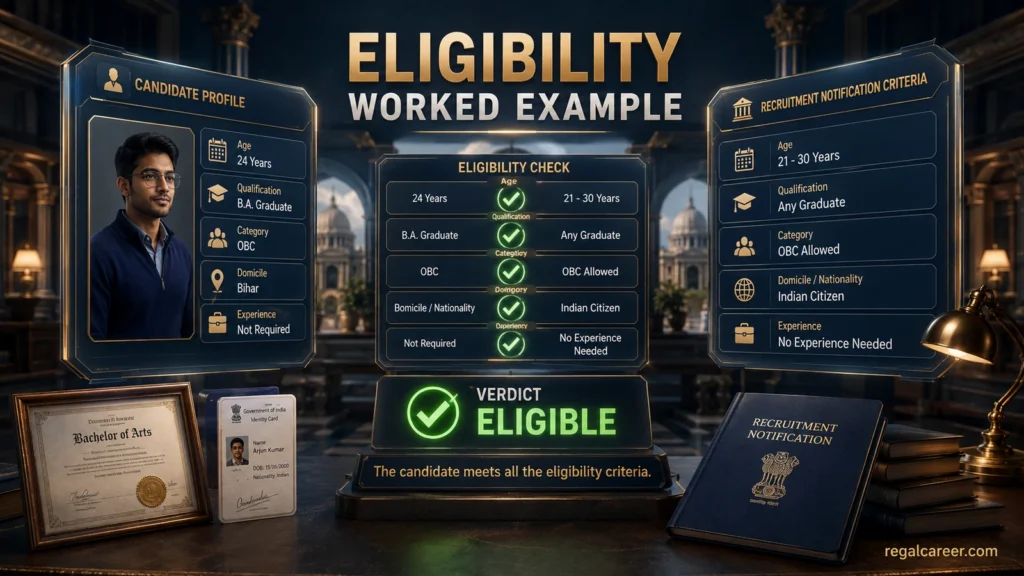
Worked example: one candidate, one post
A complete eligibility check before applying Suppose a recruitment contains a post called Junior Technical Assistant, Post Code JTA-04. The candidate should not stop after seeing “Graduate/Diploma” in a summary. They should create a post-specific record: Only when every mandatory row is clear should the candidate proceed to the application stage.
- Post: JTA-04
- Qualification: exact diploma/degree branch required by the notice
- Qualification date: must be completed by the stated cut-off
- Age: calculated on the notified age-reckoning date
- Category: benefit checked against the recruitment's certificate rules
- Experience: relevant duration checked only if the post requires it
- Language/domicile: checked if the regional vacancy includes such a condition
- Skill/licence: checked if specified
- Corrigendum: official recruitment page rechecked before submission
Common Government Job Eligibility Mistakes
Most eligibility errors are preventable because they come from shortcuts.
1. Checking age on today's date
Fix: calculate age on the exact date stated in the notification.
2. Assuming a generic age-relaxation table applies everywhere
Fix: use the relaxation table and footnotes from the exact recruitment.
3. Reading only the qualification level
Fix: check subject, branch, recognition, percentage, licence, registration and cut-off date.
4. Treating “equivalent” as a personal judgement
Fix: verify whether the recruitment rules or competent authority recognise your qualification as equivalent.
5. Ignoring post codes and footnotes
Fix: follow the exact post code through vacancy, eligibility and annexure sections.
6. Assuming category certificate = every reservation benefit
Fix: check the specific benefit, certificate format, authority and status date.
7. Confusing domicile with current address
Fix: use the recruitment's own definition and required document.
8. Counting all work as relevant experience
Fix: check field, duration, employer type and whether post-qualification experience is required.
9. Ignoring skill, physical or medical conditions
Fix: review these before serious preparation or fee payment.
10. Assuming final-year status is automatically accepted
Fix: find the exact qualification cut-off clause.
11. Assuming form submission confirms eligibility
Fix: treat portal acceptance as provisional unless the recruitment clearly states otherwise.
12. Forgetting corrigenda
Fix: revisit the official recruitment page before final submission and again before important later stages.
MYTH: If an online application portal lets me submit the form, the recruiting authority has already confirmed that I am eligible. FACT: Many recruitments verify eligibility and original documents at later stages. The candidate remains responsible for satisfying the notified conditions.
What to Do After You Confirm Eligibility
Once eligibility is clear, move to the application workflow in a controlled order.

- Save the official notification and applicable corrigenda.
- Record the exact post and post code.
- Save your eligibility record and calculations.
- Prepare the required certificates and supporting documents. For file preparation, use the Document Scanner, Image Compressor, PDF Compressor, JPG to PDF, PDF Merger, PDF Splitter or PDF to JPG only when the portal's format rules require them.
- Read the application start, closing and correction dates.
- Check the exact application fee and exemption rules.
- Read photo, signature, document and live-photo specifications, then use the Photo Resizer, Signature Resizer, Thumb Impression Resizer or Handwritten Declaration Resizer only when that exact upload is required.
- Fill the form using details that match your documents.
- Preview the form before final submission.
- Save the final application, payment receipt and acknowledgement.
View Regal Career Application Tools
After confirming eligibility, use the relevant age, percentage, CGPA, experience, image or PDF tool only according to the recruitment's exact instructions.
Continue With the Right Regal Career Guide
Ready to Apply After the Eligibility Check?
Use the complete application guide only after you have verified every mandatory eligibility condition for the exact post.
All Regal Career Application Tools
Government job eligibility should never be decided from a headline, remembered rule or application portal alone. Use the exact post, exact notification wording, exact crucial date and your own documentary proof. The reliable sequence is: identify the post, list every mandatory condition, record the date that controls each condition, match each rule to evidence, resolve unclear clauses, recheck corrigenda and only then apply. That method takes a few extra minutes at the beginning and can save you from spending months preparing for a post whose essential condition you never actually satisfied.
What is government job eligibility?
Government job eligibility is the complete set of mandatory conditions for a specific recruitment post. It can include age, educational qualification, category or reservation status, nationality, domicile, experience, skills, professional registration, physical or medical standards and other post-specific requirements.
What is the normal age limit for government jobs in India?
There is no single age limit for every government job. The minimum and maximum age depend on the recruiting authority, post and recruitment rules. Always use the age clause and crucial date in the exact official notification.
How is age calculated for government job eligibility?
Calculate age on the date specified by the recruitment, often described as an “as on,” crucial, cut-off or reckoning date. Do not use today's date unless the notice specifically makes it the relevant date.
Is age relaxation the same for every government recruitment?
No. The amount, eligible categories, calculation method, combination rules and required documents can differ. Read the exact recruitment's relaxation table and notes.
Can a final-year student apply for a government job?
It depends on the recruitment. Some notices allow appearing candidates, while others require the result or qualification to exist by a specific date. Check the exact educational-qualification cut-off clause.
Is any bachelor's degree enough for all graduate government jobs?
No. Some posts accept a degree in any discipline, while others require a specified subject, branch, professional qualification, percentage, registration or experience. Match the official wording exactly.
Can I claim an equivalent degree if my course is similar?
Do not assume equivalence yourself. Claim it only where the applicable recruitment rules or competent authority recognise the qualification as equivalent and where you can provide the required proof.
Does submitting the application mean I am eligible?
Not necessarily. Application systems can accept forms provisionally, while detailed eligibility and document checks may happen later. You remain responsible for satisfying every notified condition.
What is the difference between domicile and nationality in government jobs?
Nationality concerns the citizenship or nationality status permitted by the recruitment. Domicile or residence concerns a state or regional connection where the recruitment requires it. They are separate conditions and can require different proof.
What should I do if an eligibility clause is unclear?
Re-read the complete notification, footnotes, annexures, FAQs and later corrigenda. If the recruiting authority provides an official helpdesk or clarification channel, use that instead of relying on an unofficial interpretation.
Quiz Yourself
Question 1: A notification says age is measured on 1 August, but the application closes on 20 August. Which date should you use for the age calculation? Answer: Use 1 August because that is the date specifically stated for the age condition.
Question 2: A post requires “Bachelor's degree with Economics as one of the subjects.” Is any bachelor's degree automatically sufficient? Answer: No. The candidate must satisfy the subject condition stated in the notification.
Question 3: You hold a category certificate. Can you automatically assume age relaxation and fee exemption both apply? Answer: No. Check each benefit separately under the exact recruitment rules.
This is an educational Career Guide, not an eligibility certificate for a specific recruitment. Government recruitment conditions can differ by organisation, post, state, category and year and may be changed or clarified through official corrigenda or addenda. Always treat the recruiting authority's latest official notification and applicable rules as the final source for your eligibility decision.
