
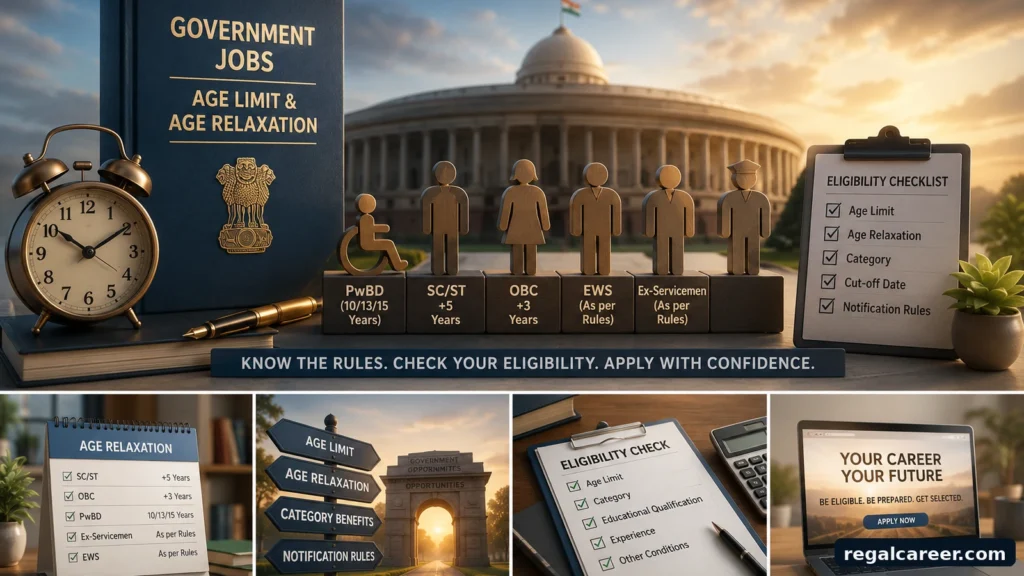
Age is one of the easiest government-job eligibility conditions to misunderstand. A notification may say 18–27 years, but that does not automatically mean every candidate older than 27 is ineligible. The answer can depend on your category, the post, the recruitment authority, the crucial date used to measure age and any special relaxation written into that specific notice.
At the same time, it is risky to assume that every relaxation seen in one examination applies everywhere. Central recruitments often follow common patterns, while state recruitments, uniformed services, banks, public-sector bodies and specific cadres may use different limits or special concessions.
The safest rule is simple: calculate your age on the exact crucial date first, then apply only the relaxations expressly allowed by the official notification.
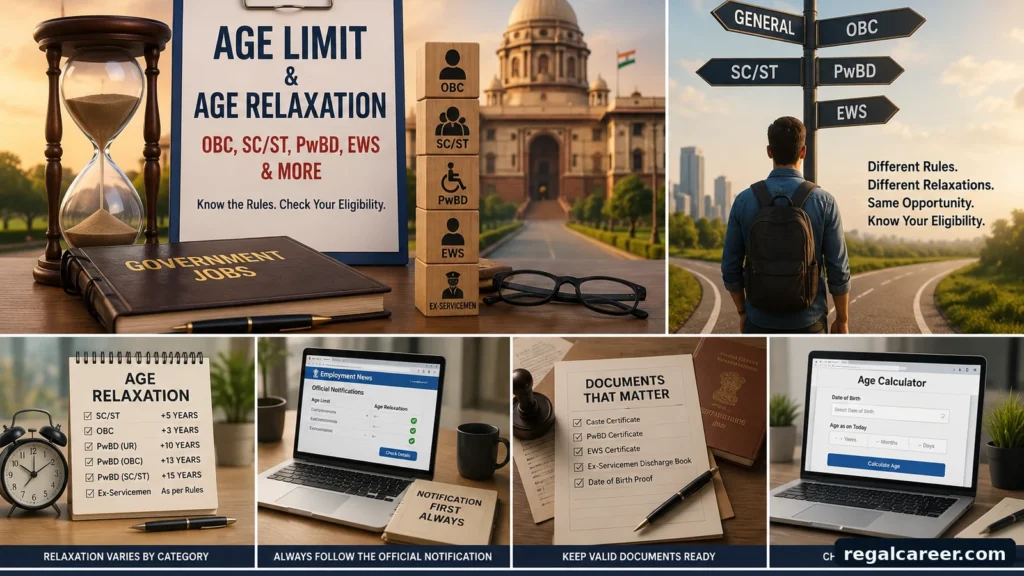
For many Central Government direct recruitments, SC/ST candidates commonly receive 5 years of upper-age relaxation and eligible OBC candidates commonly receive 3 years. PwBD candidates may receive larger relaxations, often 10/13/15 years depending on category. EWS reservation by itself does not ordinarily create an extra age relaxation. Ex-servicemen and other special-category rules can use different formulas. Always treat the recruitment notification as the final authority.
- Your age is tested on a crucial date, not simply on the day you apply.
- Lower age and upper age are separate conditions; relaxation normally affects the upper limit unless the notice says otherwise.
- Common Central Government patterns include OBC-NCL +3 years and SC/ST +5 years.
- PwBD relaxations are often larger, but the post must also be identified/suitable and the notice conditions must be met.
- EWS status does not ordinarily add age relaxation merely because the candidate is EWS.
- Ex-servicemen rules can involve a service-deduction formula rather than a simple fixed number.
- State government, police, defence, banking and PSU recruitments can differ materially.
- Use the Government Job Age Calculator before deciding that you are eligible or over-age.
What Does “Age Limit” Mean in a Government Job Notification?
A recruitment notice usually defines a minimum age, a maximum age, or both. A range such as 18–27 years means the candidate must satisfy the lower-age requirement and must not cross the applicable upper-age limit on the date specified by the recruiter.
The upper limit shown in the main eligibility table is often the base limit for unreserved candidates. Reserved-category or special-category concessions are then explained separately under headings such as “Age Relaxation”, “Permissible Relaxation in Upper Age Limit”, “Concessions”, or “Eligibility Conditions”.
If you are reading a recruitment notice for the first time, use our guide to reading a government job notification before relying on a summary page or social-media post.
Lower age limit: the minimum age you must have completed. Upper age limit: the maximum age allowed before applicable relaxation. Age relaxation: an authorised extension of the upper-age limit for a stated category or situation. Crucial date: the specific date on which your age is measured for that recruitment.
The Crucial Date Is More Important Than the Application Date
One of the most common mistakes is calculating age on the date the form is submitted. Recruiters usually specify a particular crucial date for age reckoning. Depending on the examination, that may be the first day of a month, the closing date, 1 January of a year, 1 August, or another date stated in the notice.
For example, if a notification says the age limit is 18–27 years as on 1 January 2027, submitting the application in November 2026 does not make November the reference point. Your age must be tested as on 1 January 2027.
This is why two candidates born only a few days apart can receive different results even when they apply on the same day.
Do not calculate eligibility from your current age shown in an app, profile or ID card summary. Find the notification’s exact “as on” date / crucial date first. A one-day difference can change eligibility at the boundary.
Calculate Your Exact Age on the Crucial Date
Enter your date of birth and the recruitment’s official age-reckoning date before applying any category relaxation.
Common Age Relaxation Pattern in Central Government Recruitment
The Government of India’s Department of Personnel and Training consolidates several reservation and relaxation instructions for Central Government services. A widely used direct-recruitment pattern is 5 years for SC/ST candidates and 3 years for OBC candidates, subject to the recruitment rules and the candidate satisfying the relevant category conditions.
Recruitment notices from bodies such as SSC also commonly show larger PwBD relaxations, including 10 years for unreserved/EWS PwBD, 13 years for OBC PwBD and 15 years for SC/ST PwBD in applicable recruitments.
| Category / situation | Common central-government pattern | What the candidate must verify |
|---|---|---|
| UR / General | No category-based upper-age relaxation | Base lower and upper age limits in the notification |
| EWS | EWS status itself does not ordinarily add upper-age relaxation | Whether any separate recruitment-specific concession applies |
| OBC (Non-Creamy Layer) | Usually +3 years beyond the upper age limit | Central OBC-NCL eligibility, certificate format and crucial date |
| SC / ST | Usually +5 years beyond the upper age limit | Valid category certificate and whether the vacancy permits the benefit |
| PwBD — UR / EWS | Often +10 years | Post suitability, benchmark-disability requirement and notice-specific rules |
| PwBD — OBC | Often +13 years | PwBD eligibility plus valid OBC-NCL status |
| PwBD — SC / ST | Often +15 years | PwBD eligibility plus valid SC/ST status |
| Ex-Servicemen | Formula varies by recruitment; many central Group C notices deduct military service and then allow a further margin | Exact formula, service definition, discharge status and category rules in the notice |
| Other special groups | May have post- or exam-specific concessions | Central/state employee, widow/divorced woman, defence personnel, sportsperson or other stated condition |
The table above is a common Central Government pattern, not a universal entitlement for every job in India. The official recruitment notice, recruitment rules and any corrigendum always override a general guide.
Category-Wise Rules Candidates Should Understand
OBC Age Relaxation
For many Central Government direct recruitments, eligible OBC Non-Creamy Layer (OBC-NCL) candidates receive 3 years beyond the normal upper age limit. DoPT’s consolidated instructions state the 3-year increase for OBC in direct recruitment.
The important word is eligible. A candidate should not assume that a state OBC certificate automatically qualifies for a Central Government OBC-NCL benefit. The notification can prescribe the recognised list, certificate format, non-creamy-layer status, issuing authority and the date by which the certificate must be valid.
If you plan to claim OBC relaxation, verify both parts: your name/community must qualify under the applicable rules, and your certificate/NCL status must satisfy the recruitment notice. Category selection in the form is not proof by itself.
SC/ST Age Relaxation
For many Central Government direct recruitments, candidates belonging to Scheduled Castes or Scheduled Tribes receive 5 years of relaxation in the prescribed maximum age. This pattern is expressly reflected in DoPT’s consolidated instructions.
However, the candidate must still satisfy the other eligibility conditions of the post. Age relaxation does not waive qualification, experience, physical standards, nationality, registration or document requirements unless a separate rule says so.
PwBD Age Relaxation
Persons with Benchmark Disabilities may receive larger upper-age concessions in eligible recruitments. Common SSC-style patterns include 10 years for PwBD (UR/EWS), 13 years for PwBD-OBC and 15 years for PwBD-SC/ST.
Do not check only the number of relaxation years. The candidate must also verify whether the specific post is suitable/identified for the disability category, the benchmark-disability requirement, certificate rules, functional classification and any post-specific restrictions.
Does EWS Get Age Relaxation?
For Central Government recruitment, EWS reservation status should not be treated as an automatic extra age relaxation. DoPT’s consolidated EWS instructions focus on the reservation benefit and the Income and Asset Certificate; the general direct-recruitment relaxation provision separately specifies SC/ST and OBC.
That does not mean an EWS candidate can never benefit from any age concession. A recruitment may provide another relaxation because of PwBD status, ex-servicemen status, service history, a special government order or another qualifying condition. The point is that EWS by itself is not a safe basis for adding extra years unless the notice says so.
- Myth: EWS gets the same age relaxation as OBC because both are reserved categories.
- Fact: Reservation and age relaxation are different benefits. Read the notification’s relaxation table instead of inferring one benefit from the other.
Ex-Servicemen Age Relaxation
Ex-servicemen rules deserve separate attention because the calculation may not be a simple “+3” or “+5”. In many central Group C-style recruitments, the notice may direct the candidate to deduct eligible military service from actual age and then compare the remaining age with the prescribed limit, sometimes with an additional margin. SSC-style notices commonly describe a 3-year rule after deduction of military service for specified recruitments.
Other examinations and services can use different definitions or concessions, so candidates should never transfer an ex-servicemen formula from one recruitment to another.
Ex-servicemen eligibility is one of the worst places to rely on a generic calculator or memory from an earlier exam. Read the exact clause defining military service, date of discharge, permitted deduction and maximum residual age in the current notice.
Can Two Age Relaxations Be Combined?
Sometimes a recruitment expressly shows a combined concession. PwBD tables, for example, may separately list PwBD-OBC and PwBD-SC/ST limits rather than asking the candidate to add numbers independently.
But candidates should never create their own stacked relaxation formula simply because they belong to more than one category. Some concessions are cumulative, some are expressed as a separate maximum age, and some cannot be combined.
Use the notification’s final category row or maximum-age statement. If your exact combination is listed, use that number. If it is not listed, do not add relaxations yourself unless the rules explicitly permit it.
How to Calculate Your Government Job Age Correctly
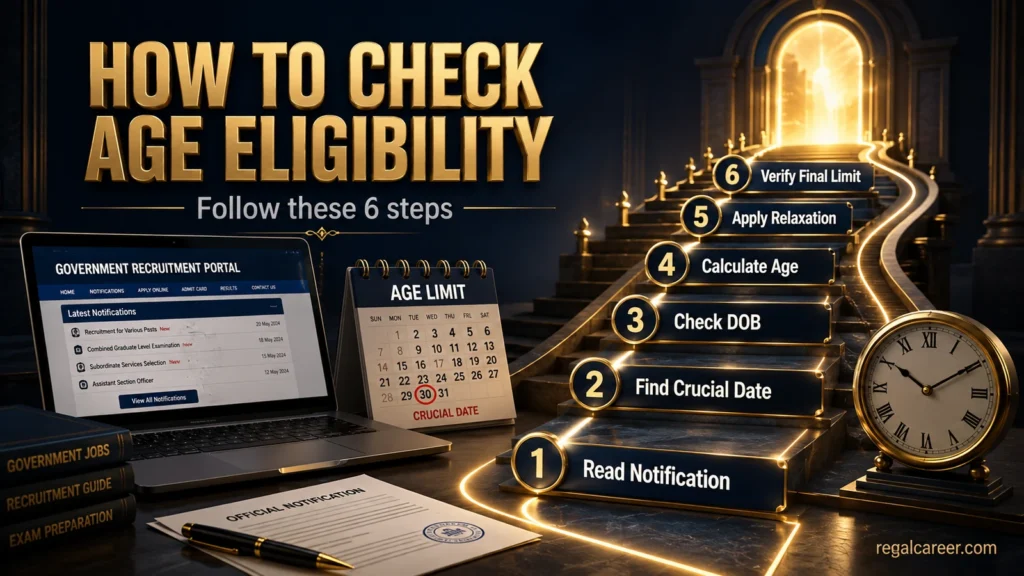
The reliable calculation has four steps:
Locate the exact “age as on” date in the official notification.
Compare your date of birth with that crucial date, including years, months and days.
Use the limit for the exact post; different posts in one recruitment may have different age bands.
Use the exact category/special-condition row given in the recruitment notice.
Confirm you can produce the required category, disability, service or other certificate in the prescribed form.
| Candidate | Base upper age | Possible relaxation | Effective upper limit for this illustration | Result at crucial date |
|---|---|---|---|---|
| Candidate A — UR | 27 years | None | 27 years | Age 27 years 2 months → Not eligible if the rule is strictly up to 27 |
| Candidate B — OBC-NCL | 27 years | +3 years | 30 years | Age 29 years 8 months → Potentially eligible |
| Candidate C — SC | 27 years | +5 years | 32 years | Age 31 years 10 months → Potentially eligible |
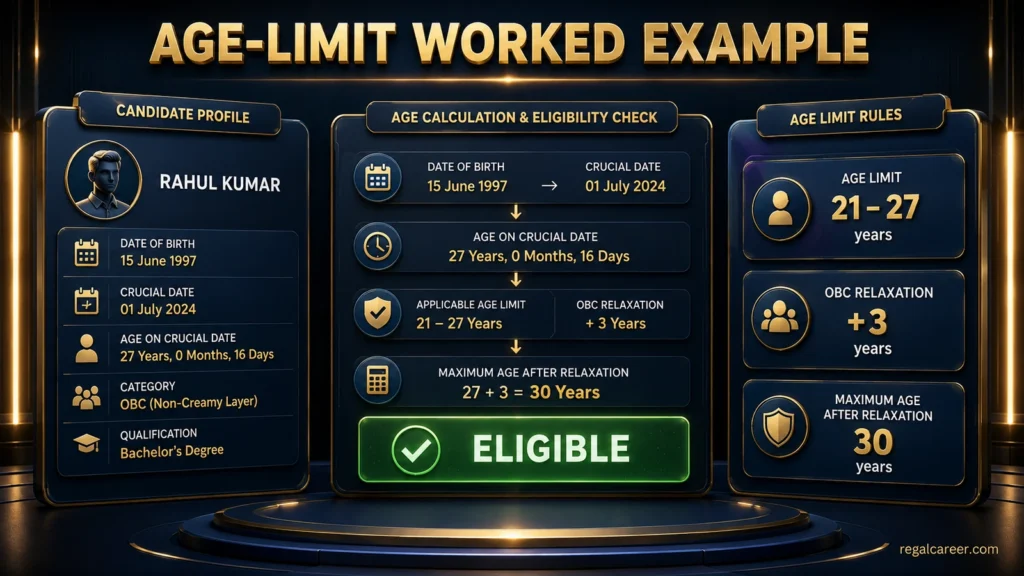
Assume a recruitment has a base age limit of 18–27 years on 1 January 2027. A candidate is 29 years and 8 months old on that crucial date. If the candidate is valid OBC-NCL and the notice permits the common +3-year relaxation, the effective upper limit becomes 30 years, so the candidate may satisfy the age condition. If the same candidate is UR with no other concession, the candidate exceeds the base 27-year upper limit. This is only an illustration—the actual notice decides the result.
Why Date-of-Birth Ranges Can Be Safer Than Mental Arithmetic
Many recruitment notices publish an allowed “born not before / born not after” range. When such a range is provided, use it. Recruiters may specify how birthdays on boundary dates are treated, and the date range reduces ambiguity.
For example, SSC notices often publish both the age band and corresponding permitted birth-date range for a post.
If your date of birth is exactly on a boundary, do not round your age or assume “27 years” means any time before your 28th birthday. Use the recruiter’s wording and date range.
State Government, Police, Defence, Banking and PSU Rules Can Differ
Central Government patterns are useful for orientation, but they are not a substitute for recruitment-specific rules. State governments can prescribe different upper age limits and relaxations. Police and uniformed services may use tighter age bands because physical requirements are integral to the post. Defence entries can have their own date-of-birth windows. Banking recruitment and public-sector undertakings can also define separate rules.
The variation is not theoretical. Governments can issue recruitment-specific or one-time relaxations, and state rules can change independently. This is another reason an evergreen guide should teach the method of verification, not claim one table applies to every government vacancy.
If you move from an SSC job to a state PSC, police, railway, bank or PSU recruitment, restart the age check from zero. Do not carry the previous exam’s relaxation table into the new application.
The 8 Age-Limit Mistakes That Commonly Make Candidates Ineligible
- Calculating age on the application date instead of the crucial date.
- Looking only at the base upper age and missing an eligible relaxation.
- Assuming a reserved category automatically guarantees age relaxation in every recruitment.
- Claiming OBC relaxation without satisfying the required OBC-NCL conditions.
- Assuming EWS automatically adds years to the upper limit.
- Adding two relaxations together without an explicit cumulative rule.
- Using an ex-servicemen formula from a different examination.
- Ignoring a separate post-wise age limit inside a multi-post recruitment.
A Safe Age-Eligibility Workflow Before You Submit the Form
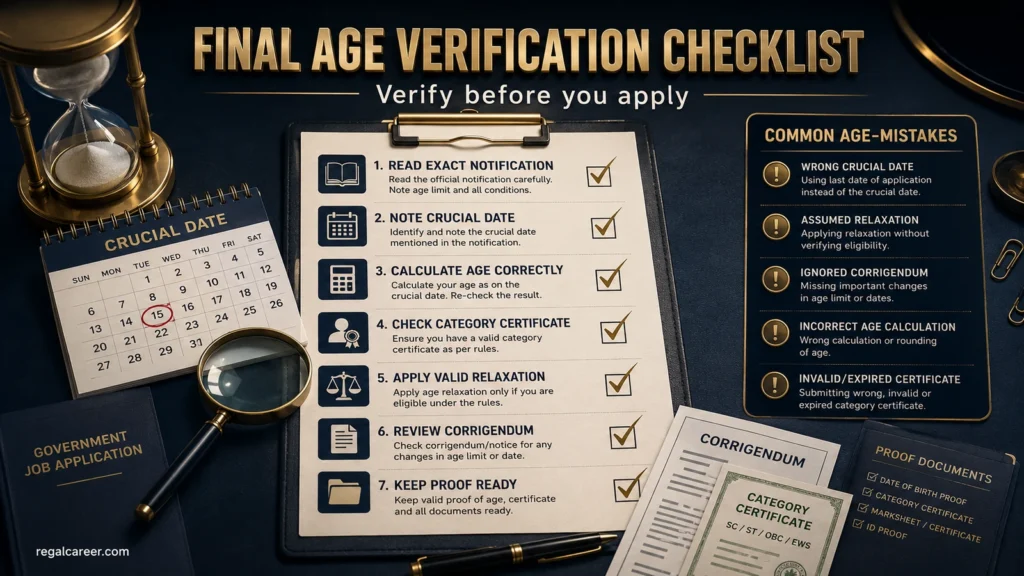
Before paying an application fee or completing a lengthy form, check age eligibility in this order:
1. Open the official notification, not only a job summary. 2. Find the exact post you want to apply for. 3. Note the lower age, upper age and crucial date. 4. Note the allowed date-of-birth range if one is provided. 5. Find the relaxation table and identify your exact category row. 6. Verify certificate/status conditions for the relaxation you plan to claim. 7. Calculate your exact age using the Government Job Age Calculator. 8. Keep a screenshot or note of the clause used for your calculation. 9. Recheck any corrigendum before the closing date. 10. Then continue with our step-by-step government job application guide.
Green signal: your calculated age falls within the allowed range after applying an expressly permitted relaxation, and you can prove the qualifying category/status. Red signal: the only way to become eligible is to assume a relaxation that the notification does not actually grant.
Related Eligibility Guides and Tools
Frequently Asked Questions
What is the usual age limit for government jobs in India?
There is no single age limit for all government jobs. Common ranges include 18–27, 18–30, 21–30 or 21–32, but the exact post and recruitment notification decide the applicable lower and upper limits.
How much age relaxation does OBC get in Central Government jobs?
Many Central Government direct recruitments provide 3 years of upper-age relaxation to eligible OBC candidates, generally subject to OBC-NCL and notification-specific conditions.
How much age relaxation do SC and ST candidates get?
A common Central Government direct-recruitment rule is 5 years beyond the prescribed upper age limit, subject to the recruitment rules and notification.
Does EWS get 5 years of age relaxation?
Do not assume so. EWS reservation by itself does not ordinarily create the same category-based age relaxation as SC/ST or OBC under the general Central Government direct-recruitment rules. Check the exact notification for any separate concession.
What is the age relaxation for PwBD candidates?
Many central recruitments use 10 years for PwBD-UR/EWS, 13 years for PwBD-OBC and 15 years for PwBD-SC/ST, but post suitability and notice-specific conditions must also be satisfied.
Is age calculated on the last date to apply?
Not necessarily. Use the specific crucial date or “age as on” date stated in the recruitment notification. The closing date is relevant only when the notice makes it the reference date.
Can age relaxations be added together?
Only when the recruitment rules or notification allow the combination. Do not add multiple relaxations yourself. Use the exact combined category row or maximum age stated in the notice.
Which date of birth should I use for a government job application?
Use the date of birth recognised by the recruitment rules and supported by the required official record, typically the matriculation/secondary certificate or another document specified in the notice. Entering a different date later can create a document-verification problem.
Official Sources and Verification
Department of Personnel & Training — Consolidated Reservation / Relaxation Instructions | https://doptcirculars.nic.in/OM/ViewOMNew.aspx?id=471 Union Public Service Commission — Civil Services (Preliminary) Examination 2026 | https://www.upsc.gov.in/examinations/Civil%20Services%20%28Preliminary%29%20Examination%2C%202026 Staff Selection Commission — Official Website | https://ssc.gov.in/
The DoPT consolidated instructions state the common Central Government direct-recruitment age-relaxation rule of 5 years for SC/ST and 3 years for OBC. UPSC and SSC continue to publish examination-specific notifications and schedules, reinforcing why candidates should verify the exact notice rather than rely on a generic table.
Government job age eligibility is not “my current age versus one number.” It is your exact date of birth + the official crucial date + the post’s base age limit + only the relaxation expressly allowed for your category or situation. Once you use that sequence, most age-limit confusion disappears. Calculate first, verify the official clause, then apply.
