
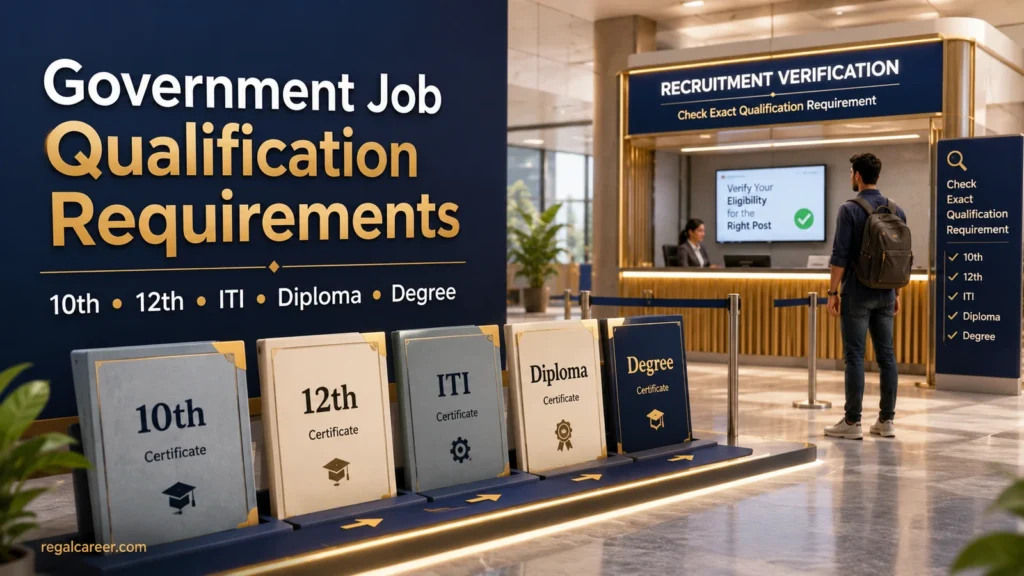
A government job notification may look simple when it says 10th pass, 12th pass, ITI, diploma, graduate or degree holder, but the actual educational eligibility can be much narrower. A post may require a particular subject, branch, trade, percentage, registration, recognized institution, experience period or completion date. A candidate can therefore hold a “higher” qualification and still fail the exact requirement of a specific recruitment.
This guide explains how to read government job qualification requirements correctly before you apply. It covers the questions candidates repeatedly face: whether a graduate can apply for a 12th-pass post, whether a degree can replace a diploma or ITI, who decides an “equivalent qualification,” whether NIOS or distance/online degrees are valid, how final-year candidates are treated, which CGPA conversion to use, and what documents finally prove your qualification.
QUICK ANSWER
For a government job, your qualification is not decided only by the highest certificate you hold. Eligibility depends on the exact essential qualification written in the recruitment notification and applicable recruitment rules. Match the education level, subject or trade, recognized institution, minimum marks, equivalence clause, professional registration, experience and cut-off date. A higher qualification does not automatically replace a specifically prescribed lower qualification, and an “equivalent” degree should not be assumed unless the recruiting authority or applicable rules accept it.
KEY TAKEAWAYS
- Read the exact essential qualification, not only the short job summary.
- “Any graduate” and “graduate in a specified subject” are very different requirements.
- A higher degree is not automatically a substitute for a required diploma, ITI, trade or subject combination.
- UGC does not decide equivalence of Indian degrees for employment; the employing organisation decides employment equivalence.
- NIOS Secondary and Senior Secondary certificates have recognition comparable to other boards, but post-specific subject or skill conditions still apply.
- A recognized ODL/online degree can be equivalent to the corresponding conventional award when the institution/programme satisfies UGC rules for the relevant period.
- Final-year or result-awaited eligibility depends on the exact recruitment cut-off rule.
- For CGPA conversion, use the university/institution’s official method rather than a generic formula.
1. How Government Job Qualification Requirements Are Actually Decided
The safest way to understand educational eligibility is to stop thinking in terms of “highest qualification” and start thinking in terms of conditions.
A recruitment may combine several conditions such as:
- minimum education level;
- exact degree, diploma, certificate or trade;
- required subject, stream, branch or specialization;
- recognized board, university, institution or regulator;
- minimum percentage, class, grade or CGPA;
- professional registration or licence;
- computer, typing, language or technical certificate;
- prescribed experience;
- experience acquired after the essential qualification;
- possession of the qualification by a stated cut-off date.
Current Union Public Service Commission recruitment advertisements show this distinction clearly. They can separately list Essential Educational Qualification, Essential Experience and Desirable Qualifications, and a post may also require professional registration in addition to a degree.
CANDIDATE NOTE
Do not reduce a qualification clause to one word such as “graduate.” Copy the complete sentence from the official notification and verify every condition in that sentence.
The words that should make you slow down
When reading a qualification clause, pay special attention to:
“in” — may restrict the degree to a subject or branch. “with” — may add a compulsory subject, percentage or certificate. “from a recognized…” — adds a recognition requirement. “or equivalent” — allows an alternative only when equivalence is validly recognized. “and” — normally means both conditions must be satisfied. “or” — normally creates alternative eligibility routes. “after acquiring…” — can change how experience is counted. “as on / on or before…” — creates a qualification cut-off date.
IMPORTANT
The online form accepting your application is not proof that you are eligible. Qualification is often checked again during scrutiny or document verification.
2. Government Job Qualifications by Level: 10th, 12th, ITI, Diploma, Degree & More
Candidates often search for “government jobs by qualification,” but a qualification level is only the starting point. Use this table to understand what you must check at each level.
| Qualification level | What the notification may additionally require | Common mistake |
|---|---|---|
| 8th / 10th / Matriculation | Recognized board, pass status, local language, licence, experience or trade certificate | Assuming every 10th-pass post has identical eligibility |
| 12th / 10+2 / Intermediate | Stream, Mathematics, Science, specific subjects, typing or skill | Reading “12th pass” but missing the subject requirement |
| ITI / NTC | Exact trade, duration, NCVT/DGT-recognized route, related trade wording | Assuming any ITI trade is acceptable |
| NAC / Apprenticeship | Exact designated trade and whether NAC is accepted by the recruitment | Assuming apprenticeship automatically replaces ITI everywhere |
| Diploma | Exact branch, duration, recognized technical board/institution | Assuming B.E./B.Tech automatically substitutes for diploma |
| Graduation / Bachelor’s Degree | “Any degree” or a specific discipline/subject | Treating every graduate-level post as “any graduate” |
| Engineering / Technical Degree | Exact engineering branch, specialization, registration or GATE/technical requirement | Applying with a related but unlisted branch |
| Post-Graduation | Exact subject, percentage, specialization, experience | Assuming a PG degree cures an incorrect bachelor’s subject |
| Professional Qualification | Statutory registration, licence or council recognition | Treating registration as optional |
| PhD / Research Qualification | Relevant field, prior degrees, experience, publications or other conditions | Looking only at the highest degree |
10th and 12th pass qualification
A notification may say simply “Matriculation from a recognized board,” but another 10th-level post may additionally require a driving licence, ITI certificate, local language or experience.
Similarly, “12th pass” can mean:
- 12th in any stream;
- 12th with Mathematics;
- 12th with Physics and Mathematics;
- 12th in Science;
- 12th plus typing speed;
- 12th plus a technical or computer certificate.
So the correct question is not only “Am I 12th pass?” It is “Does my 12th qualification satisfy the exact post requirement?”
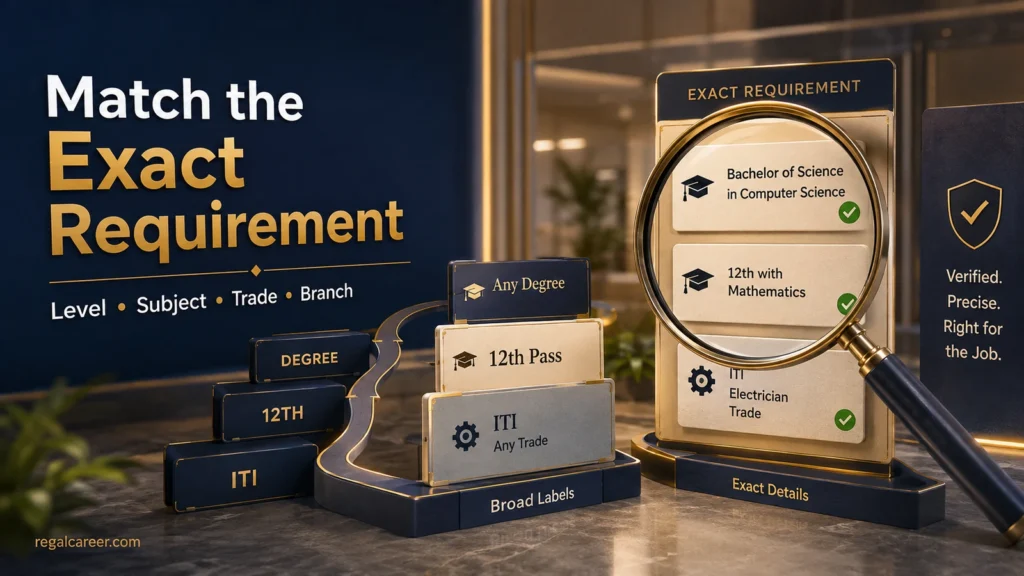
Graduate qualification: any degree vs specified degree
Compare these two requirements:
Bachelor’s degree from a recognized university
and
Bachelor’s degree with Statistics as a subject
Both are graduate-level requirements, but the second is much narrower.
WORKED EXAMPLE
Riya has a B.Com degree. Arjun has a B.Sc degree with Statistics.
If a post requires “Bachelor’s degree in any discipline,” both may satisfy the educational level, subject to all other conditions.
If another post requires “Bachelor’s degree with Statistics as one of the subjects,” Arjun may satisfy the subject condition while Riya cannot claim eligibility merely because both are graduates.
3. Essential, Desirable and Additional Qualifications: Do Not Mix Them Up
Government recruitment notices often divide qualifications into different categories.
Essential qualification
The essential qualification is the minimum required condition. It can include education and, in some posts, experience or professional registration.
If a post requires:
- a particular degree;
- two years of qualifying experience;
- registration with a professional council; or
- a specified certificate,
you normally need to satisfy it unless the notification itself provides another route, relaxation or legally applicable exception.
Desirable qualification
A desirable or preferred qualification can improve suitability, shortlisting or assessment, but it does not normally replace an essential qualification.
Current UPSC advertisements provide a useful real-world example: a post can require a recognized degree plus prescribed experience as essential, while listing another practical experience or PhD as desirable.
Additional qualification or skill
Some posts require a skill in addition to the academic qualification:
- typing speed;
- stenography;
- computer proficiency;
- driving licence;
- language knowledge;
- trade test;
- professional registration;
- valid GATE or other specified score;
- physical/medical standard.
WARNING
Do not read “desirable” as compulsory, and do not read a compulsory registration, licence, skill or experience condition as merely desirable. Follow the heading and exact wording used in the notification.
4. Higher Qualification for Government Jobs: Does a Degree Automatically Make You Eligible?
This is one of the most misunderstood areas of government recruitment.
The short answer is:
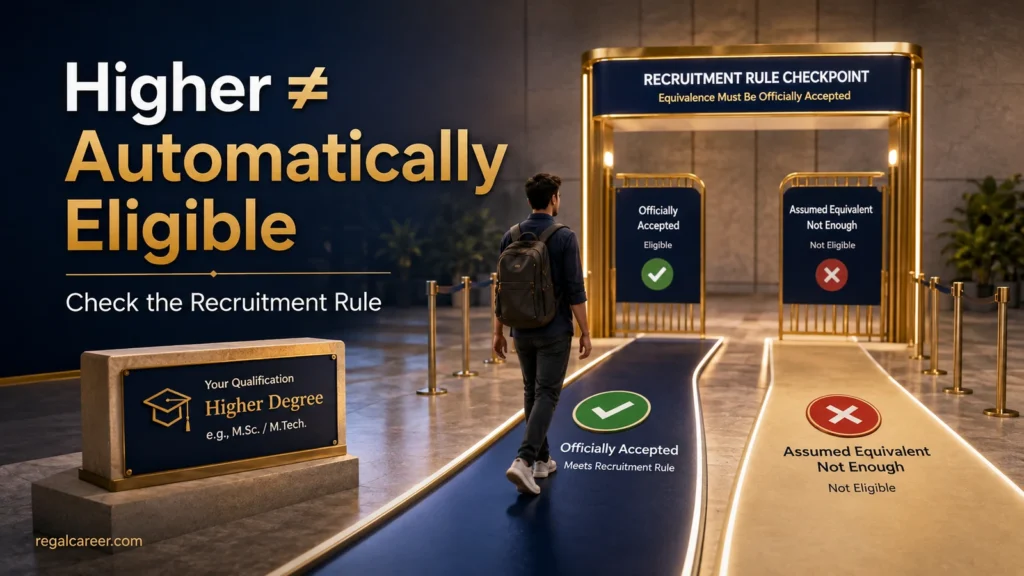
No universal rule says that a higher qualification automatically satisfies every lower qualification requirement.
Eligibility depends on the recruitment rules and the exact qualification prescribed for the post.
Can a graduate apply for a 12th-pass government job?
Often, yes — if the requirement is simply a minimum of 12th pass and the notification does not exclude candidates with higher qualifications.
But a graduate may still be ineligible if the 12th-level requirement contains a condition the candidate does not possess, such as:
- a specific 12th stream;
- Mathematics or Science at 10+2 level;
- a particular vocational subject;
- a prescribed certificate;
- a maximum qualification restriction;
- any other post-specific condition.
Can B.E./B.Tech replace a required diploma?
Do not assume so.
If the notification says Diploma in Civil Engineering, a B.Tech in Civil Engineering may look academically higher, but recruitment eligibility depends on whether the rules/notification allow degree holders or treat the degree as an accepted alternative.
Some recruitment frameworks expressly list degree OR diploma. Others prescribe only a diploma. That difference matters.
Can a degree replace ITI?
Again, not automatically.
An ITI/NTC/NAC requirement can represent a specific trade pathway and hands-on occupational qualification. A higher academic degree may not be treated as the same credential unless the recruitment expressly accepts it.
What about “overqualification”?
If a notification or recruitment rule prescribes a maximum qualification, excludes higher-qualified candidates, or reserves the post for a specified training pathway, a higher qualification can become relevant to disqualification.
The candidate-safe rule is simple:
> Never convert “higher” into “equivalent” by yourself.
ELIGIBILITY CHECK
Before applying with a higher qualification, verify:
- Do you also possess the exact prescribed qualification?
- Does the notification list your higher qualification as an alternative?
- Does the notification use “or equivalent” and is your qualification officially covered?
- Does any rule exclude higher-qualified candidates or prescribe a maximum qualification?
- Is there an official FAQ/corrigendum clarifying the issue?
5. Equivalent Qualification in Government Jobs: Who Decides?
The phrase “or equivalent” creates many disputes because candidates often treat similarity as equivalence.
UGC’s official FAQ is very clear on one point: UGC does not determine equivalence of Indian degrees for employment purposes. For employment, equivalence is decided by the employing organisation.
That means two Indian degrees are not automatically equivalent because:
- the names sound similar;
- they have the same duration;
- some subjects overlap;
- one appears academically higher;
- another university considers them similar for admission.
What should you do when the notification says “or equivalent”?
Look for one or more of the following:
- an equivalence clause in the recruitment rules;
- an official equivalence order;
- a recruiting-authority FAQ;
- a corrigendum;
- a list of accepted degrees/branches/trades;
- an official clarification from the employer;
- a regulator or statutory-council requirement where applicable.
If “or equivalent” is not written
Do not add it yourself.
If a post says “Degree in Agricultural Engineering or Mechanical Engineering”, the safest interpretation is to match one of the stated qualifications unless the authority provides an accepted equivalence route.
Similar subject names are especially risky
Modern courses can have overlapping names such as:
- Computer Science;
- Computer Engineering;
- Information Technology;
- Data Science;
- Artificial Intelligence;
- Electronics;
- Electronics & Communication;
- Electrical & Electronics;
- Biotechnology;
- Bioinformatics.
Whether a related discipline is accepted is a recruitment question, not a guessing exercise.
PRO TIP
When your degree title is not an exact match, search the official notification for “equivalent,” “allied,” “relevant discipline,” “accepted branches,” “Annexure,” “FAQ” and “corrigendum” before applying.
6. Recognized Board, University, NIOS, Distance & Online Degree Rules
“Recognized” is not decorative wording. It can decide whether the qualification is valid for the recruitment.
Degree from a recognized university
UGC states that a statutory university can award specified degrees subject to applicable approvals and regulations. Candidates should verify the status of the awarding institution rather than relying only on an admission brochure, coaching website or institute advertisement.
Are NIOS 10th and 12th certificates valid for government jobs?
NIOS states that its Secondary and Senior Secondary certificates have the same recognition as certificates issued by other boards.
That is important for candidates with open-school backgrounds. However, a recruitment can still impose additional requirements such as:
- particular 12th subjects;
- a vocational stream;
- percentage;
- typing;
- technical qualification;
- local-language requirement.
So NIOS recognition answers the board-recognition question; it does not remove post-specific eligibility conditions.
Are distance and online degrees valid for government jobs?
A blanket “yes” or “no” is misleading.
UGC regulations provide that undergraduate and postgraduate degrees, and relevant postgraduate diplomas, obtained through recognized Open and Distance Learning (ODL) or Online modes can be treated as equivalent to corresponding conventional awards when they conform to the UGC framework.
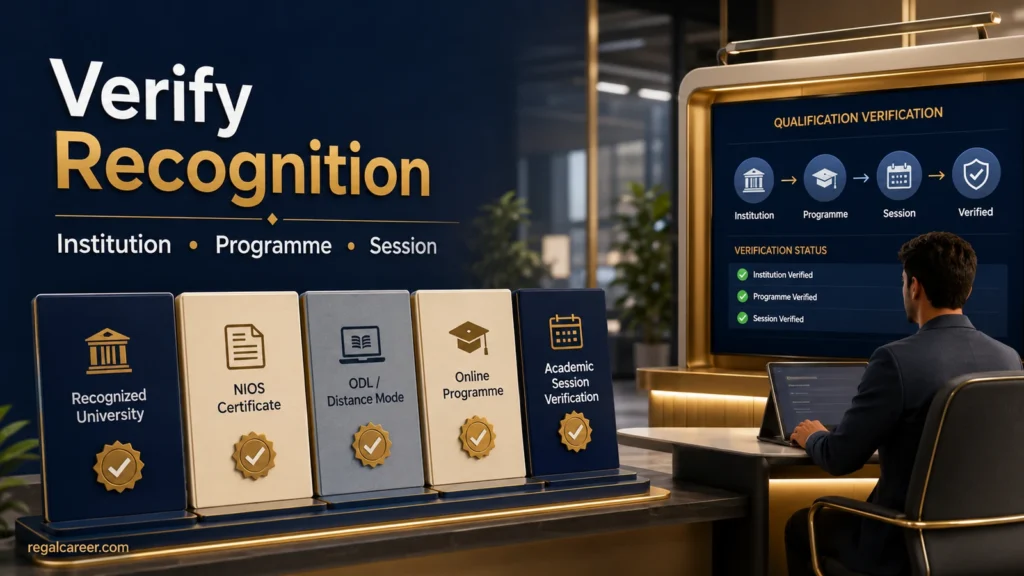
The practical check is therefore:
- Was the institution entitled/recognized for the mode?
- Was the specific programme recognized/entitled where required?
- Was recognition valid for the academic session in which you took admission?
- Is the programme permitted in ODL/online mode?
- Does the recruitment impose any additional professional or regulator-specific condition?
UGC-DEB publishes recognized/entitled institutions and programme information and advises candidates to verify the relevant academic session.
IMPORTANT
Do not rely on the statement “UGC approved university” alone for an ODL/online qualification. Verify the mode, programme and academic session where applicable.
7. Foreign Degree Equivalence for Government Jobs
Foreign qualification guidance changed significantly with UGC’s dedicated equivalence framework.
UGC notified the Recognition and Grant of Equivalence to Qualifications obtained from Foreign Educational Institutions Regulations, 2025 and operates an equivalence portal for foreign qualifications.
The framework covers academic foreign qualifications subject to the prescribed conditions and procedure. The UGC portal also states that professional qualifications in regulated fields such as Medicine, Pharmacy, Nursing, Law and Architecture fall under the relevant statutory councils rather than the general UGC equivalence route.
What should a foreign-degree holder check?
- Is the foreign institution recognized/accredited in its home country?
- Does the qualification require a UGC equivalence certificate?
- Is the field governed by a professional/statutory council?
- Does the specific recruiting authority ask for additional equivalence proof?
- Can you produce transcripts, degree certificates and accreditation/programme details?
CANDIDATE NOTE
Older articles on the web may describe foreign-degree equivalence using older institutional routes. For a current application, check the latest UGC equivalence framework and the recruiting authority’s notification instead of relying on an old generic article.
8. Final-Year and Result-Awaited Candidates: Check the Qualification Cut-Off Date
There is no universal rule that final-year candidates can always apply for government jobs.
Some examinations allow candidates to apply provisionally and require proof later. Other recruitments require the essential qualification to be completed on or before the closing date or another specified cut-off date.
Search the notification for these phrases
- “must possess the essential qualification on…”
- “as on the closing date”
- “on or before…”
- “result should have been declared by…”
- “candidates appearing in the final examination…”
- “provisional candidature”
- “proof of passing must be produced…”
“Exam completed” and “qualification possessed” may not be the same
A candidate may have written the final examination but still be waiting for:
- declaration of result;
- final marksheet;
- provisional certificate;
- degree certificate;
- registration;
- equivalence certificate.
If the notification requires possession of the qualification by a specified date, the relevant documentary proof can matter.
WORKED EXAMPLE
Suppose a recruitment closes on 30 September and says candidates must possess the essential degree on or before 30 September.
Candidate A’s university declares the final result on 25 September.
Candidate B finishes the examination in August but the university declares the result on 10 October.
Candidate B should not assume eligibility merely because the examination was completed before the closing date. The exact notification wording and accepted proof must be checked.
9. Subject, Stream, Percentage, Grade and CGPA Requirements
The education level may be correct while the detailed academic condition is not.
Subject and stream
Check whether the notification requires:
- Mathematics at 10+2;
- Science stream;
- Statistics during graduation;
- a specific engineering branch;
- a particular postgraduate subject;
- a prescribed trade;
- a subject studied for a minimum duration or number of semesters.
Minimum percentage
Recruitments may require:
- simply a pass;
- 50%;
- 55%;
- 60%;
- first class;
- a specified grade;
- category-specific minimum marks.
Do not assume the marks rule is the same across categories or posts.
Which CGPA-to-percentage formula should you use?
Use the conversion formula prescribed by the awarding university/institution and follow any specific instruction in the recruitment notification.
A generic “CGPA × 9.5” rule is not universal.
For a quick preliminary calculation, use the CGPA to Percentage Calculator or Marks Percentage Calculator. For document verification, the university’s official conversion method/certificate remains the safer evidence where required.
TOOL CTA
Check Your CGPA or Percentage
Convert your marks for an initial eligibility check, then verify the result with your university’s official formula and the recruitment notification.
10. ITI, NTC, NAC, Diploma and Technical Qualification Rules
Technical recruitment creates a different set of qualification questions.
ITI and National Trade Certificate
The Directorate General of Training states that the National Trade Certificate (NTC) awarded through the relevant trade-testing system is a recognized qualification for recruitment to relevant posts and services in Central/State Government and private establishments.
But “relevant” matters. A recruitment may specify an exact trade rather than accepting all ITI trades.
National Apprenticeship Certificate
DGT states that candidates who successfully complete the prescribed apprenticeship assessment can receive a National Apprenticeship Certificate (NAC) and that NAC is recognized for seeking employment.
However, that does not mean every post requiring ITI automatically accepts NAC. Check whether the notification says:
- ITI/NTC;
- NAC;
- NTC or NAC;
- a particular trade;
- a related trade;
- diploma/degree as an alternative.
DGT’s own training-course eligibility pages show why reading the alternatives matters: some courses explicitly list degree OR diploma OR NTC OR NAC. When an authority intends to accept several routes, it can say so clearly.
Diploma branch and duration
For diploma-level government jobs, verify:
- branch/discipline;
- duration;
- mode where relevant;
- board/institution recognition;
- whether a degree is separately accepted;
- whether lateral-entry qualifications are covered;
- any experience linked to the diploma.
WARNING
“Technical qualification” is not one interchangeable category. ITI, NTC, NAC, diploma and engineering degree can represent different recruitment pathways.
11. Professional Registration, Licence, Computer Certificate and Other Credentials
Some candidates satisfy the academic qualification but miss an additional credential.
Depending on the post, the notification may require:
- professional registration;
- statutory council membership;
- driving licence;
- computer certificate;
- typing proficiency;
- stenography;
- teacher-training qualification;
- nursing/medical/allied-health registration;
- bar enrolment;
- language certificate;
- trade test or skill test;
- valid score/certification.
A current UPSC recruitment advertisement, for example, can require both a professional degree and enrolment on the relevant medical register. The degree alone does not complete the eligibility condition.
Computer certificates
Do not assume that every “computer certificate” is interchangeable. If a notification asks for CCC, O Level, a particular duration or an equivalent course, verify the issuing body and accepted equivalence from the recruitment authority.
Professional courses
For regulated professions, recognition may depend on the relevant statutory council in addition to general university recognition.
12. Post-Qualification Experience: When Your Work Experience Starts Counting
The phrase “post-qualification experience” can change the entire eligibility calculation.
If a notification requires three years of experience after acquisition of the essential qualification, experience gained before obtaining that qualification may not count.
Current UPSC recruitment advertisements use wording such as experience “after acquisition of essential qualification” for some posts.
Check all four dimensions of experience
- When did the experience start?
- What field was the work in?
- What type of employer/organisation is accepted?
- How is duration calculated up to the cut-off date?
IMPORTANT
Do not count internship, apprenticeship, training, part-time work or pre-qualification employment automatically. Count it only when the recruitment rule accepts that type of experience.
13. Qualification Documents Required at Verification
Your eligibility finally has to be proved with documents.
Depending on the recruitment, keep ready:
- 10th certificate for name/date of birth where required;
- 12th certificate and marksheet;
- semester/year-wise marksheets;
- final degree/diploma/ITI certificate;
- provisional certificate;
- NTC/NAC;
- CGPA conversion certificate/formula;
- equivalence certificate/order;
- UGC/DEB recognition evidence where relevant;
- foreign qualification equivalence certificate;
- professional registration certificate;
- licence;
- computer/typing/skill certificate;
- experience certificate with dates and nature of work;
- corrigendum/official clarification relevant to your qualification claim.
Name mismatch or course-name mismatch
If your documents use different spellings, abbreviations or qualification titles, do not wait until verification to investigate. Check the notification’s document instructions and obtain the required supporting correction/equivalence proof in time.
PRO TIP
Create one folder containing the official notification, qualification paragraph, your marksheets/certificates and any equivalence or recognition proof. This makes final application review much safer.
14. Government Job Qualification Verification: 9-Step Method Before You Apply
PROCESS
01
Identify the exact post
One recruitment can contain many posts with different educational requirements.
02
Copy the complete essential qualification
Do not paraphrase it as “10th,” “graduate” or “diploma.”
03
Match level + subject + branch/trade
Verify every named subject, stream, specialization and credential.
04
Check recognition
Verify the board, university, institution, ODL/online programme/session or professional regulator where relevant.
05
Test higher/equivalent qualification carefully
Look for an express alternative, equivalence rule, FAQ or corrigendum.
06
Check marks and CGPA
Apply the university’s official conversion method and the notification’s minimum-marks rule.
07
Verify the cut-off date
Confirm when the qualification/result/registration must exist.
08
Verify experience and extra credentials
Check post-qualification experience, licence, registration, typing, computer and other conditions.
09
Prepare documentary proof
Keep certificates, marksheets, conversion/equivalence documents and official clarifications ready.
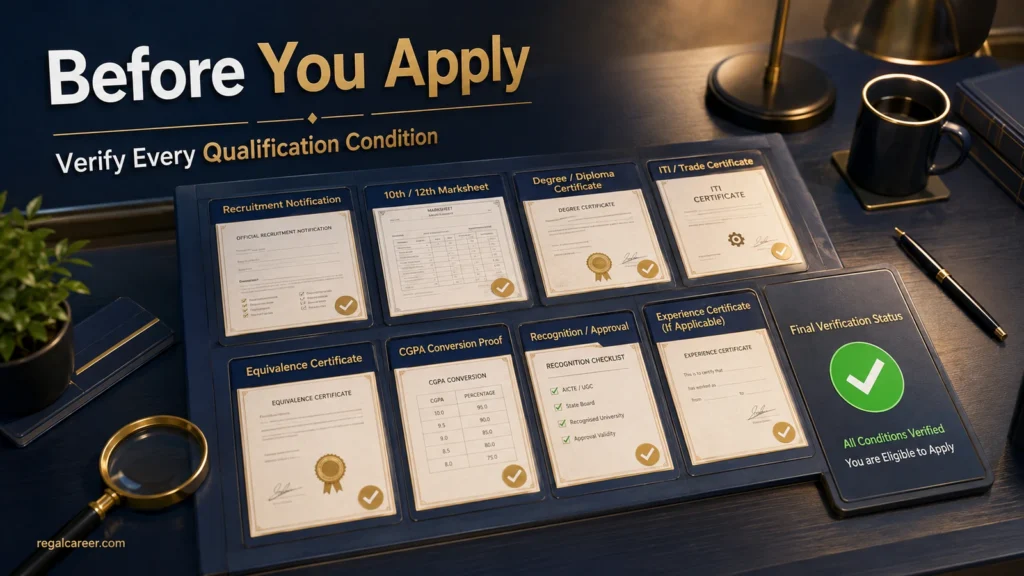
Final Qualification Checklist
CHECKLIST
- Exact post/post code confirmed.
- Complete essential qualification copied from official notification.
- 10th/12th/ITI/diploma/degree level matched.
- Subject, stream, branch, trade or specialization matched.
- “Any degree” vs “specific degree” checked.
- Essential and desirable qualifications separated.
- Higher qualification not assumed to be automatically acceptable.
- “Equivalent” relied on only with an official basis.
- Board/university/institution recognition checked.
- NIOS/open-school requirement checked where relevant.
- ODL/online programme and academic-session recognition checked where relevant.
- Foreign-degree equivalence checked where relevant.
- Minimum marks/grade/CGPA requirement checked.
- Official CGPA conversion method identified.
- Qualification cut-off date checked.
- Final-year/result-awaited condition checked.
- Professional registration/licence checked.
- ITI/NTC/NAC trade wording checked.
- Post-qualification experience calculated correctly.
- Corrigenda/FAQs checked.
- All supporting documents ready for verification.
ACTION CTA
Check the Rest of Your Eligibility
Educational qualification is only one part of eligibility. Verify age, category, crucial date, relaxation, experience and other recruitment-specific conditions before final submission.
Frequently Asked Questions
FAQ
What is the minimum qualification for a government job?
There is no single minimum qualification for all government jobs. Depending on the post, eligibility may start from 8th/10th pass and extend to 12th, ITI, NAC, diploma, graduation, engineering, post-graduation, professional qualifications or research degrees. Always check the exact post notification.
Can a graduate apply for a 12th-pass government job?
Often yes when 12th pass is only the minimum requirement and higher-qualified candidates are not excluded. However, the candidate must still satisfy any required 12th subject, stream, skill, certificate or maximum-qualification condition.
Can a B.Tech holder apply for a diploma post?
Not automatically. Check whether the recruitment rules or notification accept a degree as an alternative to the diploma. A higher academic level alone does not prove recruitment equivalence.
Can a degree holder apply for an ITI post?
Only when the recruitment conditions permit it or the candidate also possesses the required ITI/NTC/NAC credential. A degree does not automatically replace a trade qualification.
Who decides equivalent qualification for government jobs?
For Indian degrees in employment, UGC says equivalence is decided by the employing organisation. Follow the recruitment rules, official equivalence orders, FAQs and clarifications of the recruiting authority.
Is a NIOS 10th or 12th certificate valid for government jobs?
NIOS states that its Secondary and Senior Secondary certificates have the same recognition as certificates from other boards. Candidates must still satisfy the specific subjects, percentage, skill or other conditions in the recruitment.
Is a distance degree valid for government jobs?
A recognized ODL degree can be valid when the institution/programme and relevant academic session satisfy UGC rules, and the recruitment does not impose another professional or post-specific restriction. Verify the current UGC-DEB recognition details.
Is an online degree valid for government jobs?
It can be, when the online programme is offered by an entitled/recognized HEI under the applicable UGC framework and meets the recruitment’s own conditions. Verify the programme and session rather than relying only on the university name.
Can final-year students apply for government jobs?
It depends on the notification. Some recruitments allow provisional applications; others require possession of the qualification by the closing date or another cut-off date.
Can I apply if my final result is awaited?
Only if the recruitment permits it or your result/proof becomes available by the required cut-off. Completing the examination does not always mean the qualification is considered possessed.
Which CGPA-to-percentage formula is accepted for government jobs?
Use the official conversion method of your awarding university/institution and any specific instruction in the recruitment notification. There is no single universal CGPA formula for every university.
Is desirable qualification compulsory?
Normally, desirable/preferred qualification does not replace or form part of the essential minimum unless the notification says otherwise. Read the qualification headings carefully.
Is work experience before graduation counted?
Not when the recruitment specifically requires post-qualification experience after obtaining the essential qualification. Other posts may define experience differently, so follow the exact wording.
Is NAC accepted for government jobs?
DGT recognizes the National Apprenticeship Certificate for seeking employment, but a particular recruitment must still accept NAC for the post/trade in question.
Is a foreign degree valid for a government job in India?
It may require recognition/equivalence under the UGC 2025 foreign-qualification framework or the relevant statutory council for regulated professional fields, plus any requirement of the recruiting authority.
OFFICIAL SOURCE
Always verify the final qualification from the recruiting authority’s notification, recruitment rules, corrigenda and FAQs.
University Grants Commission — Degree validity and employment equivalence
UGC Distance Education Bureau — ODL/Online recognition and entitled HEIs
UGC Foreign Qualification Equivalence Portal
Union Public Service Commission — Current Recruitment Advertisements
Directorate General of Training — NTC/NAC and Apprenticeship information
FINAL TAKEAWAY
The safest way to check government job qualification requirements is to match your documents against the exact recruitment wording, not against a broad label such as “10th pass,” “graduate,” “ITI” or “degree holder.” Verify the essential qualification, subject or trade, recognition, marks, equivalence, higher-qualification rule, cut-off date, experience and any professional credential. If the notification is silent or ambiguous, do not invent an equivalence—look for the recruitment rules, official FAQ/corrigendum or clarification from the recruiting authority before applying.
