

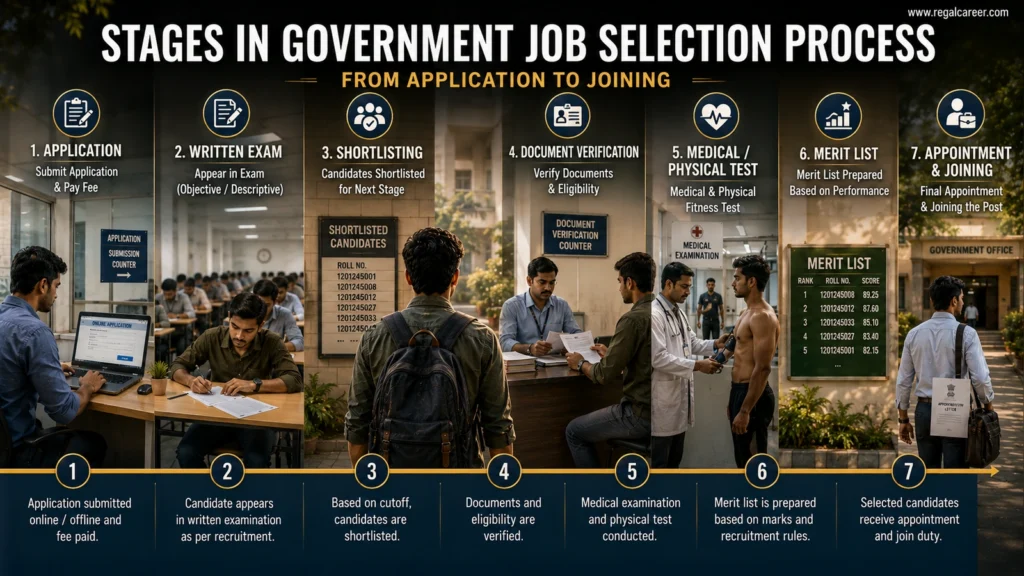
Clearing a government examination is not always the same as getting selected, and getting selected is not always the same as receiving an appointment order. Government recruitment can contain several independent stages between the first application and the day a candidate actually joins service.
The exact government job selection process depends on the recruiting authority, post, service rules and notification. One recruitment may use a single computer-based examination and document verification. Another may use prelims, mains and an interview. A railway recruitment may add a skill test, aptitude test, document verification and medical examination. Police recruitment can include physical measurements and endurance tests. Some recruitments shortlist directly from qualifications, experience, GATE scores or another prescribed criterion without a conventional written examination.
That variation is why candidates should never prepare from a generic “six-stage” or “seven-stage” selection chart alone. The official notification tells you which stages apply, which stages are only qualifying, which marks count toward final merit, and which checks can still affect appointment after your name appears in a result. If the selection paragraph feels difficult to decode, first use our guide to reading a government job notification.
QUICK ANSWER
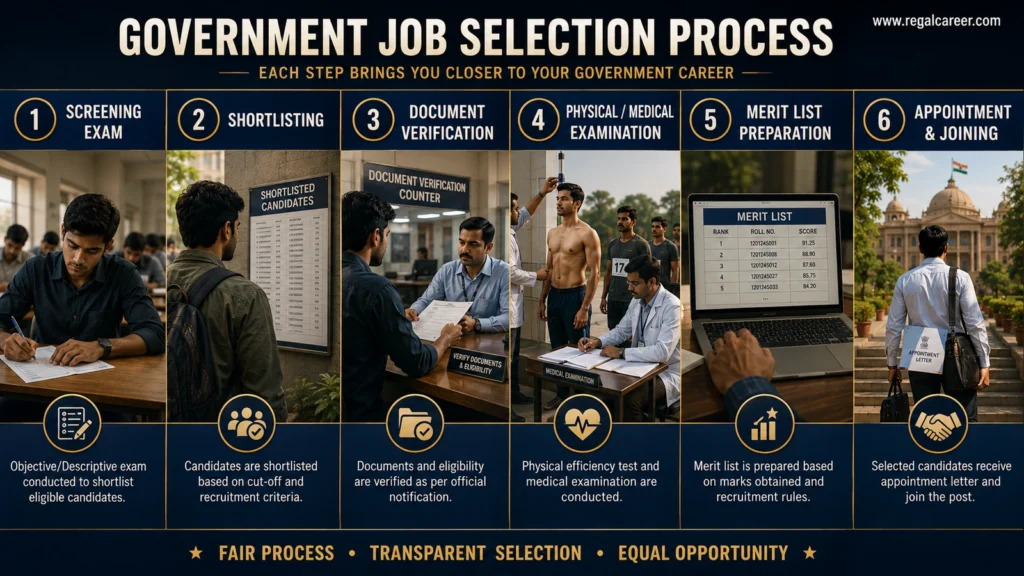
There is no single government job selection process that applies to every recruitment. A typical recruitment may move through application scrutiny, written or computer-based examination, answer-key objections, shortlisting, skill/physical/interview stages where applicable, document verification, medical or other suitability checks, final merit, preference or post allocation, provisional selection or recommendation, background verification, appointment and joining. Some stages may be skipped, combined or reordered. Always distinguish a stage result from final selection and final selection from an appointment order.
KEY TAKEAWAYS
- The official notification, recruitment rules and later corrigenda control the selection process.
- A stage can be screening, qualifying, merit-counting or verification-only; those are not the same.
- “Qualified,” “shortlisted,” “provisionally selected,” “recommended,” “allotted” and “appointed” describe different points in recruitment.
- Answer-key objections, normalization and cut-offs can change the score used for shortlisting.
- Interviews are not universal; Central Government Group C and Group B non-gazetted interviews have been dispensed with since 1 January 2016.
- Document verification can reject an otherwise high-scoring candidate if eligibility claims are not supported.
- Reserve/waiting-list rules vary by authority and do not guarantee appointment.
- Medical, police/character verification, preference allocation and appointment formalities may occur at different points depending on the recruitment.
1. There Is No Universal Government Job Selection Process
The most important rule is also the simplest: do not assume the stages from another examination apply to your recruitment.
The official Rajasthan Recruitment Portal’s examination lifecycle illustrates how long a public recruitment can become. Its published lifecycle includes registration, advertisement, application, admit card, examination, answer key, provisional shortlist, document verification, final merit, preference-based service allocation, recommendation, medical test, police verification, and appointment/posting.
At the same time, the Staff Selection Commission describes Selection Posts as involving stages such as computer-based testing, skill testing and document verification, while its current results pages show other recruitments moving through physical tests, trade tests, document verification and tentative allocation.
The Union Public Service Commission maintains separate workflows for written results, interviews and final results, while Railway Recruitment Board pages show CBT shortlisting, aptitude or trade tests for some posts, DV/medical rounds and provisional panels.
So the useful model is not a fixed number of stages. It is a branching lifecycle.
CANDIDATE NOTE
Open the notification and find the heading “Selection Process,” “Mode of Selection,” “Scheme of Examination,” “Recruitment Process” or similar wording. Write the stages in the exact order given there. Then check every later notice because the authority may publish corrigenda, revised schedules, answer-key notices, shortlist rules or additional verification instructions.
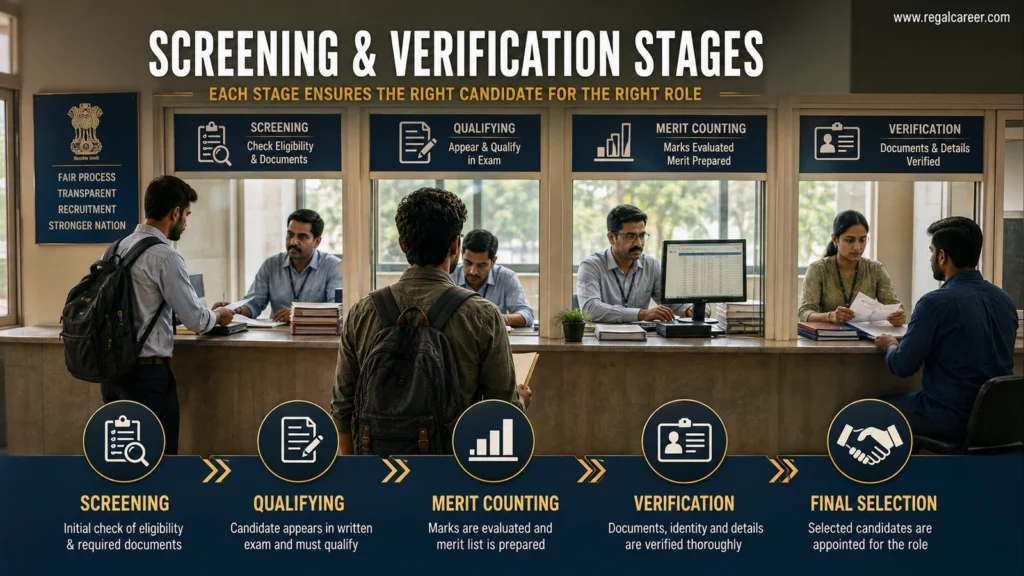
2. Four Types of Selection Stages You Must Distinguish
A stage matters differently depending on what it does.
| Stage type | Purpose | Does passing it guarantee final merit? |
|---|---|---|
| Screening / Shortlisting | Reduces the candidate pool for a later stage | No |
| Qualifying | Requires a minimum standard but may not add marks to rank | No |
| Merit-counting | Contributes marks or weightage used for final ranking | Potentially, subject to all other conditions |
| Verification / Suitability | Confirms eligibility, documents, fitness or other conditions | Usually no additional merit marks, but failure can end candidature |
Screening stage
A preliminary examination, CBT-1, shortlisting formula or academic-score filter may exist only to decide who proceeds.
For example, Railway Recruitment Board notices regularly publish lists of candidates shortlisted from one CBT to the next stage. A shortlist is permission to continue, not final selection.
Qualifying stage
Typing tests, skill tests, language tests, physical tests or aptitude tests may be qualifying in some recruitments. You may need to meet the standard, while the marks are not added to final merit.
But never assume a named test is always qualifying. The notification must say so.
Merit-counting stage
A mains examination, Tier-II paper, interview, GATE score, academic score or combination of components may determine final rank if the recruitment rules assign weightage to it.
Verification or suitability stage
Document verification and medical/suitability checks may not improve your rank, but they can still remove you from consideration.
IMPORTANT
“Qualifying” does not mean “unimportant.” A stage can carry zero merit marks and still be compulsory. If you fail a qualifying stage, a very high written score may not save your candidature.

3. Stage 0: Eligibility and Application Scrutiny Can Eliminate Candidates Before or After the Exam
The selection process effectively begins before the examination.
When you submit an application, the portal may perform basic validations, but that does not prove final eligibility. Check the broader government job eligibility guide and the qualification requirements guide before assuming that successful form submission confirms your candidature. IBPS explicitly warns on its current application portal that submission of an online form does not mean the candidate has fulfilled every notification criterion; the application remains subject to later scrutiny and can be rejected if the candidate is found ineligible.
Depending on the recruitment, scrutiny may happen:
- immediately after application;
- before admit-card release;
- after the written examination;
- before document verification;
- during document verification;
- or even later if an eligibility claim is re-examined.
SSC regional sites, for example, publish lists of provisionally accepted, finally accepted and rejected candidates for Selection Posts, showing that application acceptance itself can remain conditional.
What scrutiny can check
- age and cut-off date;
- educational qualification;
- subject/branch/trade;
- category and reservation claim;
- experience;
- required certificates;
- photograph/signature/application details;
- post preference;
- eligibility for a specific post code;
- debarment or other disqualification conditions.
WARNING
An admit card is normally permission to appear in the examination, not a certificate that every eligibility claim has already been finally verified.
4. Written Examination, CBT, Prelims and Mains: Different Exams Use Different Structures
Many government recruitments use a written or computer-based examination, but even here there is no single model.
Possible structures include:
- one CBT only;
- CBT-1 followed by CBT-2;
- preliminary examination followed by mains;
- objective paper plus descriptive paper;
- paper-based written exam;
- subject/trade examination;
- recruitment test followed by interview;
- no written exam where shortlisting is based on another notified criterion.
The UPSC Civil Services Preliminary Examination 2026 page separately publishes the preliminary examination and written result, after which qualified candidates move to the Main Examination.
Railway recruitment provides another model. Current RRB pages show candidates being shortlisted from CBT-1 to CBT-2, from CBT to CBAT, or directly from CBT to document verification depending on the post.
Preliminary does not always mean “easy first paper”
The purpose matters more than the label. A preliminary or first-stage exam is often used to reduce the candidate pool, but the score treatment varies.
Mains does not automatically mean final merit
Some recruitments still add an interview, skill test, physical test, medical examination or document verification afterward.
PRO TIP
Create a small selection-stage table from the notification with four columns: Stage | Minimum standard | Marks count in final merit? | What comes next? This prevents the common mistake of treating every stage as if it has the same weight.
5. Answer Keys, Objection Windows and Score Revision Are Part of the Selection Process
Candidates often mentally jump from “exam completed” to “result,” but many CBT recruitments include an important stage in between.
RRB pages routinely publish:
- question papers/responses;
- provisional or displayed answer keys;
- objection windows;
- later results, cut-offs and scorecards.
For example, the current RRB NTPC Graduate recruitment page records an answer-key and objection-tracker stage before later CBT results and shortlisting.
The UPSC Recruitment Tests page also maintains sections for provisional answer keys, answer keys, results, cut-off marks and marks information.
Why objections matter
If the authority accepts an objection, the final key or evaluation can change. That can affect:
- raw score;
- normalized score;
- cut-off;
- shortlist status.
Do not use unofficial keys as final evidence
Coaching-institute keys can help estimate a score, but only the recruiting authority’s evaluation determines the official result.
IMPORTANT
If the official notice allows answer-key objections, check the deadline, objection fee if any, acceptable evidence and prescribed submission method. Missing the objection window can remove your opportunity to challenge a disputed answer through that process.
6. Normalization, Raw Score, Cut-Off and Shortlisting: Why Your Exam Marks May Not Tell the Whole Story
When an examination is conducted in multiple shifts, some recruiting authorities use normalization or another score-calculation method.
RRB has published normalized cut-off marks for multi-shift recruitments and separately publishes score-calculation methodologies in some recruitment cycles. SSC also maintains an official Normalization Method resource on its candidate portal.
The practical lesson is:
> Do not compare only your raw answer count with another candidate’s raw answer count when the recruitment applies normalization or scaling.
Cut-off is not the same as minimum qualifying marks
Minimum qualifying marks are the threshold you must cross to be considered qualified under the rules.
Cut-off marks can be the score of the last candidate shortlisted or selected within a category, post, zone or stage.
A candidate may cross the minimum qualifying mark but still miss the competitive cut-off.
Cut-offs can exist at several stages
A recruitment may publish:
- CBT-1 cut-off for CBT-2;
- CBT-2 cut-off for skill test/CBAT;
- cut-off for document verification;
- final empanelment cut-off.
WORKED EXAMPLE
Suppose a recruitment requires at least 40% in CBT-1. A candidate scores 58%, so the minimum qualifying condition is satisfied. But if the category-wise shortlist cut-off for CBT-2 is 63%, the candidate does not proceed. “Qualified the minimum standard” and “shortlisted for the next stage” are different outcomes.
7. Shortlisted, Qualified and Provisionally Shortlisted: Read the Result Heading Carefully
A government result PDF can contain your roll number without meaning that you have secured the job.
Common result labels include:
- qualified for next stage;
- shortlisted for CBT-2;
- shortlisted for interview;
- shortlisted for PET/PST;
- shortlisted for skill test;
- shortlisted for document verification;
- provisional shortlist;
- tentative shortlist;
- provisionally accepted;
- result withheld.
The Rajasthan recruitment lifecycle explicitly contains a Provisional Shortlist stage before document verification and final merit.
RRB pages also use “list of candidates shortlisted for Document Verification” or “shortlisted for CBAT.”
Why “provisional” matters
It generally means the outcome remains subject to one or more later checks such as:
- document verification;
- eligibility confirmation;
- category validity;
- medical fitness;
- verification of claims;
- vacancy/post allocation;
- other conditions in the notice.
CANDIDATE NOTE
When your roll number appears in a result, read the title and notes of the result PDF, not only the roll-number list. The title usually tells you what you have actually qualified for.
8. Skill Test, Typing Test, Trade Test, CBAT and Language Test: Often Misunderstood
After a written examination, a recruitment may test whether a candidate can perform a job-related skill.
Possible stages include:
- typing test;
- stenography test;
- computer proficiency test;
- data-entry speed test;
- trade test;
- translation test;
- driving test;
- language proficiency test;
- Computer Based Aptitude Test (CBAT).
SSC’s current result pages show candidates proceeding to combinations such as PE&MT, DV and Trade Test/Skill Test for Delhi Police recruitments.
RRB’s Section Controller recruitment page shows candidates shortlisted from CBT for CBAT, while other railway recruitment pages show translation or trade-test results followed by DV.
Is a skill test qualifying or merit-counting?
There is no universal answer.
Read the notification for:
- minimum speed/standard;
- allowed error percentage;
- number of attempts;
- whether marks are added to merit;
- whether the test is only qualifying;
- whether failure causes elimination.
WARNING
Do not assume “qualifying test” means you can prepare for it after the written result. Skill standards such as typing, stenography or physical endurance often require weeks or months of practice.
9. PET, PST, Physical Measurement and Endurance Tests
Police, CAPF, defence and some field/operational posts can include physical stages.
Common terms are:
PET — Physical Efficiency Test PST — Physical Standard Test PE&MT — Physical Endurance and Measurement Test
SSC regional sites in 2026 continue to publish PE&MT/PET/PST notices for Delhi Police and CAPF-related examinations.
These stages can check recruitment-specific standards such as:
- running/endurance;
- height;
- chest measurement where applicable;
- long jump/high jump or other prescribed events;
- physical standards linked to category, sex or post.
Physical rules are never safe to generalize
Do not copy a running time, height, chest standard or number of attempts from another recruitment. The applicable notice controls the standard.
10. Interview or Personality Test: Important for Some Recruitments, Absent from Many Others
A common competitor mistake is to present the interview as a standard late-stage requirement for all government jobs.
It is not.
A July 2026 Department of Personnel and Training reform update published by PIB states that interviews for appointment to Central Government Group C and Group B non-gazetted posts were dispensed with from 1 January 2016.
That does not mean interviews disappeared from every public-sector recruitment.
UPSC continues to publish interview schedules and final results for examinations and direct recruitment where interviews are part of the notified process. TNPSC’s published selection procedures also distinguish interview and non-interview posts.
Interview vs personality test vs oral test
Different bodies use different names:
- interview;
- personality test;
- oral test;
- personal interaction.
The marks and role also differ.
A recruitment may use the interview:
- as a merit-counting component;
- after a recruitment test;
- after mains;
- for direct recruitment shortlisting;
- or not at all.
IMPORTANT
Never add an interview stage to your preparation plan unless the official selection scheme includes one.
11. Document Verification: High Marks Cannot Fix an Unsupported Eligibility Claim
Document verification (DV) is where the authority compares your claims with the required original or acceptable documents. Age-related claims should also match the relevant cut-off date; see the government job age limit and age relaxation guide for the calculation logic.
Current SSC, RRB and TNPSC pages regularly publish DV/certificate-verification schedules.
Common documents can include:
- date-of-birth proof;
- educational certificates and marksheets;
- qualification/equivalence proof;
- category certificate;
- OBC-NCL/EWS certificate in prescribed format and period;
- PwBD certificate;
- domicile/residence proof where required;
- experience certificate;
- NOC;
- identity documents;
- name-change/marriage documents where relevant;
- professional registration/licence;
- application printout and declarations;
- other post-specific evidence.
DV is not a re-application window
If the notification required possession of a qualification or valid certificate by a particular date, obtaining it later may not cure the original eligibility defect unless the recruitment rules permit it.
Documents can be re-uploaded or claims can be withheld
TNPSC’s results systems show document re-upload phases and withheld results where claims or supporting documents still require verification. This is another reason not to assume one DV date always ends the issue.
CHECKLIST
- Match your name, date of birth and parent details across documents.
- Carry originals where the notice requires originals.
- Use the prescribed category/certificate format.
- Check certificate issue date and validity period.
- Keep semester/year-wise marksheets where required.
- Keep degree/provisional/equivalence proof.
- Prepare experience certificates with exact dates and role details.
- Read the DV call letter separately from the original notification.
- Keep copies/scans in the format requested by the authority.
- Do not conceal a mismatch; follow the authority’s correction/clarification process.
12. Medical Examination: Common in Some Recruitments, Not a Universal Identical Stage
Medical examination is crucial in recruitment where the job has notified medical standards.
Railway Recruitment Boards frequently schedule Document Verification & Medical Examination together or in linked rounds. The current RRB JE and Paramedical pages show multiple DV/medical rounds followed by provisional part panels.
The Rajasthan recruitment lifecycle also lists medical testing before police verification and appointment/posting.
However, it is unsafe to say that every government job has the same formal medical examination or the same standards.
What can vary
- timing of medical examination;
- designated medical authority;
- vision standards;
- hearing requirements;
- physical fitness classification;
- post-specific medical category;
- appeal/review procedure;
- whether the recruitment body or appointing department conducts the check.
WARNING
Never use a generic statement such as “6/6 vision is required for government jobs.” Medical standards are post-specific and can differ substantially even within the same organization.
13. How Final Merit Is Calculated
Final merit is not always “total marks from every stage.”
The notification may use:
- one final written-paper score;
- mains score only;
- written + interview;
- GATE/academic score + interview;
- normalized CBT marks;
- multi-tier weighted scores;
- category/post-specific merit;
- tie-breaking rules;
- qualifying stages that contribute no marks.
Qualifying stage vs merit stage
Suppose a typing test is qualifying. You must pass it, but the final ranking may still come entirely from the written examination.
In another recruitment, an interview may carry a stated percentage of final weightage.
Tie-breaking rules
If two candidates receive equal final scores, the authority may apply notified tie-break rules such as:
- higher marks in a particular paper;
- higher score in a priority component;
- date of birth/age;
- alphabetical rule;
- another prescribed criterion.
The tie-break must come from the recruitment rules, not a general assumption.
14. Post, Department, Zone and Service Preference Can Affect What You Actually Get
Passing the examination may not decide your final post automatically.
Some recruitments ask candidates to submit preferences for:
- post;
- department;
- service;
- cadre;
- state/UT;
- railway/RRB;
- bank/participating organization;
- zone;
- institution.
The Rajasthan portal includes Preference Based Service Allocation as a distinct lifecycle stage.
SSC’s current results pages also show processes such as First Round of Tentative Allocation (FRTA) and Option-cum-Preference forms for some examinations.
Merit + preference + vacancy = allocation
Where the rules use preferences, the final allotted post can depend on:
- rank;
- category;
- vacancy position;
- eligibility for the post;
- medical/physical suitability;
- preference order;
- allocation rules.
IMPORTANT
Do not fill preferences casually. In some recruitments, a higher-ranked candidate can still receive a lower preference because the higher preference is unavailable or the candidate is not eligible/suitable for it.
15. Merit List, Selection List, Recommendation, Allotment and Panel: These Terms Are Not Interchangeable
A major source of candidate confusion is treating every final-looking PDF as an appointment list.
Merit list
A merit list ranks candidates according to the recruitment’s scoring rules. Whether every person on a published list receives an immediate appointment depends on vacancies and the type of list.
Selection list
A selection list identifies candidates selected under the relevant rules, but appointment can still depend on formal checks or action by the appointing authority.
Recommendation
A commission may recommend candidates to a department or Government, after which the appointing authority performs its own formal appointment process.
TNPSC explains that approved selection lists are forwarded to Government/HODs for issue of appointment orders.
Allotment
Banking and some multi-organization recruitments use allotment terminology. IBPS, for example, publishes candidates provisionally allotted to participating organizations.
Panel / part panel
Railway recruitment pages use terms such as Main Panel and Part Panel for provisionally selected candidates.
The current RRB Paramedical page shows repeated DV/medical rounds and multiple part panels of candidates described as provisionally selected.
CANDIDATE NOTE
Whenever you see your name or roll number, identify the exact noun used by the authority: shortlist, merit list, selection list, recommendation, allotment, panel, reserve list or appointment order. That word tells you what stage you are actually at.
16. Provisional Selection Is Not the Same as Final Appointment
“Provisional” means something remains subject to fulfillment or verification of conditions.
Possible outstanding conditions can include:
- document/eligibility verification;
- medical fitness;
- character/antecedent verification;
- category verification;
- employer/department checks;
- vacancy/allocation conditions;
- court cases or administrative decisions;
- other notified requirements.
Railway panels frequently use the phrase provisionally selected.
IBPS uses provisional allotment, including allotment under reserve lists.
Can an appointment letter itself be provisional?
Yes, depending on the applicable rules.
The July 2026 DoPT reform update states that provisional appointment letters can be issued on the basis of self-attestation, with a six-month time limit for character and caste certificate verification in the described Central Government reform framework.
That is important because it proves another universal claim is unsafe: not every recruitment waits for every background verification step before issuing any form of appointment letter.
IMPORTANT
Do not resign from an existing job, relocate or make irreversible commitments solely because you have been “provisionally selected” unless you understand the exact status, conditions and appointment instructions from the authority.
17. Reserve List and Waiting List: What They Really Mean
A reserve or waiting list is not a universal second merit list with guaranteed appointment.
Different recruiting bodies use different systems.
TNPSC states that after the selection list and reserve list are approved, both can be published, and selected candidates are forwarded to the Government/HOD for appointment orders. Candidates placed in the reserve list are separately informed.
SSC regional sites publish candidates nominated from reserve lists for certain Selection Posts.
IBPS publishes provisional allotment under reserve list and tells candidates to refer to the relevant notification for the reserve list’s validity.
Why a reserve list may move
Depending on the governing rules, movement can arise when:
- a selected candidate does not join;
- candidature is cancelled;
- a candidate declines;
- a vacancy becomes available under the same recruitment;
- the authority operates the reserve list under its rules.
Why your reserve-list rank is not a promise
Movement depends on:
- category/post;
- number and type of vacancies;
- validity period;
- authority’s reserve-list rules;
- whether the vacancy is permitted to be filled from that list.
WARNING
Do not assume a reserve/waiting list always remains valid for six months or one year. The validity and method of operation must be checked in that recruitment’s rules or notice.
18. Background, Character, Police and Caste Verification
Some appointment processes include verification beyond academic documents.
Depending on service rules, checks can include:
- character and antecedents;
- police verification;
- caste/category verification;
- identity verification;
- employer verification;
- vigilance or other service-specific checks.
Rajasthan’s published lifecycle explicitly places Police Verification before Appointment and Posting.
The DoPT reform update discussed earlier allows provisional appointment letters in the Central Government framework while character and caste verification are completed within the stated time limit.
A clean exam record does not replace background formalities
Selection marks assess the competitive process. Background verification serves a different administrative/legal purpose.
19. Appointment Order, Offer Letter, Joining Letter and Joining Are Different Milestones
After selection, the appointing authority may issue one or more communications.
Possible documents include:
- offer of appointment;
- appointment order;
- provisional appointment letter;
- posting order;
- joining instructions;
- medical/verification directions;
- reporting letter.
Appointment order
This is the formal communication appointing or offering appointment to the post under stated terms and conditions.
Joining
Joining is the act of reporting to the designated office/training centre/place of posting and completing required formalities within the permitted time.
A selected candidate can face problems if they:
- miss the reporting deadline;
- fail to complete pending formalities;
- do not produce required documents;
- fail a condition attached to appointment;
- seek an extension without following the prescribed process.
Probation/training
Many government posts place new appointees on probation or require induction/training. Selection is therefore the end of recruitment, not the end of all service conditions.
20. What Happens After a Government Exam Result? Use This Decision Tree
PROCESS
01
Read the result heading
Is it a stage result, shortlist, final result, panel, allotment or selection list?
02
Read the result notes
Check whether the result is provisional and what conditions remain.
03
Check the next-stage notice
Look for DV, skill test, PET/PST, interview, medical, preference or allocation instructions.
04
Download the cut-off/scorecard
Confirm the score actually used for shortlisting where published.
05
Check document requirements
Do not wait for DV day to identify certificate problems.
06
Track official updates
Watch the recruiting authority’s result/notice page, not only third-party alerts.
07
Check preference/allocation
Submit post/service/zone/bank preferences within the window where applicable.
08
Identify your final status
Distinguish recommended, selected, provisionally selected, allotted and reserve-listed.
09
Wait for appointing-authority action
A commission/recruiting body may send recommendations to a separate department.
10
Complete appointment formalities
Medical/background verification, reporting, joining and probation/training may remain.
21. How Major Recruiting Bodies Differ: Real Official Examples
This comparison is more useful than a generic stage count.
| Recruiting system | Real pattern visible on official sites | Important candidate lesson |
|---|---|---|
| SSC | CBT/written stages, skill/trade/physical stages depending exam, DV, option/preferences, tentative allocation, reserve-list nomination | Read the exact exam scheme; not every SSC exam uses the same stages |
| UPSC examinations | Preliminary/written result, Main exam, interview/personality test where prescribed, final result | A preliminary result is only progression to the next examination stage |
| UPSC direct recruitment | Application scrutiny, recruitment test and/or interview depending post, final result/recommendation | Direct recruitment can differ from large competitive examinations |
| RRB | CBT-1/CBT-2 for some posts, CBAT/TST/trade stage for some, DV, medical, main/part panels | “Panel” and “provisional selection” can follow multiple DV/medical rounds |
| TNPSC | Written exam, certificate verification, oral test for interview posts, counselling where applicable, selection/reserve list, forwarding to appointing authority | Selection list and appointment order can be issued by different authorities/stages |
| IBPS | Online exams/interview depending CRP, provisional allotment to participating organization, reserve-list allotment | “Allotted” is not the same wording as direct appointment |
| Rajasthan recruitment portal | 14-stage lifecycle from registration to appointment/posting, including answer key, shortlist, DV, allocation, recommendation, medical and police verification | Recruitment can contain important stages after the written result |
PRO TIP
When comparing two government jobs, compare the selection scheme, not only salary and vacancy count. A post with one merit-counting CBT has a very different preparation risk from a post with CBT-1, CBT-2, physical test, skill test, DV and medical.
22. Common Mistakes That Cost Candidates After the Exam
Mistake 1: Treating a stage result as final selection
A roll number in a CBT result may only mean you are shortlisted.
Mistake 2: Ignoring answer-key and objection notices
You may miss the only formal objection window.
Mistake 3: Confusing minimum qualifying marks with cut-off
Passing the minimum standard does not guarantee shortlisting.
Mistake 4: Preparing for skill/physical tests only after the written result
Some skills need long preparation.
Mistake 5: Assuming interview is part of every recruitment
Many Central Group C and Group B non-gazetted recruitments do not use interviews.
Mistake 6: Assuming DV is a routine formality
Incorrect category, qualification, experience or identity evidence can end candidature.
Mistake 7: Assuming medical standards are the same everywhere
Railway, police and technical posts can have highly specific standards.
Mistake 8: Filling preferences without strategy
Preference order can affect allocation where rules use merit-cum-preference.
Mistake 9: Calling a reserve list “selected”
Reserve-list status is conditional on the authority operating that list.
Mistake 10: Stopping official-site checks after “final result”
Appointment, medical, police verification, department allocation or joining instructions may be published separately.
23. How to Track Your Recruitment Without Missing a Stage
Use one recruitment tracker for every job you apply to.
Record:
- advertisement/CEN/notification number;
- post/post code;
- application number;
- official recruitment page;
- selection stages;
- application status;
- exam date;
- answer-key window;
- result date;
- cut-off;
- scorecard;
- next-stage schedule;
- DV documents;
- medical/physical requirements;
- preference window;
- final result/panel;
- reserve-list validity if applicable;
- appointing department;
- appointment/joining deadline.
ACTION CTA
Read the Notification Before You Track the Stages
The selection process is only accurate when it is taken from the specific recruitment notification and later official notices.
24. Before You Apply: Build the Selection Process From the Notification
Use this checklist before submitting any application. For the form-filling stage itself, keep the government job online application guide open alongside the notification.
CHECKLIST
- Selection stages copied exactly from the official notification.
- Screening vs qualifying vs merit-counting stages identified.
- Minimum qualifying marks noted.
- Negative marking noted.
- Normalization/scaling rule checked where applicable.
- Skill/typing/trade standards noted.
- Physical standards/PET/PST noted where applicable.
- Interview weightage checked where applicable.
- DV documents prepared early.
- Medical standard checked for the exact post where applicable.
- Merit calculation formula noted.
- Tie-break rules noted.
- Post/service/zone preferences understood.
- Provisional-selection conditions understood.
- Reserve/waiting-list rule checked.
- Appointment/joining conditions reviewed.
- Corrigenda and later official notices bookmarked.
Frequently Asked Questions
FAQ
What is the government job selection process?
It is the sequence used by a recruiting authority to move candidates from application to appointment. Depending on the post, it can include scrutiny, written/CBT stages, skill or physical tests, interview, document verification, medical checks, merit calculation, allocation, provisional selection, background verification and joining. No single sequence applies to every recruitment.
Is a written exam compulsory for every government job?
No. Many recruitments use written or CBT examinations, but some direct recruitments can shortlist using academic qualifications, experience, GATE scores or another notified method and then use interview or another selection mechanism. The notification controls the method.
Does clearing the written exam mean I am selected?
Usually not. A written result may only shortlist you for another examination, skill test, physical test, interview or document verification.
What is the difference between qualifying marks and cut-off marks?
Qualifying marks are the minimum standard prescribed by the rules. The cut-off is usually the competitive score used to determine the last candidate shortlisted/selected for a category, post or stage. You can meet the minimum marks and still miss the cut-off.
What is normalization in government exams?
Where an authority uses normalization/scaling for multi-shift examinations, it converts or adjusts raw scores under its published method for comparison. Check the recruiting authority’s official normalization method instead of assuming raw marks alone determine the cut-off.
Is document verification the final stage?
Not always. DV may be followed or accompanied by medical examination, preference allocation, final merit, recommendation, background/police verification, appointment or joining formalities.
Can I be rejected during document verification after scoring high marks?
Yes. Merit marks cannot cure failure to satisfy an essential eligibility or documentary requirement where the rules require it.
Does every government job have an interview?
No. DoPT states that interviews for appointment to Central Government Group C and Group B non-gazetted posts were dispensed with from 1 January 2016. Other recruitments, including UPSC and various interview posts, can still include interviews where notified.
Does every government job have a medical test?
Not as one identical recruitment stage. Formal medical standards and the timing of medical examination depend on the service/post and applicable rules. Railway, police and operational posts often have detailed medical or physical standards.
What does “provisionally selected” mean?
It means the candidate has reached a selection status that remains subject to fulfillment or verification of specified conditions, such as eligibility, documents, medical fitness, background verification or appointment requirements.
What is the difference between a merit list and a selection list?
A merit list ranks candidates according to the recruitment’s scoring method. A selection list identifies candidates selected under the rules/vacancies. The terminology and legal effect depend on the authority, so read the result notice.
What is a reserve or waiting list in government jobs?
It is a pool/list that an authority may operate under its recruitment rules if eligible vacancies arise, for example because a selected candidate does not join. The size, validity and method differ by recruitment, and reserve-list status does not guarantee appointment.
What is provisional allotment in IBPS?
IBPS uses provisional allotment terminology when assigning successful candidates to participating organizations under the CRP rules. It also publishes provisional allotment under reserve lists. The participating organization then handles further appointment formalities.
What is a part panel in Railway recruitment?
RRBs can publish main panels and subsequent part panels of provisionally selected candidates as recruitment progresses through DV/medical and vacancy processing. A part panel is an official recruitment-stage list, not a generic term for every government job.
Can final selection happen before police/character verification?
The sequence varies. Rajasthan’s portal shows police verification before appointment/posting, while DoPT’s 2026 reform update says provisional appointment letters can be issued on self-attestation with character and caste verification completed within the specified six-month period in that Central Government framework.
What happens after my name appears in the final result?
Read the final-result notice. Depending on the recruitment, you may still need to complete allocation/preferences, medical examination, police/character verification, departmental document checks, appointment formalities and joining.
Is a recommendation by UPSC/TNPSC the same as an appointment?
Not necessarily. A commission can recommend or forward selected candidates to the Government/department, while the appointing authority issues the appointment order under the applicable rules.
How long does the government job selection process take?
There is no universal timeline. It depends on the recruitment size, number of stages, examination schedule, objections, court/administrative issues, verification, medicals, vacancies and appointing-authority processing. Avoid generic “6–12 months” or “12–18 months” promises unless the authority publishes a schedule.
Where should I check my next selection stage?
Use the recruiting authority’s official notice/result page and the specific recruitment page referenced in your notification. Third-party alerts are useful for discovery, but the official notice controls the stage, date and conditions.
OFFICIAL SOURCE
This guide is based on current official recruitment systems and should always be applied together with the notification for the exact post.
- Staff Selection Commission — official portal, results and exam resources
- UPSC — official examination and recruitment portal
- UPSC — Recruitment Tests, results, cut-offs and answer keys
- RRB Chandigarh — official recruitment notices and stage-wise results
- Rajasthan Recruitment Portal — published examination lifecycle
- TNPSC — recruitment functions, selection list and reserve-list process
- TNPSC — Selection Schedule
- IBPS — official CRP updates
- IBPS — FAQs including provisional allotment and reserve-list issues
- DoPT/PIB — July 2026 reforms in UPSC and SSC recruitment
FINAL TAKEAWAY
The best way to understand a government job selection process is to stop asking “How many stages are there?” and ask four better questions: Which stages apply to this post? Which are qualifying? Which marks create final merit? What conditions remain before appointment and joining? Follow the exact notification and every later official notice. A written result can be only a shortlist, a merit list can differ from a selection list, provisional selection can still carry conditions, and even a recommendation or allotment may require further appointment formalities. Track the full recruitment lifecycle until you have completed the official joining process.
