

Searching for government jobs by qualification sounds simple until a notification says 10th + ITI, 12th with Mathematics, three-year Diploma in Civil Engineering, or Bachelor’s degree with a specified subject. The qualification label gets you into the right search bucket; the official notification decides whether you can actually apply.
QUICK ANSWER
Government jobs are available across 10th, 12th, ITI, Diploma, Graduate and Postgraduate qualification levels, but each level opens different recruitment routes. A 10th- or 12th-pass candidate may target entry-level, clerical, operational or uniformed roles where notified; ITI candidates usually need the correct trade; diploma holders often need the correct engineering or professional branch; graduates enter many broad competitive-exam routes; and postgraduates can add specialist, research or academic options. Higher qualification does not automatically mean eligibility. Always match the exact subject, trade, branch, cut-off date, age, marks, experience and other conditions in the current official notification.
KEY TAKEAWAYS
- Use your qualification to discover suitable recruitment routes, not to declare yourself eligible.
- For ITI and Diploma posts, the trade or branch can matter as much as the qualification level.
- “Any graduate” and “graduate in a specified subject” are different eligibility conditions.
- A degree or higher qualification does not automatically replace a prescribed ITI, diploma or technical credential.
- Final-year candidates must check the exact date by which the qualification or result must be available.
- After qualification matching, verify age, marks, experience, skills, documents and the latest official notification.
Government Jobs by Qualification: At-a-Glance Roadmap
Use this roadmap as a starting point, not as a substitute for the notification.
| Qualification | Main Recruitment Direction | Common Opportunity Types | Extra Check That Often Matters |
|---|---|---|---|
| 10th / Matriculation | Entry-level, operational, support and selected uniformed routes | MTS-type posts, selected Railway/department posts, trades/support roles | Age, physical standard, licence, trade or language |
| 12th / 10+2 | Clerical, assistant, data-entry, stenography and selected defence/state routes | CHSL-type recruitment, clerical/assistant posts, selected 10+2 vacancies | Stream, subject, typing, skill test or certificate |
| ITI / NTC / NAC | Skilled trade and technician pathway | Technician, fitter, electrician, mechanic, machinist and trade-specific roles | Exact trade and accepted certificate route |
| Diploma | Technical and junior-engineering pathway | Junior Engineer, technical assistant, supervisor and branch-specific posts | Exact branch, duration and accepted alternatives |
| Graduate | Broad competitive-exam and officer/assistant pathway | CGL-type recruitment, public-sector banking, Railway graduate, PSC/UPSC and department posts | Any degree vs specified degree, skill or experience |
| Postgraduate | Specialist, academic, research and advanced subject pathway | Research, teaching, scientific, analytical and specialist roles | PG subject, registration, additional qualification or experience |
CANDIDATE NOTE
The table shows common recruitment directions, not universal eligibility. A vacancy described as “Diploma Jobs” may accept only Civil Engineering; an “ITI Job” may accept only named trades; a “Graduate Job” may require a particular subject or professional degree.
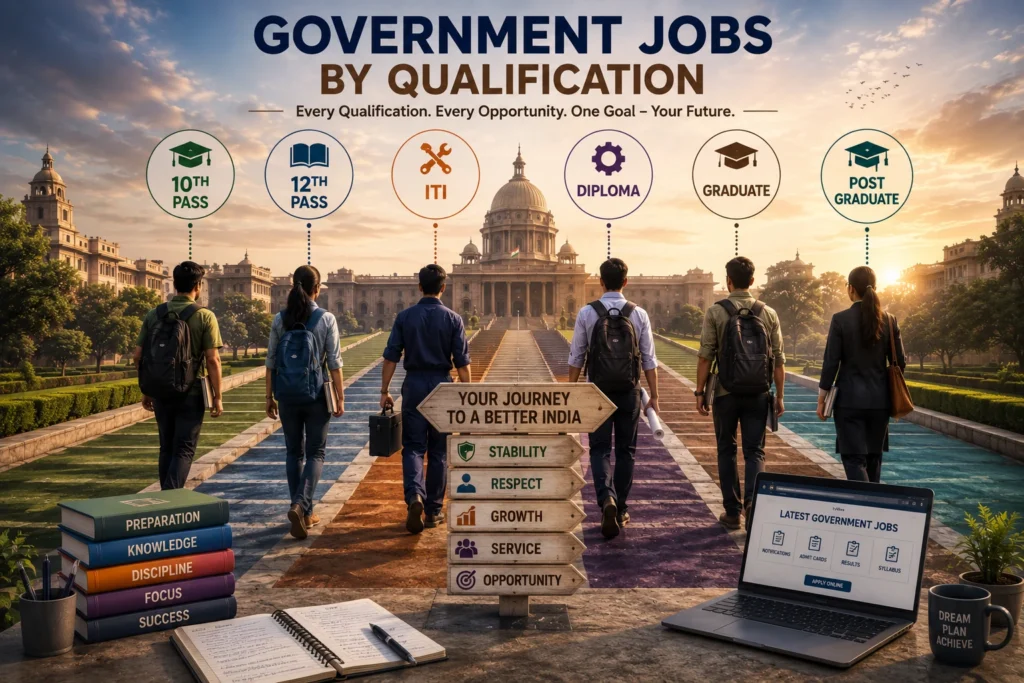
Government Jobs After 10th Pass
Class 10 or Matriculation can be enough for genuine government recruitment, but the opportunity pool is usually narrower than it is after 12th or graduation. Candidates should look for posts where Matriculation is the complete educational requirement or one part of a larger condition.
Common routes can include MTS-type support posts, selected Railway or departmental categories, trades/support positions, driver or field roles, and some uniformed opportunities where the notification prescribes Matriculation.
ELIGIBILITY CHECK
Before treating a vacancy as a “10th-pass job”, check whether the rule actually says:
- 10th pass only;
- 10th + ITI or another certificate;
- 10th + valid driving licence;
- 10th + physical/medical standard;
- 10th + experience, local language or another post-specific condition.
A candidate who satisfies only the academic part can still be ineligible if the additional condition is missing.
PRO TIP
If you are eligible for a suitable 10th-level recruitment, you can apply while continuing education or skill development. Completing 12th, ITI, a diploma or another recognised qualification can widen your future options without forcing you to ignore legitimate opportunities available now.
Government Jobs After 12th Pass
Passing Class 12 or 10+2 expands the search into clerical, assistant, data-entry, stenography, selected defence/uniformed and state-level recruitment where 12th is prescribed. SSC’s Combined Higher Secondary Level examination is a useful example of a recruitment family built around the 10+2 level, but candidates must still read the current notice for post-specific conditions.
The biggest mistake is treating “12th pass” as one universal qualification. A notice may require 12th from a recognised board, 12th with Mathematics, 12th with Physics and Mathematics, or 12th plus a typing/skill requirement.
IMPORTANT
Your stream and subjects matter when the notification names them. A Humanities or Commerce candidate should not assume eligibility for a post that specifically requires Science subjects or Mathematics simply because both candidates passed Class 12.
If your long-term target includes large graduate-level examinations or officer/assistant recruitment, completing graduation can significantly widen your options. You do not need to wait until graduation to learn the exam pattern, build aptitude skills or apply for suitable 12th-level posts.
ITI and Diploma Government Job Routes
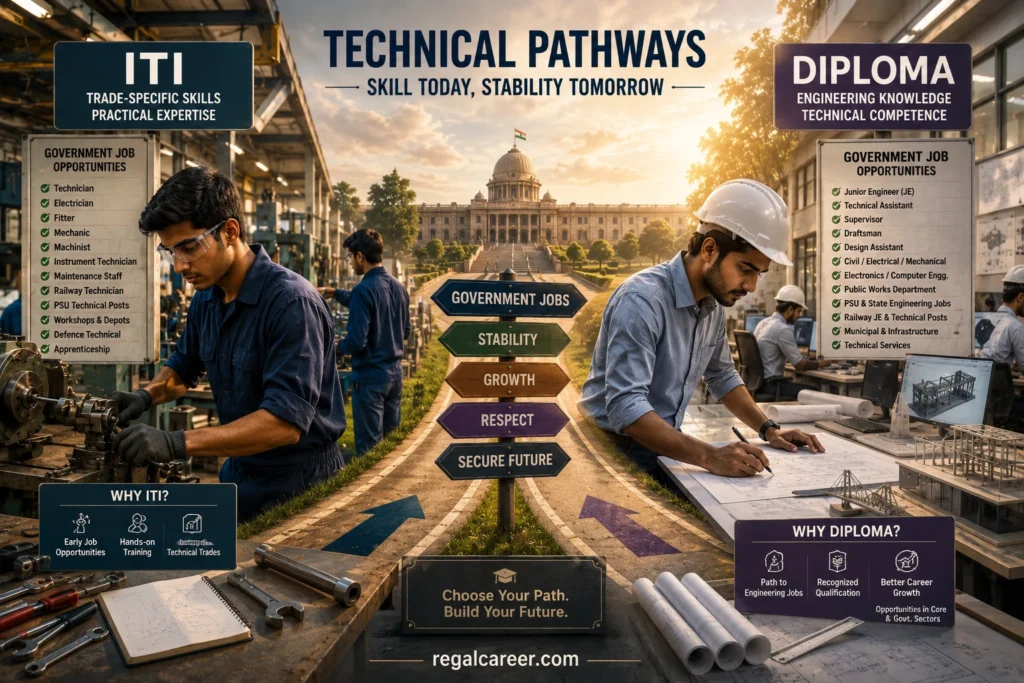
ITI and Diploma are both technical pathways, but they are not interchangeable categories. ITI is primarily trade-oriented; diploma recruitment is commonly branch- or discipline-oriented.
ITI: search by trade, not only by qualification
An ITI candidate should search using the exact trade: Electrician, Fitter, Electronics Mechanic, Machinist, Mechanic Motor Vehicle, Welder or another notified trade. If a recruitment accepts Fitter, Electrician and Electronics Mechanic, an ITI holder in an unrelated trade should not assume eligibility merely because both certificates are ITI.
Technical notices can also distinguish ITI, National Trade Certificate, National Apprenticeship Certificate and Course Completed Act Apprenticeship routes. Read the accepted route exactly as written.
WARNING
RRB Technician recruitment provides a strong example of why higher does not always mean accepted. In CEN 02/2025, RRB states that an engineering diploma/degree is not accepted in place of the prescribed CCAA/ITI for specified Technician Level-2 posts unless otherwise stated. Always follow the current post-wise qualification table.
Diploma: search by branch and accepted alternatives
“Diploma Government Jobs” is a broad discovery label. A Junior Engineer or technical post can separately require Civil, Electrical, Mechanical, Electronics or another named engineering discipline.
Recent RRB Junior Engineer recruitment also illustrates branch-specific mapping: CEN 05/2025 lists different diploma combinations for different JE categories rather than treating every diploma as equivalent.
WORKED EXAMPLE
Candidate A has a three-year Diploma in Electrical Engineering. Candidate B has B.Tech in Electrical Engineering.
If a notification expressly accepts “three-year Diploma in Electrical Engineering OR Bachelor’s Degree in Electrical Engineering”, both have a listed route.
If the notification lists only the diploma and does not provide a degree alternative, Candidate B should not self-declare equivalence. The recruitment rules or an official clarification must support the substitution.
Government Jobs After Graduation and Postgraduation
Graduation opens one of the broadest general competitive-exam pools. Depending on the current notification, graduates may explore SSC graduate-level recruitment, Railway graduate categories, public-sector bank recruitment, UPSC/State PSC examinations, department-specific assistant or inspector roles, and specialist posts linked to their degree.
“Any graduate” is different from a specified degree
A notice saying “Bachelor’s degree from a recognised university” creates a broad academic threshold. A notice requiring Civil Engineering, Law, Statistics as a subject, or another named discipline creates a narrower route.
Recent IBPS Customer Service Associate recruitment is a useful reminder not to rely on old “12th-pass bank clerk” lists: the current CRP framework uses graduation/equivalent qualification requirements. Public-sector banking should therefore be checked from the current IBPS or bank notification, not from outdated job lists.
What changes after postgraduation?
A postgraduate degree can add specialist, academic, research, scientific or subject-specific opportunities, but it does not replace an unrelated required bachelor’s or professional qualification.
For example, a postgraduate in Economics does not automatically satisfy a post requiring B.Tech in Civil Engineering. Similarly, an M.A. or M.Com does not cure the absence of a prescribed technical credential.
CANDIDATE NOTE
For postgraduate recruitment, trace the full chain: bachelor’s qualification, postgraduate subject, marks/grade, professional registration, NET or another qualifying requirement, and experience where the notification asks for them.

Higher Qualification Does Not Automatically Mean Eligibility
Education is often described as a ladder: 10th → 12th → Diploma/Degree → Postgraduate. Recruitment eligibility does not always work like a simple ladder because authorities can prescribe qualification types, not just qualification levels.
A graduate may often satisfy a plain 12th-pass threshold because the candidate also possesses the underlying 12th qualification. But a degree holder who never obtained the specified ITI trade may fail an ITI-only route, and an unrelated postgraduate qualification cannot replace a required technical degree.
IMPORTANT
Use this question: “Does the notification expressly accept the qualification route I possess?”
Do not use this assumption: “My qualification is higher, so I must be eligible.”
For deeper explanation of recognition, equivalence and qualification wording, use the Government Job Qualification Requirements guide.
Minimum Qualification, Exact Subject and Cut-Off Date
Candidates should separate minimum level from exact qualification.
“12th pass from a recognised board” is mainly an education-level threshold. “12th with Physics and Mathematics”, “ITI in Electrician trade”, “three-year Diploma in Civil Engineering” and “Bachelor’s degree with Statistics” are exact or narrower conditions.
Final-year and result-awaited candidates must also check when the qualification must be possessed. A recruitment may use the closing date, a separately stated crucial date, a result-declaration date or another date written in the notification.
PRO TIP
Search the notice for phrases such as “must possess”, “as on”, “on or before”, “result declared by”, “appearing candidates” and “proof of passing”. The date attached to the qualification clause can decide eligibility even when you complete the course soon afterward.
Qualification Is Only the First Eligibility Check
Once the education condition appears to match, verify the rest of the post. Depending on the recruitment, that can include age, category, nationality/domicile, marks, CGPA conversion, experience, typing, computer proficiency, licence, professional registration, physical standards, medical standards or language.
For age-sensitive recruitment, calculate your age on the official reckoning date, not simply today. Regal Career’s Government Job Age Calculator is useful for that check.
If minimum marks are prescribed, use the Marks Percentage Calculator for a basic percentage check. If your academic record uses CGPA/OGPA, the CGPA/OGPA to Percentage Calculator can help with arithmetic—but you must use the conversion rule accepted by your institution or the recruitment.
For experience-based posts, the Work Experience Calculator can total employment periods. The recruitment still decides whether the experience must be relevant, full-time, post-qualification or completed by a specific date.
ELIGIBILITY CHECK
Before applying, verify:
- exact post and post code;
- qualification level plus subject/trade/branch;
- result or qualification cut-off date;
- age on the stated crucial date;
- category/reservation conditions if claimed;
- minimum marks or grade;
- required experience and when it was acquired;
- skill, licence, registration, language, physical or medical conditions.

Regular Job, Apprenticeship, Trainee and Contract Roles Are Different
Qualification searches often mix regular government appointments with apprenticeships, traineeships, fixed-term contracts, project posts and outsourced roles. These opportunities can all be useful, but they are not the same employment category.
An apprenticeship is primarily a training engagement under its stated terms. A contract role has a defined tenure and contract conditions. A regular government post follows the service and recruitment conditions applicable to that appointment.
WARNING
Do not infer “permanent government job” from the organisation name, stipend or salary alone. Check the nature of engagement, tenure, appointment terms and whether the notice is recruitment, apprenticeship, training or contractual engagement.
How to Choose the Right Government Job Route
Do not choose a course or career path only because someone says it has “government-job scope”. Work backward from the jobs you actually want.
PROCESS
01
Define your qualification precisely
Write the complete qualification, such as ITI Electrician, Diploma Civil Engineering, B.Com or B.Sc with Statistics.
02
Choose a target route
Technical, clerical, administrative, engineering, banking, defence, research, teaching or another area.
03
Study recent official notifications
Look for the qualifications that repeatedly appear for the roles you want.
04
Match the exact rule
Check subject, trade, branch, recognition, marks, age, skill and experience.
05
Use Regal Career for discovery and preparation
Open relevant live jobs, then use the appropriate guide or tool for the next check.
06
Verify before applying
Reopen the recruiting authority’s page for the latest notification, corrigenda and instructions.
A candidate targeting skilled technical work may benefit more from the correct ITI trade than from an unrelated general degree. Someone targeting Junior Engineer recruitment should focus on the engineering branches repeatedly accepted in official notices. A candidate seeking the broadest general competitive-exam pool will usually gain significantly from completing a recognised bachelor’s degree.
Common Qualification Mistakes to Avoid
Most qualification errors are not caused by difficult rules. They happen because candidates stop reading after seeing a familiar word such as “Graduate”, “ITI” or “Diploma”.
CHECKLIST
- I checked the exact post, not only the recruitment title.
- My qualification level matches.
- My subject, stream, trade or diploma branch matches.
- I verified whether a higher qualification is actually accepted.
- My institution/qualification satisfies any recognition condition.
- My result was declared by the required date.
- I checked the prescribed marks, grade or CGPA conversion method.
- I calculated age on the correct reckoning date.
- I checked required experience and whether it must be post-qualification.
- I checked typing, computer, language, licence or registration requirements.
- I checked physical/medical standards where applicable.
- I know whether the opportunity is regular, apprentice, trainee or contract.
- I read the latest official notification and corrigenda before applying.
For the next stage, the How to Read a Government Job Notification guide shows how to trace these conditions through a long recruitment PDF.
FAQ
Which government jobs can I apply for with my qualification?
Start with the qualification level—10th, 12th, ITI, Diploma, Graduate or Postgraduate—then narrow by subject, trade, branch and job type. Final eligibility depends on the exact current notification, including age, marks, experience, skills and other post-specific conditions.
Can a graduate apply for a 12th-pass government job?
Often yes when the notification simply requires 12th and the candidate also possesses that qualification, but the graduate must still meet any subject, stream, skill, physical or other post-specific condition. Always read the current notice.
Can a degree replace ITI in a government job?
Not automatically. Technical recruitments can prescribe a specific ITI, NTC, NAC or apprenticeship route. A degree is acceptable only when the notification or official recruitment rules provide that alternative.
Can B.Tech replace a diploma requirement?
It depends on the post. Some notices expressly accept a relevant diploma or engineering degree, while others list only a particular diploma or set of branches. Do not assume substitution without an official basis.
Which qualification gives the widest government-job options?
Graduation opens a broad general competitive-exam pool, but “widest” is not the same as “best”. ITI can be more useful for trade-specific technician recruitment, while a relevant diploma can directly match Junior Engineer and technical posts.
Does my ITI trade matter for government jobs?
Yes, often. Technician and skilled-trade recruitment may list only specific trades. An ITI certificate in an unlisted trade does not become eligible merely because the qualification level is the same.
Does my diploma branch matter?
Yes. Engineering and technical recruitment commonly map posts to specified disciplines such as Civil, Electrical, Mechanical or Electronics. Check the exact branch list and any accepted allied streams.
Can final-year students apply for government jobs?
There is no universal rule. Some recruitments permit appearing candidates under stated conditions; others require the result or qualification to be available by a fixed date. Check the qualification cut-off clause.
OFFICIAL SOURCE
- Staff Selection Commission (SSC) — Verify current SSC examination notices, educational qualifications and post-specific eligibility conditions.
- Railway Recruitment Boards — Technician CEN 02/2025 — Reference for ITI, CCAA and Technician qualification rules, including cases where higher technical qualifications are not accepted as substitutes.
- Railway Recruitment Boards — Junior Engineer CEN 05/2025 — Reference for diploma, degree and engineering-discipline qualification mapping for JE and related technical posts.
- Institute of Banking Personnel Selection (IBPS) — Verify current qualification requirements for public-sector banking recruitment conducted through IBPS.
- Union Public Service Commission (UPSC) — Verify current examination notices and qualification requirements for UPSC examinations and recruitment
Use these sources to verify the current recruitment, not to assume that an example from one notice applies universally. The latest notification, corrigendum and official instructions issued for the post always take precedence.
FINAL TAKEAWAY
Your qualification should narrow your search, not make the final eligibility decision for you. Start with the right route—10th, 12th, ITI, Diploma, Graduate or Postgraduate—then verify the exact subject, trade, branch, cut-off date, age, marks, experience and other post conditions. Apply for the right vacancies with verified eligibility, not simply the largest number of vacancies.
