
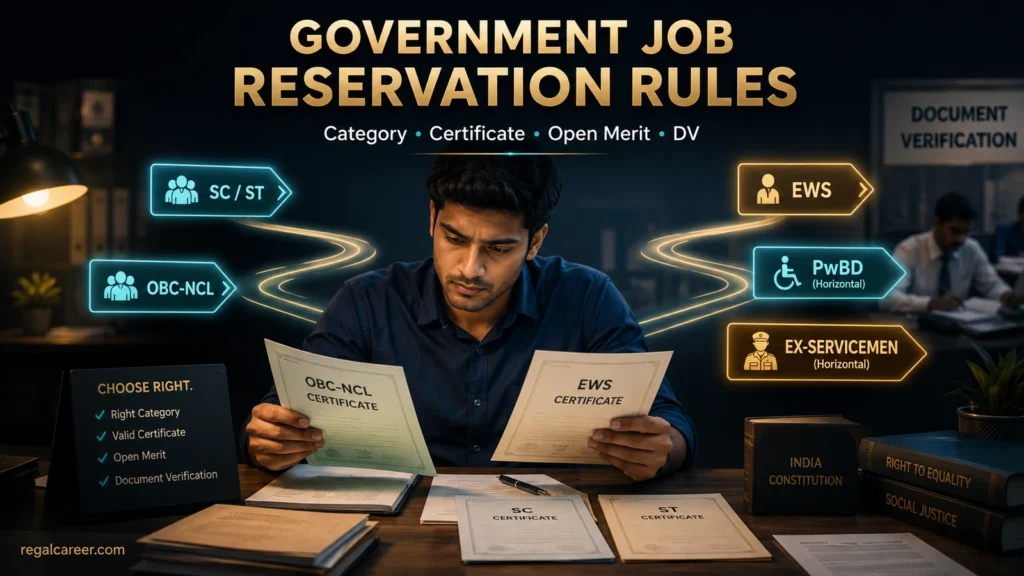
Choosing the wrong category in a government job application can create a problem months later, even after you clear the examination. The confusion usually starts because candidates treat reservation as a single percentage table. In reality, government job reservation rules involve several separate questions: whether the recruitment is Central or State, whether your community is recognized for that recruitment, whether your category is vertical or horizontal, whether you satisfy certificate conditions on the crucial date, whether you used a relaxation, and how the recruiting authority adjusts candidates against the roster.
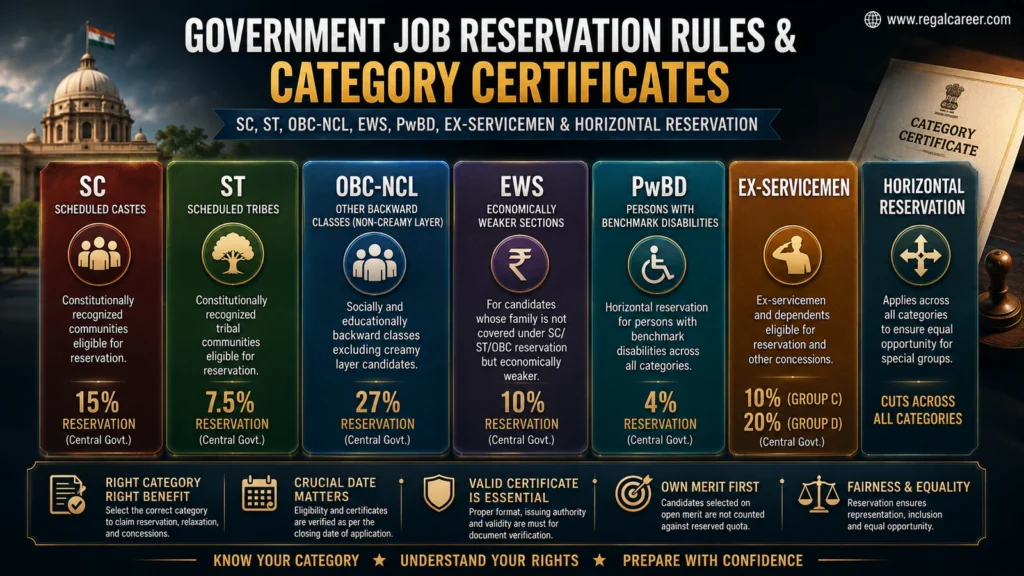
For Central Government recruitment, the Department of Personnel and Training (DoPT) provides the main reservation framework for civil posts and services. For all-India direct recruitment by open competition, the current consolidated instructions provide 15% reservation for Scheduled Castes, 7.5% for Scheduled Tribes and 27% for Other Backward Classes. Economically Weaker Sections receive 10% reservation in direct recruitment in Central civil posts and services if they are not covered by the SC/ST/OBC reservation scheme. Persons with Benchmark Disabilities are covered by a separate 4% horizontal reservation framework in direct recruitment. But those figures are not a universal table for every government vacancy in India.
State governments, locality-based recruitment, special services, identified disability-suitable posts, ex-servicemen rules and recruitment-specific reservations can operate differently. Even within the Central framework, the actual number of category-wise vacancies in one notification can be affected by the post-based roster, cadre strength, backlog, carry-forward rules and the vacancies that happened to arise.
QUICK ANSWER
For a government job, do not select a category only because you have a caste, disability, income or service certificate. First identify whether the job is Central or State and which reservation rules the notification applies. Then verify that your SC/ST/OBC community is recognized for the relevant State/Central list, that an OBC claim also satisfies non-creamy-layer rules, that an EWS claim satisfies both income and asset tests, and that any PwBD or ex-servicemen claim applies to the post. Finally check the certificate format, issuing authority and crucial date. UR/Open vacancies are open to eligible candidates of every category; they are not reserved only for candidates who do not claim a reserved category.
KEY TAKEAWAYS
- Central Government and State Government reservation systems must not be mixed.
- For all-India Central direct recruitment by open competition, DoPT currently provides 15% SC, 7.5% ST and 27% OBC reservation; Central EWS reservation is 10%.
- PwBD reservation is horizontal and is currently 4% in Central direct recruitment, subject to the applicable disability/post framework.
- OBC reservation for a Central job normally requires the community to be in the Central List and the candidate to satisfy non-creamy-layer rules.
- OBC-NCL is not correctly decided by one “family income below ₹8 lakh” shortcut; creamy-layer rules contain multiple status and income/wealth tests.
- EWS requires both the income condition and the asset tests; satisfying only the income limit is not enough.
- A State-list OBC community that is not in the Central OBC List may be able to claim Central EWS if all EWS conditions are met.
- UR/Open is an open-merit category, not a quota reserved for “General caste” candidates.
- Reservation, age relaxation, examination attempts, fee concession and qualifying-mark relaxation are separate benefits.
- Category certificates can be verified even after selection, and a false claim can lead to termination of appointment.
1. Start With the Most Important Question: Central Government Job or State Government Job?
Before checking any percentage, certificate or age relaxation, identify which Government’s reservation framework applies.
A Central Government recruitment conducted by SSC, UPSC, a Railway Recruitment Board or another Central authority normally follows Central reservation instructions together with the recruitment’s own rules.
A State Government recruitment follows the reservation law, roster, category definitions and certificate requirements applicable to that State.
This distinction matters because the same community can have different treatment in:
- a Central Government recruitment;
- the candidate’s home State;
- another State where the candidate now lives;
- a local or regional recruitment;
- a specific service with separate statutory rules.
Central reservation percentages are not a State reservation table
DoPT’s consolidated Central Government reservation instructions provide SC 15%, ST 7.5% and OBC 27% for civil posts and services filled by direct recruitment on an all-India basis by open competition.
The same consolidated instructions also contain different State/UT percentages for certain direct recruitment historically described as Group C/D posts that normally attract candidates from a locality or region. That alone demonstrates why copying “15 + 7.5 + 27” into every vacancy article is unsafe.
State recruitments can have additional or differently structured reservations, including State-specific OBC classes, women reservation, domicile-linked provisions or other horizontal categories.
IMPORTANT
Whenever a notification provides its own category-wise vacancy table and reservation clause, that notification is the candidate’s operational rulebook. Use a national reservation percentage only to understand the framework—not to overwrite the recruitment’s published vacancy distribution.
2. Reservation Is Not One System: Vertical and Horizontal Categories Work Differently
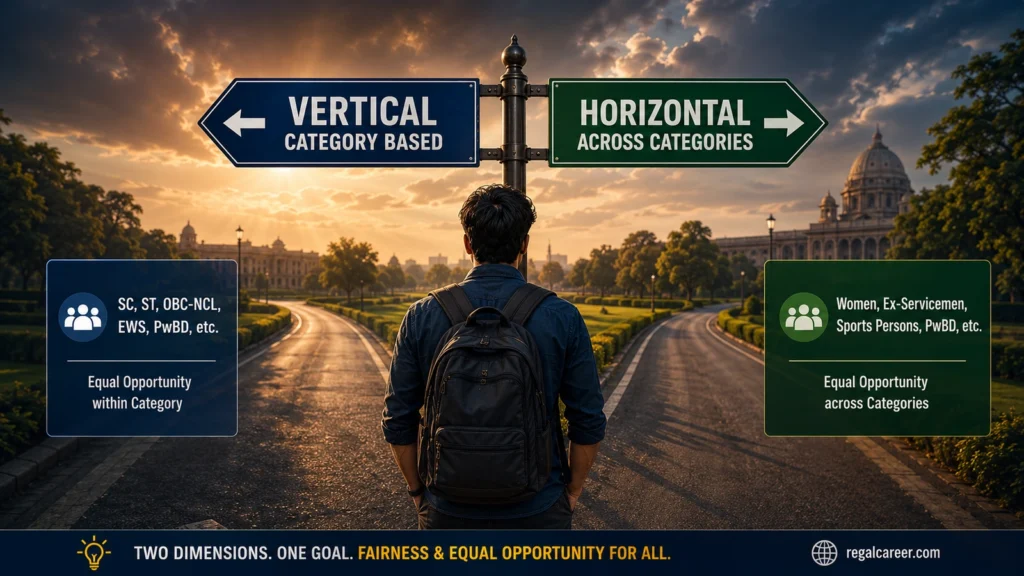
One of the most important concepts in reservation is the difference between vertical and horizontal reservation.
Vertical reservation
Vertical categories create separate reservation shares in the main vacancy structure.
In the Central direct-recruitment framework, the main vertical categories include:
- SC;
- ST;
- OBC;
- EWS;
- UR/Open points within the roster.
Horizontal reservation
Horizontal reservation cuts across the vertical categories.
PwBD and ex-servicemen are classic examples in Central recruitment. A candidate can therefore be:
- SC + PwBD;
- OBC-NCL + PwBD;
- EWS + PwBD;
- UR/Open + PwBD;
- SC + ex-serviceman;
- OBC-NCL + ex-serviceman.
Where a State recruitment provides horizontal reservation for women or another group, the same idea applies under that recruitment’s rules.
Why this matters in an application form
Your vertical category answers one question: which main reservation category do I belong to?
Your horizontal category answers another: do I also belong to a group for which a horizontal reservation or preference applies?
Those two claims can coexist.
WORKED EXAMPLE
Imagine an OBC-NCL candidate who also has a benchmark disability and applies for a Central post identified as suitable for the relevant disability. The candidate does not become “only PwBD.” If selected against a horizontally reserved PwBD vacancy adjusted within OBC, the appointment can simultaneously satisfy the OBC vertical position and the PwBD horizontal requirement. The exact adjustment follows the applicable roster and recruitment rules.
3. UR/Open Does Not Mean “Only General Category”
This is one of the most damaging misunderstandings in government recruitment.
UR usually means Unreserved. It is an open-merit space. It is not a reservation exclusively for people who do not belong to SC, ST, OBC, EWS, PwBD or another category.
DoPT’s Central instructions specifically address SC/ST/OBC candidates selected on their own merit. In direct recruitment, an SC/ST/OBC candidate selected on the same standard applied to general candidates—without specified relaxations such as age, experience, qualification, examination chances or an extended zone of consideration—is not adjusted against a reserved vacancy.
The candidate occupies an unreserved point.
The same Central instructions separately state that an EWS candidate cannot be denied the right to compete for an unreserved vacancy and, if selected on merit rather than because of EWS reservation, is not counted toward the EWS quota.
Why this protects the reserved quota
Suppose an OBC-NCL candidate scores high enough to be selected under the same standard as the open-merit candidates and did not depend on the relaxations covered by the own-merit rule.
If that candidate were automatically deducted from the OBC reserved vacancies merely because the application said “OBC,” one OBC reserved opportunity would disappear unnecessarily.
The own-merit principle prevents that.
CANDIDATE NOTE
Do not intentionally choose UR in the application merely because you expect to score above the UR cut-off. If you are legitimately entitled to a reserved category, claim it accurately in accordance with the notification. The recruiting authority, not the candidate, makes the final roster adjustment based on the applicable rules.
4. Reservation and Relaxation Are Different Benefits
Candidates often use the words reservation and relaxation interchangeably, but they are not the same.
A recruitment can provide one or more of the following:
- reserved vacancies;
- upper-age relaxation;
- relaxation in number of attempts;
- examination-fee exemption or reduction;
- relaxed qualifying standards;
- experience relaxation;
- physical-standard relaxation;
- examination accommodation;
- horizontal reservation.
A candidate may receive some of these and not others.
EWS proves why the distinction matters
Central EWS provides a 10% reservation framework in direct recruitment, but DoPT’s EWS FAQ states that EWS candidates do not receive age relaxation or additional examination attempts merely because they are EWS; the General-category conditions on age and attempts apply.
So “reserved category” does not automatically mean “age-relaxed category.”
For age questions, use the separate government job age limit and age relaxation guide and the exact notification.
PwBD accommodation is also separate from PwBD reservation
A candidate’s right to a scribe, compensatory time or another examination accommodation is a different question from whether the candidate qualifies for PwBD reservation.
The Department of Empowerment of Persons with Disabilities (DEPwD) maintains separate written-examination guidelines for persons with disabilities and separate rules/resources on reservation and identified posts.
IMPORTANT
Never infer one benefit from another. A fee exemption does not prove reservation eligibility; a scribe facility does not automatically prove PwBD reservation eligibility; and an age relaxation does not by itself determine whether a candidate will be adjusted against a reserved vacancy.
5. Scheduled Caste (SC) Reservation: What Candidates Must Verify
For a Central Government recruitment, a candidate claiming SC reservation should verify that the community is recognized as a Scheduled Caste in the relevant constitutional framework and in relation to the appropriate State/UT.
The Department of Social Justice and Empowerment maintains the State/UT-wise official Scheduled Caste lists.
SC status is State-linked
DoPT’s caste-certificate instructions say the certificate authority should verify that:
- the candidate and parents actually belong to the claimed community;
- the community appears in the applicable Presidential Order;
- the candidate belongs to the State and area in relation to which the community is scheduled.
That becomes especially important when a family has migrated.
Migration does not automatically create SC status in the new State
DoPT’s migration instructions say that where a person migrates from one State to another, the person can claim SC/ST/OBC status in relation to the State of origin, not simply because the same or a similar community name exists in the migrated State.
This distinction can become decisive in State recruitment.
Central job vs new State job
A candidate who has moved from State A to State B should therefore not assume that a caste certificate issued or recognized in State A automatically creates the same reservation entitlement for every State B recruitment.
Read the State B notification and the applicable State law.
6. Scheduled Tribe (ST) Reservation: State/Area Recognition Still Matters
Scheduled Tribe status is also linked to constitutional scheduling in relation to States/UTs.
The Ministry of Tribal Affairs provides a State-wise list of Scheduled Tribes in India and notifications concerning scheduling/de-scheduling.
For Central all-India direct recruitment by open competition, the current DoPT framework provides 7.5% ST reservation.
But again, the candidate’s first task is not to memorize 7.5%. It is to establish that the community claim is valid for the relevant recruitment and is supported by a certificate from the prescribed authority.
Migration rule
DoPT’s consolidated caste-certificate instructions apply the same State-of-origin principle to ST migration: moving to another State does not automatically convert the candidate into an ST of the destination State.
WARNING
Do not rely on the spelling of a tribe/caste name in an old family document alone. Government lists can include area restrictions, synonyms or State-specific entries. Match the official list and the certificate exactly.
7. OBC Reservation for Central Jobs Requires More Than an OBC Certificate
OBC creates more confusion than almost any other category because candidates often hold a State OBC certificate and assume it is sufficient for every Central Government job.
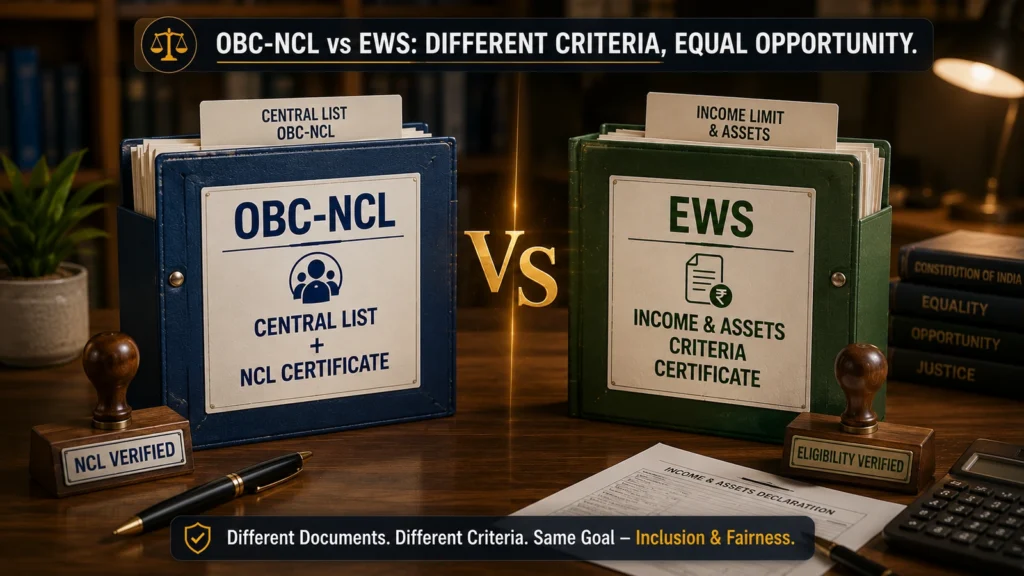
For Central reservation, two major conditions must be checked:
- the community must be recognized in the Central List of OBCs for the relevant State/UT; and
- the candidate must satisfy non-creamy-layer (NCL) requirements on the applicable crucial date.
The National Commission for Backward Classes maintains the official Central List of OBCs.
State OBC list vs Central OBC list
A community can be:
- OBC in a State list and also OBC in the Central List;
- OBC in a State list but not in the Central List;
- listed under a different entry/area description in the Central List.
For a Central Government OBC reservation claim, the State certificate alone is not the final test. The candidate must satisfy the Central-list requirement used by the recruitment.
PRO TIP
Search the NCBC Central List using the exact State/UT of origin and exact community wording. Do not rely on a coaching-site table or a certificate agent saying “your caste is OBC everywhere.”
8. OBC-NCL: Why the “Below ₹8 Lakh = Non-Creamy Layer” Shortcut Is Wrong
Many websites, social posts and even informal certificate advice reduce OBC-NCL to one question:
> “Is your family income below ₹8 lakh?”
That is not an accurate statement of the full Central creamy-layer framework.
DoPT’s consolidated instructions contain multiple creamy-layer categories based on the status of parents, including constitutional posts, Government service categories, armed-forces or comparable positions, property/wealth-related categories and the separate income/wealth test.
The ₹8 lakh test is one part of the framework
Under the income/wealth test in the DoPT consolidation, children of persons having gross annual income of ₹8 lakh or above—or the specified wealth condition—for three consecutive years fall within that income/wealth test, subject to the detailed rule.
Importantly, the same DoPT text says income from salaries or agricultural land shall not be clubbed for that particular creamy-layer income/wealth test.
That is why a simple calculator using “father salary + mother salary + agriculture income” and comparing the result to ₹8 lakh can produce a legally wrong answer.
Parent’s Government post can matter independently of income
The creamy-layer schedule contains status-based rules for parents in Group A/Class I and Group B/Class II services and other categories.
So a family may need to examine the parent’s service status rather than only annual income.
Do not self-certify creamy-layer status from a social-media formula
The practical candidate rule is:
- verify that the community is in the Central OBC List;
- obtain the prescribed OBC-NCL certificate from the competent authority;
- ensure that the non-creamy-layer status is valid on the recruitment’s crucial date;
- follow any certificate-issue-period requirement written in the notification.
IMPORTANT
An “OBC certificate” and an “OBC-NCL claim for Central Government reservation” are not automatically the same thing. DoPT describes the OBC certificate as containing both community status and non-creamy-layer status for reservation purposes.
9. What Is the Crucial Date for OBC-NCL?
Creamy-layer status can change over time.
DoPT’s Central instructions say that the appointing authority should verify both the community certificate and whether the candidate did not fall in the creamy layer on the crucial date.
For this purpose, the crucial date may be treated as the closing date for receipt of applications, except where another crucial date is fixed.
Certificate issue date vs status date
These are not always the same question.
A recruitment may say:
- the candidate must be NCL on the closing date;
- the certificate must be issued within a specified financial year or period;
- a declaration is also required;
- a newer certificate must be produced at DV.
Therefore, “my OBC certificate is five years old” cannot be answered without the notification.
A newer certificate cannot rewrite past eligibility
If a candidate was creamy layer on the actual crucial date but later becomes NCL, obtaining a later certificate does not automatically make the candidate retrospectively NCL for the earlier date.
The reverse concern also exists: a certificate may have been issued earlier, but the authority can still verify the candidate’s actual status on the crucial date.
10. Can an OBC Candidate From a State List Claim EWS in a Central Job?
Sometimes, yes—and this is one of the most misunderstood Central reservation questions.
DoPT’s EWS FAQ specifically addresses a person who belongs to OBC in a State list but not in the Central List.
For Government of India posts/services, such a person may apply for an Income & Asset Certificate and claim Central EWS if all other EWS conditions are satisfied, because the EWS exclusion refers to SC/ST/OBC coverage under the relevant Central reservation scheme.
That is very different from a person whose community is included in the Central OBC List.
An applicant who belongs to SC, ST or OBC included in the Central List is not eligible to claim Central EWS merely because the person has moved to a State where that category has a different local status.
WORKED EXAMPLE
Candidate A belongs to Community X, which is OBC in the State list but does not appear in the Central OBC List. For a Central Government recruitment, Candidate A may potentially claim EWS if the income, asset and all other EWS conditions are satisfied.
Candidate B belongs to Community Y, which appears in the Central OBC List. Candidate B cannot switch to Central EWS merely because an EWS certificate appears financially more advantageous.
11. Central EWS Reservation: The Income Limit Is Only Half the Test
Central EWS reservation is intended for persons not covered under the SC/ST/OBC reservation scheme who satisfy the prescribed income and asset conditions.
DoPT currently provides 10% reservation for EWS in direct recruitment to Central civil posts and services.
Income condition
The family’s gross annual income must be below ₹8 lakh for the financial year prior to the year of application.
For EWS, unlike the OBC creamy-layer income/wealth test discussed earlier, the DoPT EWS rule says income includes sources such as:
- salary;
- agriculture;
- business;
- profession;
- other income.
This difference is another reason candidates should never mix OBC-NCL and EWS calculations.
Asset exclusions
Even if family income is below ₹8 lakh, the family is excluded from Central EWS if it owns or possesses any of the specified assets at or above the threshold, including:
- 5 acres of agricultural land and above;
- residential flat of 1,000 sq ft and above;
- residential plot of 100 sq yards and above in a notified municipality;
- residential plot of 200 sq yards and above in areas other than notified municipalities.
Property held by the family in different locations is clubbed for the asset test.
Family definition
For this purpose, DoPT defines family to include:
- the candidate;
- parents;
- siblings below 18;
- spouse;
- children below 18.
The FAQ specifically clarifies that adult siblings/children aged 18 or above are not included in this family definition.
WARNING
“Family income below ₹8 lakh” alone does not prove EWS eligibility. A candidate can fail the EWS asset test even with very low annual income.
12. EWS Certificate: Financial Year, Validity Year and Closing Date
The Income & Asset Certificate is not merely an income certificate.
For Central employment, DoPT prescribes the Income & Asset Certificate framework and states that the crucial date for submitting it may be treated as the closing date for the application, unless another date is fixed.
The certificate is linked to the income of the financial year prior to the year of application.
DoPT’s FAQ gives an example: if the closing date falls in 2022-23, the certificate would use the prior financial year’s income and be valid for the relevant certificate year.
Why “EWS certificate is valid for one year” is an incomplete answer
Candidates often ask whether an EWS certificate is “valid for one year.”
The better question is:
- which financial year’s income must be assessed?
- for which year is the certificate valid?
- what does the recruitment notification require by the closing date?
- does the certificate follow the prescribed format?
A certificate can be recent and still be wrong for the recruitment if it assesses the wrong financial year.
Issuing authority
In March 2024, DoPT delegated to States/UTs the power to decide which authorities are competent to issue Income & Asset Certificates for Central EWS reservation.
However, the prescribed Central certificate format remains important.
CANDIDATE NOTE
Do not obtain an EWS certificate simply by asking for “current year EWS.” Show the issuing authority the recruitment closing date and confirm which financial-year income must be assessed.
13. PwBD Reservation: 4% Does Not Mean Every Disability Fits Every Post
For Central direct recruitment, DoPT provides 4% reservation of vacancies for Persons with Benchmark Disabilities across Groups A, B and C, under the Rights of Persons with Disabilities framework.
The four percentage points are distributed across the disability groups specified in the Central instructions.
But a candidate should not stop at “I have 40% disability, therefore every government post has a PwBD vacancy for me.”
Post identification matters
DEPwD maintains the official identification-of-posts resources for PwBD, including identified-post lists and 2024 guidelines.
The nature of the post and the disability category can therefore matter.
Certain establishments/cadres can also be exempted under the statutory process.
Benchmark disability and exam accommodation are different questions
A person may be eligible for a scribe or other examination accommodation under separate disability examination guidelines without necessarily being entitled to reservation against a PwBD vacancy.
Likewise, a PwBD reservation claim does not automatically answer every question about scribe, compensatory time or examination format.
DEPwD also issued a December 2025 clarification on eligibility of PwBD candidates for reservation in recruitment, so candidates should check current departmental guidance for borderline or post-identification issues.
PwBD can compete on unreserved vacancies
DoPT’s instructions state that for posts identified as suitable, a PwBD candidate cannot be denied the right to compete for an unreserved vacancy.
That again reinforces that horizontal reservation is not a separate closed universe.
14. Ex-Servicemen Reservation: Treat It as a Separate Horizontal Framework
Ex-servicemen reservation and concessions are governed through the Ex-Servicemen (Re-employment in Central Civil Services and Posts) framework and subsequent instructions.
The Department of Ex-Servicemen Welfare published an updated Compendium of Guidelines on Reservation for Ex-Servicemen, updated on its site in February 2026.
Why one “ESM percentage” table is risky
The applicable reservation can depend on:
- group/category of post;
- recruiting organization;
- whether the recruitment is Central Government, PSU, bank or another sector;
- specific ESM rules of the notification;
- whether the candidate has already obtained civil employment using ESM benefits;
- the exact definition of ex-serviceman applicable under the rules.
Therefore, candidates should not assume that an ESM percentage copied from another recruitment applies universally.
ESM is usually horizontal
A candidate may be SC-ESM, OBC-ESM, EWS-ESM or UR-ESM. The ESM claim interacts with the vertical category.
Age relaxation and reservation are separate
A recruitment may provide age deduction/relaxation for ex-servicemen under the applicable rules even where the vacancy adjustment requires separate analysis.
IMPORTANT
If you are serving, recently discharged, retired, medically released or already re-employed in a civil post, read the exact ESM definition and eligibility clause. “Former member of the Armed Forces” is not a sufficient self-test for every recruitment.
15. Women Reservation and Other Horizontal Categories: Do Not Invent a National Percentage
Many State recruitments provide horizontal reservation or preference for women, and some recruitment systems contain additional categories created by State law or service rules.
But there is no single women-reservation percentage that can safely be applied to every government job in India.
The correct approach is:
- read the notification’s reservation clause;
- identify whether the benefit is vertical or horizontal;
- check domicile/residency rules if the State law requires them;
- check how the category is adjusted within SC/ST/OBC/EWS/UR;
- verify whether the benefit is reservation, preference, relaxation or a combination.
The same caution applies to other special categories notified by States or specific services.
16. Why Category-Wise Vacancies Rarely Equal the Percentage on Your Calculator
Candidates often multiply the advertised vacancies by 15%, 7.5%, 27% or 10% and then accuse the notification of being wrong when the category table does not match.
That is not how post-based reservation necessarily works.
DoPT’s Central instructions explain that reservation rosters are used to determine category entitlement across the cadre/recruitment system.
Factors can include:
- cadre strength;
- post-based roster points;
- direct recruitment vs promotion roster;
- previous representation;
- backlog reserved vacancies;
- carry-forward rules;
- small-cadre roster patterns;
- vacancies arising in that recruitment year.
A roster is not a fresh percentage calculation for every advertisement
If only seven vacancies arise, you cannot reliably calculate each category by multiplying seven by the national quota percentages.
The roster points attached to those vacancies determine which categories appear.
Backlog is another reason
SC/ST/OBC backlog can alter the category distribution in a recruitment.
EWS is different: DoPT’s current Central instructions state that an EWS vacancy unfilled due to non-availability of a suitable EWS candidate is not carried forward as backlog to the next recruitment year under the EWS scheme.
PRO TIP
When evaluating a vacancy table, ask “Which roster points/vacancies are being filled?” rather than “Why is exactly 27% of this one advertisement not OBC?”
17. Category Certificate Format Matters
A certificate must establish the claim that the recruitment actually needs.
Typical category documents include:
- SC certificate;
- ST certificate;
- OBC certificate showing Central-list community and NCL status where required;
- EWS Income & Asset Certificate;
- PwBD disability certificate/UDID-related documentation where required;
- ex-servicemen discharge/service certificate and prescribed declarations;
- State-specific horizontal reservation certificates.
“Issued by Government” is not enough
The notification can prescribe:
- competent issuing authority;
- certificate format;
- language;
- issue period;
- validity period/year;
- crucial date;
- additional declaration;
- document to be produced at DV.
A certificate issued by the wrong authority or in the wrong category format may fail even if the candidate’s underlying background is genuine.
Scheduled-language certificates
DoPT has also informed States/UTs that SC/ST/OBC caste/community certificates may be issued in scheduled languages in the prescribed framework, with efforts toward digital availability for verification.
The practical rule remains: follow the recruiting authority’s document instructions.
18. Certificate Date, Certificate Validity and Eligibility Date Are Three Different Things
This distinction can prevent many DV failures.
Certificate date
The day the authority issued the document.
Validity period/year
The period for which the certificate or its financial/status assessment is treated as valid under the relevant rules.
Eligibility/crucial date
The date on which the candidate must actually satisfy the category condition for that recruitment.
These can be different.
For OBC-NCL, DoPT’s Central instructions focus on NCL status on the crucial date, normally the closing date unless another date is fixed.
For EWS, the Income & Asset Certificate is linked to the prior financial year’s income and the prescribed certificate year, while the recruitment can specify what must be available by the closing date.
WARNING
A certificate obtained after the closing date does not automatically cure the absence of eligibility on the closing date. Conversely, an older certificate is not automatically invalid merely because of age if the applicable rules treat the underlying status differently. Read the notification.
19. Can You Change Category After Submitting the Application?
There is no universal “yes” or “no” for every recruitment platform.
Some recruitments provide a correction or modification window and allow certain fields to be changed. Others restrict category changes after the closing date or after a particular stage.
The safest rule is:
> Treat the category submitted at the closing date as potentially binding unless the official correction rules expressly allow a change.
Why a late category switch is risky
A category change can affect:
- application fee;
- age eligibility;
- number of attempts;
- qualifying marks;
- cut-off;
- vacancy allocation;
- certificate requirements;
- post preference;
- final roster adjustment.
Allowing unrestricted category changes after results would therefore alter the competitive conditions.
Before submitting, use the government job online application guide and verify the category field twice.
20. Migration Between States: The Certificate Problem Candidates Discover Too Late
Migration creates three different questions:
- What is your category in your State of origin?
- What is your category in the State where you now live?
- What does the Central Government recognize for a Central recruitment?
DoPT’s caste-certificate instructions say that when a person migrates from one State to another, SC/ST/OBC status is claimed in relation to the State of origin, not automatically in relation to the destination State.
For an OBC migrant, the prescribed authority in the destination State/UT may in certain circumstances issue an OBC certificate based on a genuine certificate issued to the father by the State of origin, subject to the detailed verification rule.
Residence is not the same as category origin
Changing your Aadhaar address, voter registration or domicile does not itself rewrite the constitutional/community-list basis of SC/ST/OBC status.
State job implications can be different
A State Government may restrict its reserved-category benefits according to that State’s laws and certificate/domicile rules.
Do not assume that a certificate valid for Central employment automatically grants State reservation after migration.
21. What Happens if Your Category Certificate Fails at Document Verification?
Possible outcomes depend on the recruitment rules and the nature of the defect.
A problem may involve:
- wrong category;
- community not in the required list;
- creamy-layer status;
- wrong financial year for EWS;
- asset-test failure;
- wrong certificate authority;
- missing prescribed wording;
- certificate not valid on crucial date;
- inability to prove State/area origin;
- fraudulent/false certificate.
Can the candidate simply become UR?
Sometimes recruitment rules allow a reserved-category candidate to be considered as UR if the person independently satisfies all UR conditions and the rules permit that treatment.
But this cannot be assumed.
If the candidate relied on:
- age relaxation;
- extra attempts;
- relaxed standards;
- reserved-only vacancy;
- category-specific qualification;
- another concession unavailable to UR,
the candidate may not remain eligible as UR.
False claim is much more serious than a document defect
DoPT’s Central instructions state that appointments obtained through a false caste/category claim can result in termination/removal.
The EWS framework similarly provides for verification of the Income & Asset Certificate and termination where the claim is false.
IMPORTANT
Never treat document verification as a chance to “explain” a category that was knowingly selected without entitlement. If you are uncertain before applying, resolve the category status with the competent issuing authority and notification before using the benefit.
22. Can SC/ST/OBC Candidates Be Provisionally Appointed Without the Final Certificate?
DoPT’s Central instructions contain a provision under which an SC/ST/OBC candidate who cannot produce a certificate from a prescribed authority may, in certain circumstances, be provisionally appointed based on prima-facie proof, subject to later production/verification.
This is a Government appointment-verification rule—not permission for candidates to ignore a recruitment’s document deadline.
A recruiting authority may require the certificate:
- at application;
- before examination;
- at DV;
- before recommendation;
- before appointment.
CANDIDATE NOTE
Do not plan around provisional appointment. Treat the certificate deadline in your recruitment as mandatory unless the appointing authority itself applies the relevant provisional-verification rule.
23. How Reservation Affects Cut-Offs Without Creating “Separate Exams”
Reserved categories often have different cut-offs because:
- separate reserved vacancies exist;
- the number of candidates competing in each category differs;
- qualifying standards may differ where the rules permit;
- own-merit candidates can be adjusted against UR;
- horizontal reservation may require further adjustment.
But candidates generally appear in the same examination unless the recruitment provides otherwise.
Category cut-off does not prove category entitlement
A candidate cannot choose OBC simply because the OBC cut-off is lower.
The right to compete against an OBC vacancy comes from valid OBC-NCL eligibility, not from the score.
Open-merit cut-off can matter to reserved candidates
A reserved-category candidate can still be selected in open merit under the applicable own-merit rules.
That is why you should track both:
- your claimed-category cut-off;
- the UR/open-merit cut-off;
- whether you used a relevant relaxation.
For the full exam-to-merit flow, see the government job selection process guide.
24. Which Category Should I Select? Use This Decision Workflow
PROCESS
01
Identify the recruiting Government
Central Government, State Government, local body, PSU, bank or another authority?
02
Read the reservation clause
Use the notification, not a generic national table.
03
Identify your vertical category
SC, ST, OBC-NCL, EWS or UR/Open under that recruitment.
04
Verify the official list
For Central OBC use the NCBC Central List; for SC/ST use the applicable official State/UT constitutional lists.
05
Check status rules
OBC-NCL creamy-layer criteria; EWS income plus asset criteria.
06
Add horizontal category if applicable
PwBD, ex-servicemen, women or another notified horizontal category.
07
Check post suitability
Especially for PwBD and service-specific physical/medical posts.
08
Check certificate authority and format
Do not assume a State certificate is valid for Central reservation.
09
Check crucial date
Closing date or another date specifically fixed by the recruitment.
10
Check relaxations used
Age, attempts, standards, fees and reservation are separate.
11
Verify correction rules
Do not assume category can be changed later.
12
Prepare DV documents now
Do not wait for the result to discover a certificate problem.

25. Reservation Certificate Checklist Before You Submit the Form
CHECKLIST
- I know whether this is a Central or State recruitment.
- I read the notification’s category-wise vacancy table.
- My SC/ST community is recognized for the relevant State/area.
- For Central OBC, my community appears in the NCBC Central List.
- My OBC-NCL status satisfies the applicable creamy-layer rules.
- I did not decide OBC-NCL from an ₹8 lakh family-salary shortcut alone.
- For EWS, I checked both gross family income and every asset threshold.
- My EWS certificate uses the correct prior financial year.
- I checked the certificate’s validity year.
- My PwBD category is eligible under the applicable post/disability framework.
- I checked the current disability certificate/UDID requirements.
- My ex-servicemen status satisfies the recruitment’s ESM definition.
- I separately checked age relaxation, attempts and fee concession.
- My certificate is issued by a competent authority.
- My certificate follows the prescribed format.
- I know the recruitment’s crucial date.
- My application category matches my documents.
- I reviewed the modification/correction rules.
- I saved the official notification and corrigenda.
- I prepared originals and required copies for DV.
26. Common Reservation Mistakes That Can Cost a Government Job
Mistake 1: Selecting OBC because you have a State OBC certificate
For a Central OBC claim, check the Central List and NCL conditions.
Mistake 2: Treating OBC-NCL as “family income below ₹8 lakh”
Central creamy-layer criteria are broader and include status-based categories; the income/wealth test also has special rules.
Mistake 3: Claiming EWS because income is below ₹8 lakh
The asset tests can independently disqualify the family.
Mistake 4: Assuming EWS gets age relaxation
Central EWS does not automatically provide age/attempt relaxation.
Mistake 5: Thinking UR is only for General-category candidates
UR/Open is open merit.
Mistake 6: Adding PwBD “4%” on top of every vacancy table
PwBD is horizontal and operates through a separate roster/post-suitability framework.
Mistake 7: Using a certificate from the wrong financial year
Especially dangerous for EWS.
Mistake 8: Assuming a destination-State certificate creates destination-State reservation after migration
SC/ST/OBC status is linked to the relevant State/area/list rules.
Mistake 9: Waiting until DV to obtain the certificate
The crucial date may already have passed.
Mistake 10: Assuming the authority must convert you to UR if the certificate fails
That depends on whether you independently meet UR conditions and whether the recruitment rules permit such treatment.
27. Central Government Reservation Snapshot — Use as a Framework, Not a Universal Vacancy Calculator
| Category | Central direct-recruitment framework | Type | Key candidate condition |
|---|---|---|---|
| SC | 15% in all-India open competition | Vertical | Valid SC status/certificate in applicable constitutional framework |
| ST | 7.5% in all-India open competition | Vertical | Valid ST status/certificate in applicable constitutional framework |
| OBC | 27% in all-India open competition | Vertical | Central List + Non-Creamy Layer |
| EWS | 10% in Central civil direct recruitment | Vertical | Not covered by SC/ST/OBC scheme + income & asset tests |
| PwBD | 4% in Central direct recruitment | Horizontal | Benchmark disability + applicable post/disability framework |
| Ex-servicemen | Recruitment/rule specific | Horizontal | Must satisfy ESM re-employment rules and notification |
IMPORTANT
This table summarizes the Central framework. It is not a substitute for the reservation table in a State recruitment, locality-based recruitment, PSU/bank rulebook, special service or individual notification.
28. Related Guides and Tools
Frequently Asked Questions
FAQ
What are the reservation percentages for Central Government jobs?
For all-India direct recruitment by open competition, DoPT currently provides 15% SC, 7.5% ST and 27% OBC reservation. EWS receives 10% reservation in direct recruitment to Central civil posts/services. PwBD has a separate 4% horizontal reservation framework. The actual vacancy table in one notification can differ because of the roster, cadre, backlog and recruitment-specific rules.
Is UR the same as General category?
UR means unreserved/open merit. Candidates belonging to reserved communities can compete for UR vacancies. Under the Central own-merit rules, SC/ST/OBC candidates selected on the same standard without specified relaxations are not adjusted against reserved vacancies.
Can an OBC candidate be selected in UR?
Yes. In Central direct recruitment, an eligible OBC candidate selected on the same standard as open candidates without the specified relaxations can be adjusted against an unreserved point rather than the OBC quota.
Is a State OBC certificate valid for Central Government jobs?
Not automatically. For Central OBC reservation, the community must be recognized in the Central List for the relevant State/UT and the candidate must satisfy non-creamy-layer requirements. Follow the notification’s certificate format and date rules.
Is OBC-NCL decided only by ₹8 lakh family income?
No. The Central creamy-layer schedule contains multiple status-based categories and an income/wealth test. DoPT also states that salary and agricultural income are not clubbed in the specified creamy-layer income/wealth test. Do not use a one-line income shortcut.
What is the crucial date for OBC-NCL?
DoPT states that the closing date for receipt of applications may be treated as the crucial date unless another date is specifically fixed. The recruiting notification may also prescribe when the certificate must be issued or produced.
Can an OBC candidate claim EWS?
A person covered by the Central OBC reservation scheme cannot simply switch to Central EWS. However, DoPT’s EWS FAQ says a person who is OBC only in a State list but not in the Central OBC List may potentially claim Central EWS if all other EWS conditions are satisfied.
What is the income limit for Central EWS?
The family’s gross annual income must be below ₹8 lakh for the financial year before the year of application, and the family must also satisfy the asset tests.
What assets disqualify a person from Central EWS?
The Central framework excludes families with 5 acres or more agricultural land, a residential flat of 1,000 sq ft or more, a residential plot of 100 sq yards or more in notified municipalities, or 200 sq yards or more in other areas. Property in different locations is clubbed.
Do EWS candidates get age relaxation?
Not merely because they are EWS. DoPT’s EWS FAQ says General-category conditions on age and number of attempts apply to EWS candidates.
What does horizontal reservation mean?
A horizontal category cuts across vertical categories. For example, a PwBD candidate may also be SC, ST, OBC, EWS or UR/Open. The horizontal vacancy is adjusted within the appropriate vertical category according to the applicable rules.
Is PwBD reservation available in every government post?
No. Central direct recruitment provides 4% PwBD reservation overall, but identified-post suitability, disability categories and exemptions can matter. Check the notification and current DEPwD identified-post guidance.
Does having a scribe make me eligible for PwBD reservation?
Not necessarily. Examination accommodation and reservation are separate questions. DEPwD maintains separate written-examination guidelines and reservation/post-identification rules.
How much reservation do ex-servicemen get?
There is no safe one-percentage answer for every government recruitment. Ex-servicemen reservation operates through the applicable re-employment rules and varies by post/organization. Use the current DESW compendium and the notification.
Can I change my category after submitting a government job form?
Only if the recruiting authority’s correction rules allow it. Some systems provide modification windows, while others restrict category changes after the closing date. Treat the submitted category as potentially binding.
Can I become UR if my OBC/EWS certificate is rejected at DV?
Do not assume so. It depends on the recruitment rules and whether you independently satisfy every UR condition without the benefit of age, attempts, relaxed standards or a reserved-only vacancy.
Can I use an old OBC-NCL certificate?
The certificate’s age alone does not answer the question. Check NCL status on the crucial date and the notification’s certificate issue-period/format requirements.
Is EWS certificate valid for one year?
The better approach is to match the certificate to the correct financial-year income, validity year and recruitment closing date. DoPT links EWS eligibility to the prior financial year and prescribed certificate year; the recruitment may impose additional timing requirements.
What happens if a category certificate is fake?
A false reservation claim can lead to candidature cancellation and, if appointment has already occurred, termination/removal under the applicable Central instructions, in addition to further legal action.
Does migration to another State change my SC/ST/OBC category?
Not automatically. DoPT’s migration instructions say SC/ST/OBC status is claimed in relation to the State of origin rather than automatically in the destination State. State recruitment benefits must be checked under that State’s rules.
OFFICIAL SOURCE
Use these Government sources to verify current rules before relying on any category claim:
- DoPT — Consolidated instructions on SC/ST/OBC, EWS and PwBD reservation in Central Government posts
- NCBC — Central List of Other Backward Classes
- Department of Social Justice — State/UT-wise Scheduled Caste lists
- Ministry of Tribal Affairs — State-wise Scheduled Tribe resources
- DEPwD — Identification of posts for Persons with Benchmark Disabilities
- DEPwD — PwD written-examination and scribe guidelines
- DEPwD — December 2025 PwBD recruitment-eligibility clarification
- Department of Ex-Servicemen Welfare — 2026 Compendium on reservation for Ex-Servicemen
FINAL TAKEAWAY
The safest way to use reservation in a government job is to treat it as an eligibility-and-document decision, not a percentage shortcut. First identify whether the recruitment is Central or State. Then establish the correct vertical category, add any horizontal category, verify the official community list, apply OBC-NCL or EWS rules correctly, check the certificate authority and crucial date, and separately verify age/fee/attempt relaxations. UR remains open merit for eligible candidates of every community. The category written in your application must be defensible at document verification and, if necessary, during post-appointment verification. When the notification and a generic reservation guide differ, follow the official notification and the governing Government rules.
