
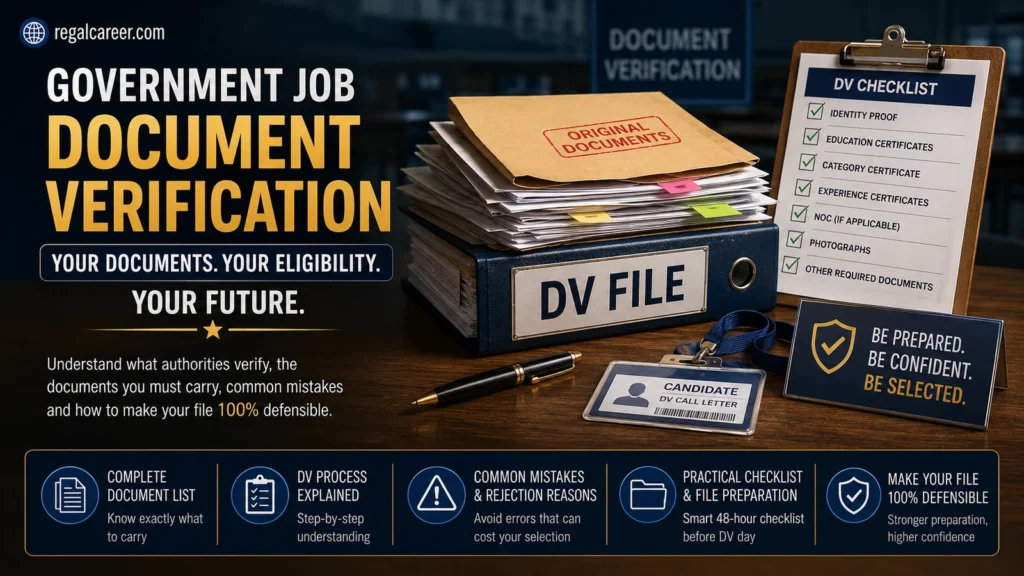
You have cleared the examination or reached the shortlist. Then the document-verification notice arrives—and suddenly the question is no longer “What did I score?” It is “Can I prove every important claim I made in my application?”
That is the real purpose of government job document verification (DV).
A DV call is a major step, but it is not a guarantee of appointment. The recruiting authority can still verify your date of birth, educational qualification, category, non-creamy-layer or EWS status, disability claim, ex-servicemen status, experience, professional registration, identity, name details, NOC and any other condition attached to the post. If the documents do not prove that you were eligible under the notification, a high score may not protect the candidature.
The good news is that not every document problem is equally serious. A missing photocopy is not the same as never having possessed the required qualification by the cut-off date. A spelling mismatch is not the same as a false identity claim. An old certificate may be a format/timing problem, while being in the wrong reservation category can be an eligibility problem.
This guide is designed to help you identify that difference before you reach the DV desk.
QUICK ANSWER
For government job document verification, carry exactly what the DV call letter and recruitment notification require—usually original identity/DOB proof, educational certificates and marksheets, category/reservation certificates where claimed, experience/NOC/registration documents where applicable, application/call-letter records, photographs and the prescribed copies. More importantly, verify that every document proves your eligibility on the recruitment’s crucial date. A genuine document can still fail if it proves the wrong qualification, wrong category, wrong period, wrong certificate format or a status acquired only after the eligibility cut-off.
KEY TAKEAWAYS
- DV verifies the claims in your application; it is not merely a photocopy-checking exercise.
- Being called for DV does not itself create a right to appointment.
- Separate eligibility defects, evidence defects and format defects before deciding what can be fixed.
- Carry the exact number/type of copies specified in the DV notice; there is no universal “2 or 3 photocopies” rule for every recruitment.
- Matriculation/10th certificate is frequently used to verify date of birth and name/parent-name details.
- Qualification must normally have been possessed by the notification’s crucial date; obtaining a degree later usually cannot create earlier eligibility.
- If you claim an equivalent qualification, some recruitments require the actual equivalence order/letter—not merely a statement that your degree is “equivalent.”
- OBC-NCL, EWS, PwBD, ex-servicemen and other category claims have their own certificate/date/format rules.
- An affidavit is not a universal cure for every name mismatch; formal name changes may require Gazette/legal evidence depending on the recruitment.
- If a category certificate fails, conversion to UR/Open is not automatic.
- DV can be followed by medical, background/police verification, allocation, appointment or additional verification.
1. What Government Job Document Verification Actually Checks
The simplest way to understand DV is:
> Application claim → official rule → documentary proof.
When you applied, you made claims such as:
- “I was born on this date.”
- “I possess this qualification.”
- “I belong to this category.”
- “I am non-creamy layer.”
- “I satisfy EWS conditions.”
- “I have this much experience.”
- “I am a serving Government employee.”
- “My name is this.”
- “I hold the required registration/licence.”
- “I qualify for this relaxation.”
During DV, the authority asks whether those claims can be proved under the exact recruitment rules.
SSC’s 2026 Selection Post Phase XIV notice, for example, says DV is conducted after CBT shortlisting and scrutiny and requires candidates to produce original matriculation and educational-qualification documents. It also specifically requires an order/letter showing the authority, number and date under which an equivalent qualification has been recognized when equivalence is claimed. See the SSC Selection Post Phase XIV/2026 notice.
RRB’s NTPC detailed notice goes even further: eligibility is checked as on the application closing date; originals are required at DV; candidates must also upload true-colour scans before DV; certificates should be in prescribed formats; and documents not in English/Hindi may require self-attested translations. See the RRB NTPC Graduate detailed notice.
CANDIDATE NOTE
Before arranging your file, print or save three documents: the original recruitment notification, every corrigendum/addendum, and your DV call letter. Your personal checklist should come from those documents—not from a generic internet checklist.
2. First Diagnose the Problem: Eligibility Defect, Evidence Defect or Format Defect?
This is the most useful distinction you can make before DV.
| Problem type | What it means | Typical seriousness |
|---|---|---|
| Eligibility defect | You did not satisfy the recruitment condition on the required date | Often fundamental |
| Evidence defect | You satisfied the condition but have not brought/provided the proper proof | May be curable only if rules/time allow |
| Format defect | Your evidence exists, but the notification requires a specific format, authority, translation, declaration or issue period | Depends on recruitment rules |
Example: qualification
Eligibility defect: The notification required a degree by 30 June. Your final result was declared on 15 July.
Evidence defect: Your result was declared before 30 June, but you forgot the final marksheet/degree proof at home.
Format/equivalence defect: You possess a different qualification that you believe is equivalent, but the recruitment requires an official equivalence order and you do not have it.
These are not the same case.
Example: category
Eligibility defect: You claimed Central OBC reservation but your community is not in the Central OBC List.
Evidence defect: You are genuinely eligible but have not brought the prescribed OBC-NCL certificate.
Format/date defect: You brought an OBC certificate, but the notice requires a specific NCL declaration or certificate period.
IMPORTANT
Do not spend your preparation time “fixing paperwork” until you know whether the underlying eligibility itself existed on the crucial date. Paperwork cannot normally manufacture past eligibility.
3. The Master DV Checklist: What Documents May Be Required?
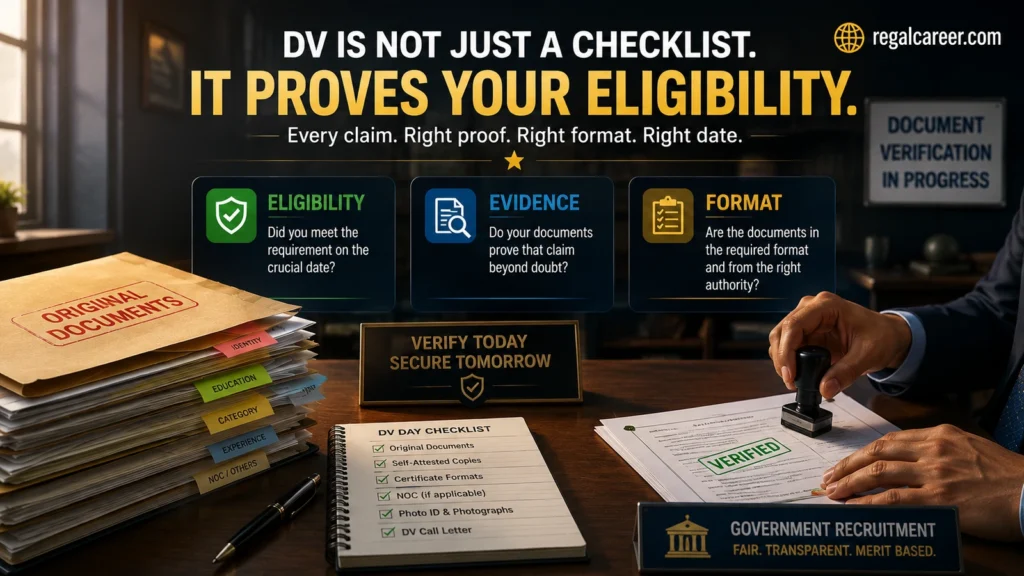
There is no single document pack that applies to every recruitment. But most DV notices draw from the same groups.
Identity and application records
Possible items include:
- DV call letter / e-call letter;
- application-form printout or registration slip;
- original photo ID;
- recent photographs;
- application number/registration number;
- signature/biometric verification material where required.
Date-of-birth documents
Frequently:
- Class 10 / matriculation / secondary certificate;
- equivalent DOB proof specifically accepted in the notification.
Educational qualification
Depending on the post:
- 10th certificate/marksheet;
- 12th certificate/marksheet;
- ITI/NTC/NAC;
- diploma;
- semester/year-wise marksheets;
- provisional degree certificate;
- final degree;
- postgraduate qualification;
- equivalence order/letter;
- professional registration;
- licence or other post-specific credential.
Reservation/category
Where claimed:
- SC/ST certificate;
- OBC-NCL certificate + declaration where required;
- EWS Income & Asset Certificate;
- PwBD certificate;
- ex-servicemen discharge/service documents;
- category-specific declarations.
Employment/experience
Where applicable:
- experience certificate;
- appointment/relieving documents where required;
- NOC from current employer;
- service certificate;
- salary/pay proof if specifically required.
Special identity/status documents
Possible examples:
- Gazette notification/legal name-change proof;
- marriage/name-change documents;
- divorce/judicial-separation decree if relevant to a claimed rule;
- translation of non-Hindi/non-English certificates;
- eligibility certificate for nationality-status cases;
- other notification-specific evidence.
RRB’s detailed NTPC notice is a good example of why the call letter matters: it lists originals ranging from matriculation and degree certificates to category certificates, NOC, ex-servicemen records, name-change legal documents and other case-specific evidence. Official RRB NTPC detailed notice.
WARNING
Do not add documents simply because another candidate carried them in a different recruitment. Use the notice to identify required, case-specific, and backup documents separately.
4. Originals, Self-Attested Copies and Scans: Follow the Exact Notice
“Carry originals and two photocopies” is common advice, but it is not a universal rule.
RRB’s NTPC notice expressly requires all original documents with two sets of self-attested photocopies at DV and also requires candidates to upload true-colour scans before the DV date.
ESIC’s March 2026 Stenographer DV notice likewise required originals plus two sets of attested/self-attested copies.
Another recruitment may ask for one set, three sets, attested copies, uploaded PDFs, or only selected documents.
What should you do?
Use this order:
- Follow the exact number/type of copies in the DV notice.
- Prepare scans in the required format if there is a pre-DV upload.
- If convenient, keep one backup set for yourself—but do not mistake your backup for an official requirement.
- Never submit an original permanently unless the authority specifically requires retention/acknowledgement.
5. Matriculation / Class 10 Certificate: The Document That Often Controls DOB and Name
Many candidates focus on the degree and ignore the Class 10 certificate.
That can be a serious mistake.
RRB’s NTPC notice says the matriculation/high-school certificate is used as proof of:
- date of birth;
- matriculation qualification;
- candidate’s name;
- father’s/mother’s name.
SSC’s Phase XIV notice also lists matriculation/secondary certificate among the original documents required at DV.
Check these fields now
Compare your application against Class 10:
- full name;
- spelling;
- initials;
- surname;
- father’s/mother’s name;
- date of birth;
- order of names.
If the application contains a mismatch, do not wait until DV morning to decide whether it is harmless.
CANDIDATE NOTE
Make a one-page “identity comparison sheet” for yourself: Application Form | Class 10 | Aadhaar/ID | Degree | Category Certificate. Highlight every spelling or date difference. Then check the notification/call letter for the acceptable resolution.
6. Educational Qualification: Degree Certificate Alone May Not Be Enough
Your educational proof must establish the exact qualification required by the post.
Depending on the recruitment, the authority may need to verify:
- institution/university;
- degree/diploma/trade;
- subject;
- branch;
- specialization;
- duration;
- marks/percentage/CGPA;
- date of passing;
- result declaration date;
- recognition;
- equivalence;
- professional registration.
Bring semester/year-wise marksheets when relevant
Even if the DV checklist simply says “educational qualification certificates,” semester-wise or year-wise marksheets can help prove:
- subjects studied;
- result date;
- marks/CGPA;
- completion of all requirements.
Some posts specifically demand particular subjects or study duration, so the final degree title alone may not prove everything.
For a deeper explanation of exact qualification and equivalence issues, see the government job qualification requirements guide.
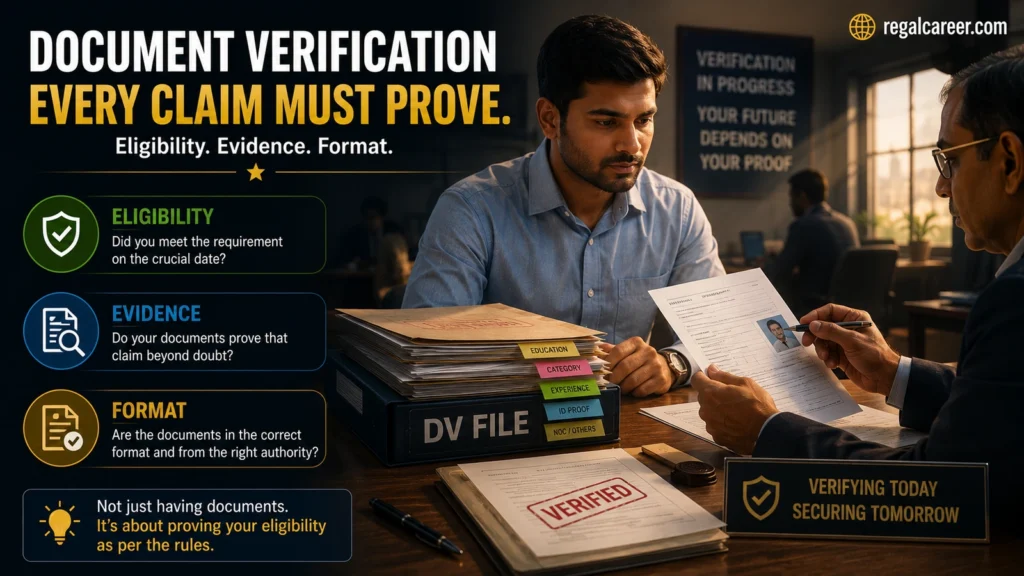
7. Provisional Degree Certificate: Is It Accepted at DV?
There is no universal rule saying “provisional degree is always accepted” or “only final degree is valid.”
The correct question is:
> Does the document prove that you had already acquired the required qualification by the recruitment’s crucial date, and does the recruiting authority accept that form of proof?
A provisional degree, final marksheet, result notification or university certificate can sometimes establish completion before the final convocation degree is issued.
But the recruitment may prescribe a specific document.
Check three things
- What date did the university officially declare your result?
- What document proves successful completion?
- What does the DV notice say must be produced?
IMPORTANT
A provisional certificate issued after the closing date can still prove an earlier qualification if it certifies that you had already passed before the crucial date. But if you actually passed only after the cut-off, the later certificate cannot usually backdate eligibility.
8. Equivalent Qualification: One of the Most Overlooked DV Risks
Candidates often read:
> “Degree in X or equivalent”
and assume that any similar degree is automatically accepted.
SSC’s Phase XIV 2026 notice shows why this can be dangerous. Where a candidate claims a qualification as equivalent, SSC requires an order/letter showing the authority, number and date under which that qualification has been treated as equivalent.
What should you carry if relying on equivalence?
Depending on the recruitment:
- your actual degree/diploma;
- marksheets;
- official equivalence order/notification;
- university/competent-authority letter;
- any document explicitly demanded by the user department.
A university saying “comparable” may not settle recruitment equivalence
The recruiting authority or governing recruitment rules may decide what counts as equivalent.
WARNING
If your eligibility depends on the word “equivalent,” treat equivalence documentation as a high-risk item and resolve it before DV.
9. Qualification Recognition, Distance/Online Education and Foreign Degrees
If your qualification came through distance, online or foreign study, bring the documents that prove the exact recognition/equivalence needed for the post.
Possible evidence can include:
- degree and marksheets;
- recognition status for the institution/program/session;
- statutory/professional-council approval where relevant;
- foreign qualification equivalence certificate where required.
Do not assume “UGC-recognized university” alone settles every professional or recruitment-specific recognition question.
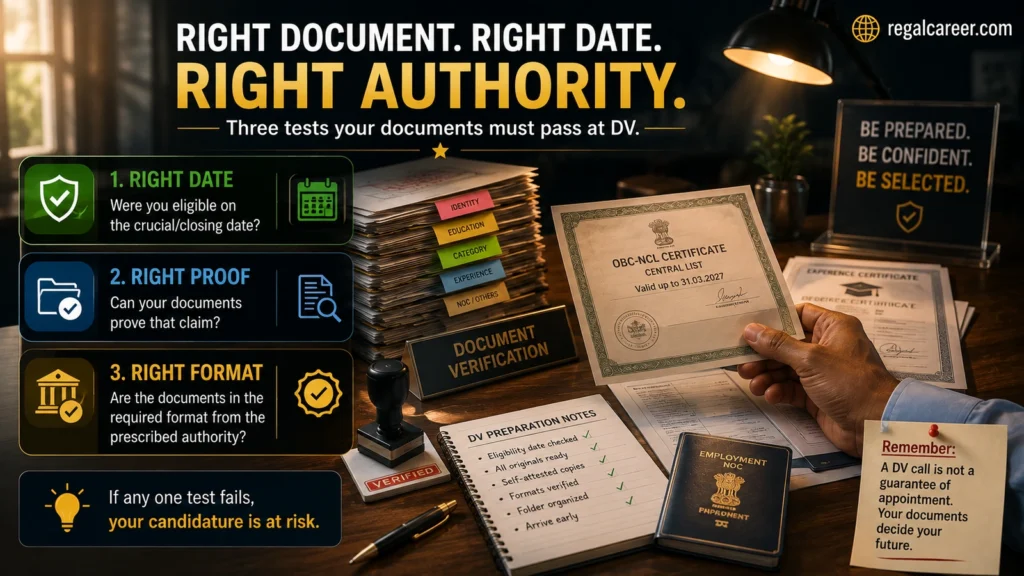
10. SC/ST/OBC-NCL/EWS Certificates: DV Checks More Than the Category Name
A certificate is not valid merely because the heading says “OBC” or “EWS.”
The authority may verify:
- correct category/community;
- Central vs State list;
- issuing authority;
- prescribed format;
- certificate date/period;
- crucial-date status;
- NCL declaration;
- income/asset year;
- State/area of origin;
- reservation claimed in the application.
For the full reservation logic, see the government job reservation rules and category certificates guide.
IMPORTANT
A category document can fail for three different reasons: you are not entitled to the category, you used the wrong certificate, or the certificate does not prove status on the required date. Diagnose which one you are facing.
11. If Your Category Certificate Fails, Can You Be Treated as UR?
Sometimes a candidate assumes:
> “If my OBC/EWS certificate is rejected, just consider me General/UR.”
Do not rely on that.
Whether a candidate can be considered under UR/Open conditions depends on the recruitment rules and whether the candidate independently met all UR conditions.
The problem becomes especially serious if the candidate used:
- age relaxation;
- extra attempts;
- relaxed qualifying standards;
- a reserved-only vacancy;
- another concession unavailable under UR.
WARNING
Never assume “my marks are above UR cut-off” automatically cures an invalid category claim.
12. PwBD Certificate and Disability Documentation
If you claimed PwBD reservation or disability-related benefits, bring the exact disability documents required by the notification.
The authority may verify:
- disability category;
- benchmark-disability status where required;
- percentage;
- issuing medical authority;
- certificate format;
- UDID/certificate details where prescribed;
- post suitability;
- benefit claimed in the application.
Exam accommodation and reservation are separate. A scribe facility does not automatically prove eligibility for a reserved PwBD vacancy.
13. Ex-Servicemen Documents
Ex-servicemen cases can require more than a discharge certificate.
RRB’s NTPC notice lists items such as:
- original discharge certificate;
- ex-servicemen self-declaration;
- NOC for serving defence personnel with probable date of discharge in applicable cases.
Other recruitments may prescribe different formats.
14. NOC for Serving Government / PSU Employees
A No Objection Certificate is easy to overlook because candidates often assume:
> “My employer knows I applied, so it is fine.”
That is not necessarily enough.
RRB’s NTPC notice expressly lists NOC from serving employees with date of appointment from the current employer.
ESIC’s 2026 DV notice also required NOC for candidates serving in Government organizations/PSUs.
CANDIDATE NOTE
If you are currently employed, place NOC in the “high-risk” section of your DV checklist because it depends on a third party and can take time.
15. Experience Certificate: Dates and Duties Matter
For experience-based posts, a generic “worked here for 3 years” letter may be insufficient.
The authority may need to establish:
- employer;
- designation;
- start date;
- end date/current status;
- full-time/part-time nature;
- duties;
- field/domain;
- whether experience is post-qualification.
Post-qualification experience
If the notification requires “three years’ experience after obtaining Degree X,” experience gained before obtaining Degree X may not count.
16. Professional Registration / Licence
Some jobs require active registration with a professional council or licence.
Examples can include:
- nursing registration;
- pharmacy registration;
- professional council registration;
- driving licence;
- technical licence;
- other statutory registration.
The authority may verify whether registration existed by the crucial date or whether it must be active at appointment.
17. Name Mismatch: Do Not Treat Every Difference the Same
Name mismatches are common:
- initials vs full name;
- surname added after marriage;
- father’s name abbreviation;
- spelling difference;
- reordered names;
- formal name change.
The solution depends on the type of mismatch and the recruitment.
ESIC’s March 2026 DV notice specifically asked for an affidavit where the candidate’s name/father’s name/surname differed across certificates/documents.
RRB’s NTPC notice separately lists Gazette notification and/or legal document in case of formal change of name.
These examples prove that “just make an affidavit” is not a universal rule.
IMPORTANT
Resolve a known name mismatch before DV. Do not rely on the verification officer to decide on the spot that two different names “obviously belong to the same person.”
18. Father’s / Mother’s Name Mismatch
Some recruitment systems verify parent names against the matriculation certificate.
A mismatch can arise from:
- initials;
- spelling;
- surname;
- honorifics;
- translation/transliteration.
Compare your application and Class 10 record first.
19. Certificates in a Regional Language: Translation May Be Required
RRB’s NTPC notice says certificates should be in English or Hindi and, where they are not, a self-attested translated version in Hindi/English should be produced when required.
Other authorities can have different translation requirements.
20. Application Printout, DV Call Letter, Photo ID and Photographs
These are easy items to forget because candidates focus on certificates.
UPSC Advertisement 07/2026 states that shortlisted candidates may have to provide self-attested supporting documents and that at interview they must produce the printout of the online application together with original certificates and self-attested copies.
ESIC’s 2026 DV notice required, among other items:
- application registration slip;
- DV call letter;
- original photo identity proof;
- recent photographs.
21. Biometric, Photograph, Signature and Identity Verification
Some recruitments use Aadhaar authentication, biometric verification, photograph comparison or signature matching.
The exact process varies.
WARNING
Never allow another person to fill/upload identity material carelessly for you. A wrong qualification entry can be explained; an impersonation or falsification concern is far more serious.
22. What if You Forget an Original Document on DV Day?
This is one of the most dangerous assumptions:
> “They will surely give me another date.”
They may not.
RRB’s NTPC notice expressly says that no additional time will be given to candidates who fail to produce original certificates on the DV date and their candidature is liable to be cancelled.
Another recruitment may allow a short deficiency period for a specific document—but you cannot assume that.
23. Lost Original Certificate: What Can You Do?
If an original was lost, start the replacement process immediately.
Possible steps depend on the issuing institution:
- duplicate marksheet/certificate application;
- police report/GD if required;
- university/board verification letter;
- DigiLocker/digital certificate if officially accepted;
- affidavit or indemnity where the issuing authority requires it.
Whether a digital or duplicate document will be accepted at DV depends on the recruitment and issuing authority.
24. Can You Submit a Document After DV?
Sometimes authorities permit re-upload, clarification or deficiency submission.
Sometimes they do not.
The rule is recruitment-specific.
Three possible outcomes
- deficiency allowed within a fixed period;
- candidature withheld/provisional pending clarification;
- candidature rejected/cancelled.
25. Provisional / Withheld Candidature: What Does It Mean?
A result or DV status can be marked:
- provisional;
- withheld;
- subject to verification;
- subject to eligibility.
This usually means the authority has not completed one or more checks.
ESIC’s March 2026 DV notice is explicit: candidates were provisionally selected, and being called for DV did not confer a right to appointment.
For the broader distinction between shortlist, provisional selection and appointment, see the government job selection process guide.
26. DV Is Not the Same as Medical Examination or Background Verification
Candidates often refer to every post-result check as “verification,” but the stages have different purposes.
Document Verification
Checks eligibility and evidence.
Medical Examination
Checks notified medical/fitness standards for the post.
Character / Police / Background Verification
Checks antecedents or other appointment-related conditions under the service rules.
Identity / Biometric Verification
Confirms the person appearing is the candidate.
RRB’s live NTPC recruitment page in 2026 shows DV and Medical Examination Round-1 as linked but distinct parts of the post-result process. See the RRB NTPC Graduate recruitment page.
27. What Happens After Successful DV?
Depending on the recruitment, the next step can be:
- medical examination;
- interview;
- skill/physical stage if DV occurs earlier;
- preference/allocation;
- final merit;
- panel/recommendation;
- background verification;
- appointment letter;
- joining.
DV is therefore not always the final administrative step.
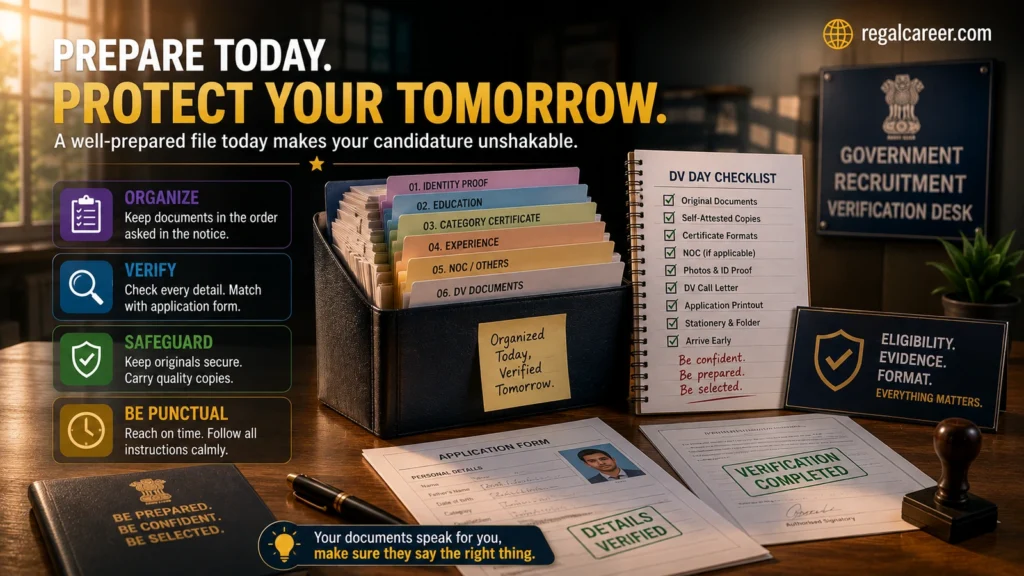
28. A User-First DV File System: Arrange Documents in the Order They Will Be Checked
A well-arranged file cannot cure ineligibility, but it reduces stress and prevents avoidable delays.
Folder A — Entry documents
- DV call letter
- Application printout
- Photo ID
- Photographs
- Registration/payment proof if required
Folder B — Identity and DOB
- Class 10 certificate
- DOB proof
- Name-change/mismatch proof
- Supporting legal/affidavit documents where applicable
Folder C — Qualification
- 10th/12th
- ITI/diploma
- semester/year marksheets
- provisional/final degree
- equivalence order
- recognition/professional registration
Folder D — Category and relaxation
- SC/ST/OBC-NCL/EWS
- NCL declaration
- PwBD
- ex-servicemen
- other relaxation certificates
Folder E — Employment
- NOC
- experience certificate
- service certificate
- relieving/appointment evidence where required
Folder F — Copies
Arrange photocopy sets in the same sequence as originals.
PRO TIP
Put a small sticky tab on each sleeve: “DOB,” “Degree,” “OBC-NCL,” “NOC,” “Experience.” At the DV desk you should be able to produce a document in seconds without unpacking the entire file.
29. The 48-Hour DV Audit
Use this two days before reporting.
PROCESS
01
Re-read the DV call letter
Highlight every document, copy count, reporting time and venue rule.
02
Re-read the eligibility clause
Confirm age, qualification, category and experience as on the crucial date.
03
Compare application vs originals
Name, DOB, category, qualification, experience and employer.
04
Verify qualification date
Ensure the result/qualification existed by the required date.
05
Check equivalence
If eligibility depends on “equivalent,” carry the official recognition/equivalence evidence.
06
Check category certificate
Correct list, format, authority, declaration and relevant date/year.
07
Check NOC/experience
Resolve documents depending on employer action.
08
Resolve name mismatch
Carry the exact legal/affidavit evidence accepted by the recruitment.
09
Prepare copies/scans
Exact number and upload format specified by the notice.
10
Arrange originals
Use the same order as the official checklist.
11
Verify travel/reporting
Reach early enough for security/entry procedures.
12
Save digital backup
Secure scans in your phone/cloud/email, but do not treat them as substitutes unless accepted.
30. Red / Amber / Green: Which DV Problems Need Immediate Action?
RED — possible eligibility failure
Examples:
- qualification obtained after cut-off;
- wrong essential subject/branch;
- category not legally available for the recruitment;
- insufficient required experience;
- mandatory registration not possessed when required;
- age not eligible without an invalid relaxation claim.
AMBER — evidence/format risk
Examples:
- wrong certificate year;
- missing NCL declaration;
- name mismatch;
- missing NOC;
- equivalence proof not arranged;
- regional-language certificate without required translation;
- lost original under reissue.
GREEN — administrative preparation
Examples:
- arranging copies;
- labeling file sections;
- printing call letter;
- taking required photographs;
- downloading application printout.
31. Common DV Mistakes That Can Cost Candidates
Mistake 1: Believing the DV call means eligibility is confirmed
Shortlisting can still be provisional.
Mistake 2: Carrying only the degree certificate
Marksheets, result date, subjects or equivalence may still need proof.
Mistake 3: Assuming a provisional degree always works
Acceptance depends on whether it proves qualification by the crucial date and satisfies the notice.
Mistake 4: Treating every OBC certificate as OBC-NCL proof
Central-list/NCL/date/format conditions can differ.
Mistake 5: Using an EWS certificate for the wrong financial year
A recent certificate can still be wrong for the recruitment.
Mistake 6: Assuming an affidavit fixes every name problem
Formal name change may require Gazette/legal evidence.
Mistake 7: Forgetting NOC
Serving employees often discover this too late.
Mistake 8: Using a vague experience letter
Dates and duties may need to prove exact essential experience.
Mistake 9: Bringing untranslated regional-language certificates
Some authorities require Hindi/English translations.
Mistake 10: Expecting another DV date automatically
Some notices explicitly say no additional time will be given for missing originals.
Mistake 11: Assuming category failure converts automatically to UR
It may not.
Mistake 12: Resigning immediately after DV
Appointment may still depend on medical, verification, allocation or formal appointment order.
32. Related Guides
Frequently Asked Questions
FAQ
What is document verification in government jobs?
DV is the stage where the recruiting authority checks whether the important claims in your application—such as age, qualification, category, experience and identity—are supported by valid documents under the recruitment rules.
Does being called for DV mean I am selected?
No. A DV call generally means you have reached the verification stage. ESIC’s 2026 DV notice expressly states that being called for document verification does not confer a right to appointment.
Which original documents are required for government job DV?
It depends on the recruitment. Common groups include matriculation/DOB proof, educational certificates and marksheets, category certificates, experience/NOC documents, photo ID, application/call letter and post-specific licences or registrations. Follow the DV notice.
How many photocopy sets should I carry?
Carry the exact number specified by the DV notice. RRB NTPC and the cited ESIC notice require two sets in their respective processes, but that is not a universal rule for every recruitment.
Can I attend DV without originals?
Do not assume so. RRB’s NTPC notice states that no additional time will be given to candidates who do not produce originals on the DV date and candidature is liable to cancellation.
Is Class 10 certificate compulsory at DV?
It is frequently required because it proves matriculation and date of birth and may be used to verify name/parent-name details. Check your recruitment’s DV list.
Do I need all semester marksheets?
Carry them when the notification/call letter requires them or when they are needed to prove subjects, marks, result date or completion. A final degree may not always prove every qualification condition.
Is a provisional degree valid for government job DV?
It can be accepted in some recruitments if it validly proves that the required qualification was acquired by the crucial date. There is no universal rule, so check the notification and DV instructions.
What is required if my degree is “equivalent” to the advertised qualification?
Some recruitments require an official equivalence order/letter. SSC Phase XIV/2026 specifically requires an order/letter identifying the authority, number and date under which the qualification has been treated as equivalent.
Can I become UR if my OBC/EWS certificate is rejected?
Not automatically. The rules and your independent UR eligibility matter, especially if you used age/attempt/standard relaxation or were considered against a reserved-only vacancy.
Is NOC required for Government employees?
Many recruitments require it. RRB NTPC and the cited ESIC DV notice include NOC requirements for serving employees in applicable cases.
What if my name is different on two certificates?
Check whether the recruitment accepts an affidavit, Gazette notification, marriage/legal document or another clarification. ESIC’s cited notice asks for an affidavit for certain name/father-name/surname discrepancies, while RRB separately requires Gazette/legal documentation for formal name change.
Can an affidavit fix every name mismatch?
No. The appropriate evidence depends on whether the issue is a spelling difference, transliteration, marriage-related change or formal legal name change and on what the recruiting authority accepts.
Do regional-language certificates need translation?
Some recruitments require it. RRB NTPC says certificates not in English/Hindi should be accompanied by a self-attested Hindi/English translation where required.
Can I submit missing documents after DV?
Sometimes a recruitment permits clarification or re-upload, while others do not. Never assume additional time will be granted; follow the specific DV notice.
What happens after document verification?
The next stage can be medical examination, final merit, allocation, background verification, panel/recommendation, appointment or joining depending on the recruitment.
Should I resign from my current job after DV?
Usually wait until you have the official appointment/allotment status required for your situation. Successful DV alone may not be the final appointment stage.
Is DigiLocker enough for DV?
Only if the recruiting authority accepts the relevant digital document for that purpose. Keep originals or other required proof unless the notice expressly allows digital substitution.
OFFICIAL SOURCE
Use the actual notification and DV call letter for your recruitment. These current official examples show how DV requirements can differ:
- SSC Selection Post Phase XIV/2026 — Document Verification requirements
- RRB NTPC Graduate CEN 05/2024 — original documents, copies, translations, NOC and certificate formats
- RRB NTPC Graduate — 2026 DV & Medical Examination updates
- UPSC Advertisement No. 07/2026 — supporting documents, originals and application claims
- ESIC Chhattisgarh — March 2026 Stenographer Document Verification notice
FINAL TAKEAWAY
Government job document verification is easiest when you stop thinking of it as “a list of papers” and start treating it as a proof audit of your application. First confirm that you were genuinely eligible on the crucial date. Then make sure every important claim is supported by the exact certificate, authority, format, translation and issue period required by the recruitment. Resolve high-risk items—qualification date, equivalence, category, NOC, experience and identity mismatches—before spending time on photocopy organisation. A neat folder helps, but the goal is bigger: when the officer checks any material claim in your application, you should be able to produce clear, valid and rule-compliant proof immediately.
