
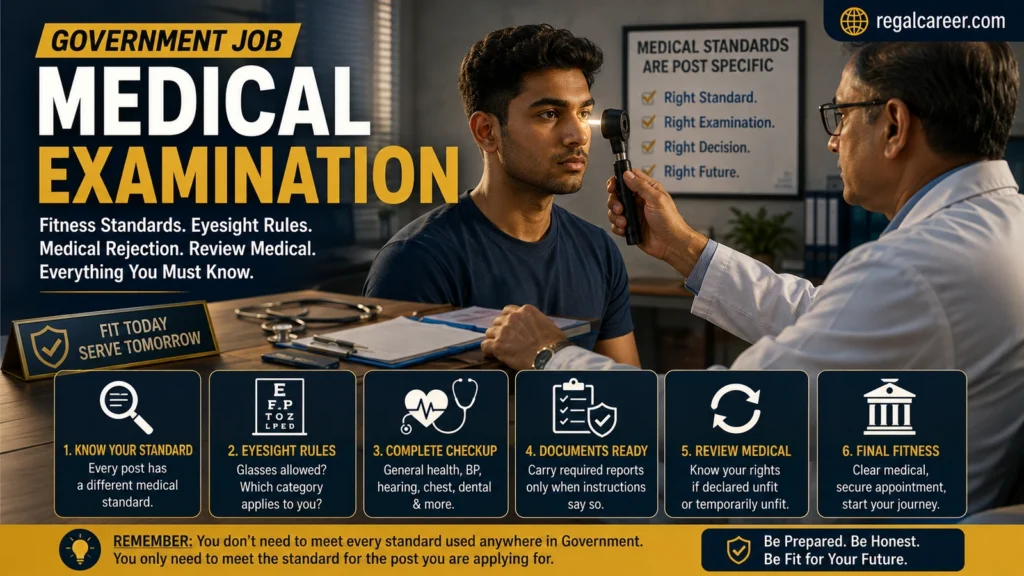
You have cleared the written exam, physical test or document verification. Then the next notice says Medical Examination.
For many candidates, this stage creates more anxiety than it should because the internet is full of generic claims such as:
- “Flat feet means rejection.”
- “Glasses are not allowed.”
- “Blood pressure above X means failure.”
- “Government jobs require 6/6 eyesight.”
- “If you fail the first medical, you always get a second chance.”
Those statements are dangerous when presented as universal rules.
The correct starting point is much simpler:
> You do not need to satisfy every medical standard used anywhere in Government. You need to satisfy the medical standard attached to the specific post you are competing for.
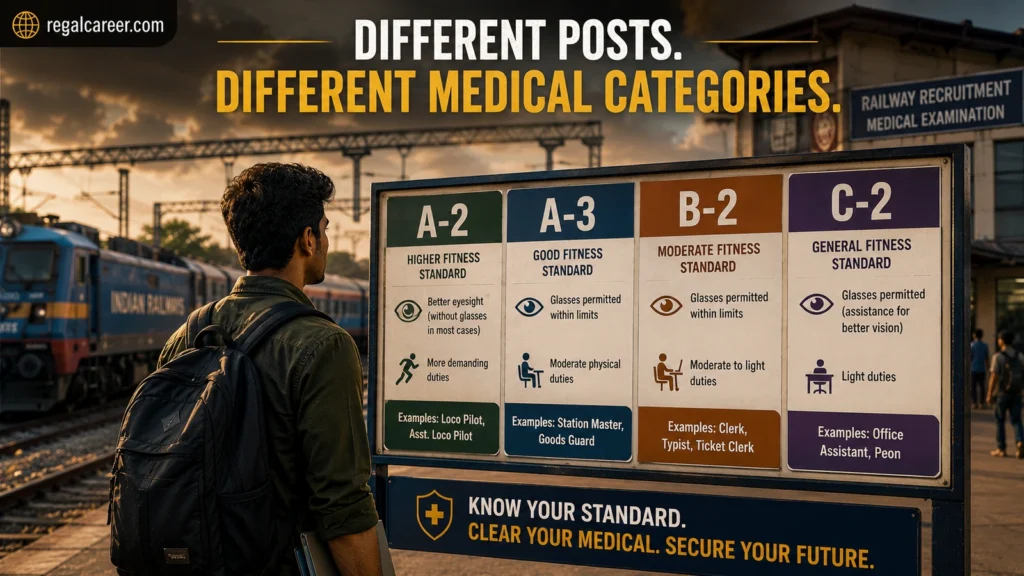
A Railway post classified A-2 can have a very different vision standard from a C-2 post. A fire-service post can prescribe height, chest, BMI, hearing and detailed fitness conditions that do not apply to an ordinary office post. CAPF recruitment can have a Detailed Medical Examination (DME) and Review Medical Examination (RME) under its own uniform guidelines. Civil Services medical rules can classify a candidate as Fit, Temporarily Unfit, Unfit for Specific Services or Unfit.
This guide will help you find your actual standard, understand what the authorized medical board is checking and respond correctly if the result is not “Fit.”
QUICK ANSWER
A government job medical examination checks whether you meet the medical/fitness standard prescribed for the specific post or service. There is no single eyesight, weight, flat-foot, blood-pressure or general fitness rule for all government jobs. First identify the medical category or standard in your recruitment notification, then follow the authorized medical-board process. If you are declared unfit, check the exact recorded reason and whether your recruitment provides re-examination, medical appeal or Review Medical Examination; do not assume a private doctor’s certificate automatically overrides the recruitment medical board.
KEY TAKEAWAYS
- Medical standards are post-specific, not universal across all government jobs.
- Read the recruitment notification before searching the internet for “medical rejection reasons.”
- Medical Examination, PST and PET are different stages with different purposes.
- Railway recruitments may use categories such as A-2, A-3, B-2 and C-2 with different eyesight requirements.
- Whether glasses or refractive surgery are permitted depends on the notified medical category and current recruitment rules.
- Flat foot, knock knee, BMI, chest, colour vision, hearing or other conditions matter only when the relevant service/post standards prescribe them.
- PwBD reservation and medical fitness are not contradictory: a candidate can be eligible for an identified post while still being assessed against the functional/medical requirements applicable to that post.
- “Temporarily Unfit” is different from “Unfit.”
- DME and RME are distinct stages in CAPF-style recruitment.
- Railway and other recruitment systems can have their own medical-appeal/reconsideration rules.
- A personal doctor’s opinion can sometimes support a permitted review, but the prescribed recruitment medical examination remains controlling.
- Do not stop prescribed medicines, dehydrate yourself, crash diet or try to manipulate medical readings before the examination.
1. What Does a Government Job Medical Examination Actually Decide?
The medical examination answers one practical question:
> Can this candidate safely and effectively perform the duties of the notified post under the medical standards prescribed for that recruitment?
That is why medical standards differ.
A safety-sensitive Railway role may require stronger visual functions than a clerical role. A fire-service post may require physical capacity for rescue work. A CAPF post may require a uniform medical standard covering a broad range of physical and functional conditions.
The standard therefore follows the job, not the candidate’s expectation of what a “government job medical” should look like.
RRB’s NTPC notice expressly states that candidates called for document verification must pass the medical fitness test conducted by the Railway Administration to ensure that they are medically fit for the duties connected with the posts they opted for. See the RRB NTPC Graduate detailed notice.
CANDIDATE NOTE
Your first task is not to ask “Am I medically fit for government service?” Your first task is to ask: “What medical standard is attached to my exact post code?”
2. How to Find the Exact Medical Standard for Your Post
Use this order:
Step 1 — Open the detailed recruitment notification
Search for:
- Medical Standard
- Medical Fitness
- Visual Acuity
- DME
- RME
- Medical Examination
- Physical & Medical Standards
- Annexure / Schedule
Step 2 — Match the standard to your post
Do not stop at the general medical section.
Railway notices often map each post to a medical category. Uniformed/service recruitments may attach separate schedules or guidelines.
Step 3 — Check corrigenda
Medical rules can be amended after the original notice.
For example, SSC issued an April 2026 corrigendum stating that revised MHA medical-examination guidance would apply to DME/RME for Constable (GD) in CAPFs/SSF and Rifleman (GD) in Assam Rifles Examination 2026. See the SSC April 2026 medical-guideline corrigendum.
Step 4 — Check the official recruitment page before reporting
Current schedule notices can specify:
- medical date;
- medical venue;
- medical call letter;
- documents/reports to bring;
- whether DV and medical are on linked dates.
RRB Bhubaneswar, for example, posted a July 2026 schedule for Document Verification and Medical Examination for NTPC Graduate posts. Use the official RRB page for the recruitment rather than relying on social-media messages.
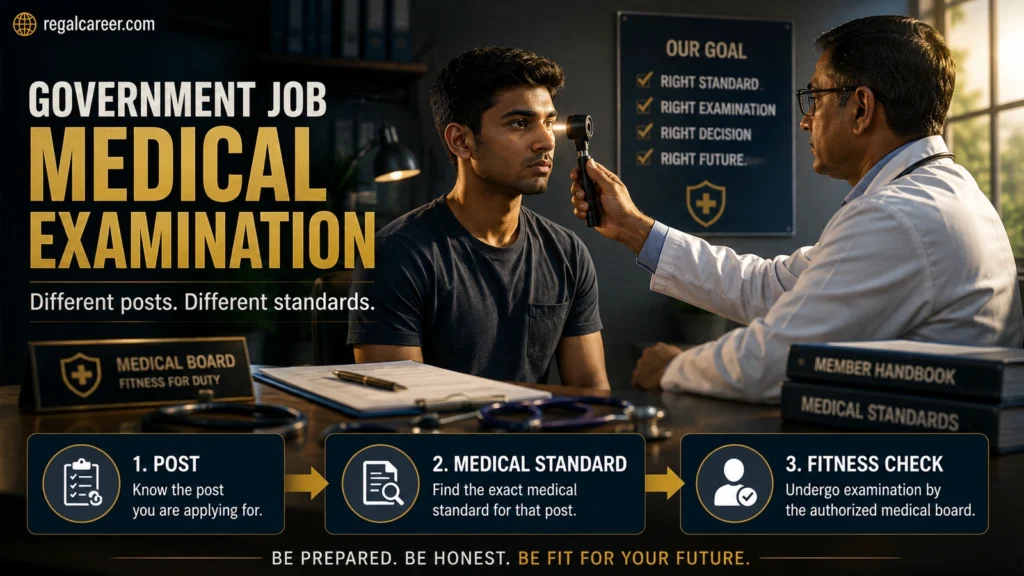
3. Medical Examination vs PST vs PET: They Are Not the Same
These stages are often mixed together.
Physical Standard Test (PST)
Measures notified physical dimensions such as:
- height;
- chest;
- weight;
- other prescribed measurements.
Physical Efficiency Test (PET)
Tests performance, for example:
- running;
- lifting;
- jumping;
- other duty-related physical tasks.
Medical Examination
Assesses medical fitness under the service/post standard.
It can include:
- vision;
- hearing;
- general physical examination;
- musculoskeletal system;
- cardiovascular/respiratory assessment;
- laboratory or other tests where prescribed;
- post-specific medical conditions.
A candidate can pass PET and still fail DME because the stages ask different questions.
VSSC’s Sub Officer recruitment is a useful example: it separately specifies physical standards, physical efficiency stages and a Detailed Medical Examination. The notice includes its own requirements for height, weight/BMI, chest, vision, hearing and other systems. See the VSSC Sub Officer detailed advertisement.
4. When Does the Medical Examination Happen?
There is no single sequence across all recruitments.
Common patterns include:
- CBT → DV → Medical;
- CBT → PET/PST → DV → DME;
- written test → PET → DME → final panel;
- interview/personality test → medical;
- DV and medical in the same post-result round.
RRB’s current 2026 recruitment pages show document verification and medical examination being scheduled together for some recruitments.
For the broader recruitment lifecycle, see the government job selection process guide.
5. What Can the Medical Board Check?
The exact list depends on the post.
Possible areas include:
- general health;
- vision;
- near vision;
- distant vision;
- colour vision;
- binocular vision;
- night/mesopic vision;
- field of vision;
- hearing;
- cardiovascular system;
- respiratory system;
- neurological system;
- musculoskeletal system;
- posture/gait;
- height/weight/chest where prescribed;
- BMI where prescribed;
- blood tests/urine tests or imaging where prescribed;
- previous surgery or relevant medical history;
- service-specific disqualifying conditions.
WARNING
Do not turn a condition listed for one specialized service into a rule for every government job. A VSSC fire-service standard or CAPF standard should not be copied onto an ordinary clerical recruitment.
6. Railway Medical Standards: Why A-2, A-3, B-2 and C-2 Matter
Railway recruitment is the clearest example of post-specific medical classification.
In the RRB NTPC Graduate CEN 05/2024 notice, the medical standards include:
| Railway medical category | Distant vision | Glasses / additional requirement |
|---|---|---|
| A-2 | 6/9, 6/9 | Without glasses; colour, binocular, night and myopic vision tests |
| A-3 | 6/9, 6/9 | With or without glasses, lens power up to 2D; additional visual-function tests |
| B-2 | 6/9, 6/12 | With or without glasses, lens power up to 4D; near/field/binocular requirements as applicable |
| C-2 | 6/12, nil | With or without glasses; combined near vision where required |
These are examples from that notification—not a universal table for every Railway recruitment.
The official notice itself says the standards are medical requirements for the listed categories and ties fitness to the duties of the selected post.
Why this matters when filling preferences
If several posts have different medical categories, your preference list is not only about salary or location.
It can also be about whether you meet the medical standard of that post.
CANDIDATE NOTE
Before finalizing Railway post preferences, make a small table: Post | Medical Category | Vision Standard | Am I likely eligible? Then verify against the current CEN and Railway Medical Manual.
7. Does Every Government Job Require 6/6 Eyesight?
No.
Even within Railway recruitment, the official NTPC example shows different visual-acuity standards for different categories.
Some specialized posts may require 6/6 without correction. VSSC’s Sub Officer advertisement, for example, prescribes 6/6 distant vision without glasses or aid for that specific fire-service post.
Another government post may allow corrected vision.
Therefore:
> “6/6 eyesight required for government jobs” is not a safe general rule.
Use the exact standard in the recruitment notice.
8. Are Glasses Allowed in Government Job Medical Tests?
Sometimes yes. Sometimes no.
RRB NTPC provides a useful example:
- A-2 requires the stated distant/near vision without glasses;
- A-3 permits glasses within the stated lens-power condition;
- B-2 permits glasses within the stated condition;
- C-2 also allows corrected vision under its notified standard.
A different recruitment can use different rules.
Do not remove prescribed glasses for days before the test or avoid using your normal correction merely because someone said “spectacles cause rejection.”
9. LASIK / Refractive Surgery: Do Not Use an Old Internet Rule
Refractive-surgery rules can change by recruitment and medical category.
Recent Railway CENs show why candidates must read the specific current notice. Some current notices distinguish A-category posts from B/C categories and refer to Railway Board conditions for candidates who underwent LASIK or another refractive procedure.
Do not rely on an old statement such as:
> “LASIK is banned in all Railway jobs.”
or
> “LASIK is allowed everywhere.”
Both can be wrong depending on the CEN/post.
IMPORTANT
If you have had LASIK or another refractive surgery and your target post has a strict visual standard, read the current CEN annexure/medical rule before choosing that post. Do not undergo elective eye surgery solely to “pass” a recruitment without understanding the applicable medical rules.
10. Colour Vision, Binocular Vision and Night Vision
Visual acuity is only one part of vision testing.
Some posts also require:
- colour vision;
- binocular vision;
- night vision;
- mesopic vision;
- field of vision;
- near vision.
RRB’s A-2 and A-3 categories in the cited NTPC notice expressly include several of these additional functions.
This matters because a candidate can read an eye chart well but still fail a post-specific visual-function requirement.
11. Hearing Standards
Hearing is not judged by one universal government-job threshold.
For some ordinary posts, routine general fitness may be enough.
For specialized posts, the notification may prescribe a specific hearing standard. VSSC’s Sub Officer advertisement, for example, states normal hearing by tuning-fork tests for that post.
Candidates using a hearing aid or having an established hearing condition should check the exact service/post requirement rather than assuming automatic rejection.
12. Height, Weight, Chest and BMI: Only Where the Post Requires Them
Many internet articles present height, chest and BMI as if they are universal government medical requirements.
They are not.
A clerical recruitment may have no such physical-standard stage.
A fire, police, defence-support or similar role may have detailed physical requirements.
VSSC’s Sub Officer recruitment prescribes separate minimum height, weight/BMI and chest measurements because of the nature of the job.
The lesson is simple:
> Physical measurements are recruitment rules, not general government-employment rules.
13. Flat Foot, Knock Knee, Bow Legs and Musculoskeletal Conditions
These are frequently searched because they appear in medical standards for some uniformed, fire or safety-sensitive services.
VSSC’s Sub Officer DME schedule, for example, lists knock knee, bow legs and flat foot among disqualifying conditions for that specific fire-service recruitment.
That does not mean every government office post rejects flat feet.
Ask the right question
Not:
> “Is flat foot allowed in government jobs?”
Ask:
> “Does the medical standard for this post specifically treat my condition as disqualifying or functionally incompatible?”
WARNING
Do not self-diagnose flat foot, knock knee, spinal deformity or another orthopaedic condition from social-media photos. If you are concerned, seek an appropriate clinical assessment, but remember the authorized recruitment medical board makes the recruitment decision.
14. Blood Pressure, Blood Sugar and Laboratory Tests
Some specialized medical standards contain explicit thresholds or investigate particular conditions.
For example, VSSC’s Sub Officer medical standard includes detailed criteria relating to blood pressure, blood sugar and other systems for that fire-service role.
Other posts may simply require general medical fitness.
Do not use another recruitment’s threshold to predict your outcome.
Safe preparation
Before the test:
- follow your prescribed medicines as directed by your treating clinician;
- sleep normally where possible;
- eat and hydrate normally unless the official medical instructions require fasting;
- carry requested medical records;
- disclose relevant treatment honestly.
Do not stop medication, deliberately dehydrate, crash diet or use unprescribed drugs to manipulate readings.
15. Tattoos: Service Rules Matter
Tattoo rules are another area where generic advice fails.
Some uniformed/service recruitments specify:
- permitted body locations;
- cultural/religious exceptions;
- size/content restrictions.
SSC’s GREF medical schedule, for example, includes its own tattoo rules.
Many ordinary government jobs have no comparable tattoo restriction.
Always read the recruitment-specific provision.
16. Dental, ENT, Skin, Hernia and Other Conditions
Some detailed service medical standards examine multiple systems and list conditions that can affect fitness.
The correct approach is not to memorize every condition from another department’s medical manual.
Instead:
- find the medical schedule for your post;
- identify whether the condition is mentioned;
- check whether the rule is absolute, temporary, severity-based or function-based;
- understand any review/re-examination procedure.
17. Previous Surgery, Scars and Medical History
A past operation does not automatically mean you are unfit.
What matters is the current medical standard and whether the surgery or residual condition affects the duties of the post.
Some specialized standards explicitly consider whether a previous major operation impairs fitness for the service.
Be accurate
If the official medical history form asks about:
- prior surgery;
- hospitalization;
- chronic illness;
- medication;
- disability;
- previous medical unfitness;
answer truthfully.
Trying to hide a material medical history can create a separate integrity issue.
18. PwBD Reservation vs Medical Fitness: Not a Contradiction
A candidate may ask:
> “If PwBD reservation exists, why is there still a medical test?”
Because these are different questions.
Reservation/identification determines whether a post is available/suitable for a category of benchmark disability under applicable rules.
Medical/functional fitness determines whether the candidate satisfies the job-related requirements for that identified post.
Railway medical rules themselves contain specific provisions for PwBD candidates, and recruitment notices can identify posts by functional requirement.
For the broader reservation framework, see the government job reservation rules and category certificates guide.
19. What Should You Carry to the Medical Examination?
Follow the medical call letter.
Possible items include:
- medical call letter;
- DV/e-call letter;
- photo ID;
- photographs;
- prescription spectacles;
- medical certificates/reports specifically requested;
- disability certificate/UDID where relevant;
- specialist reports if officially requested;
- prescribed forms.
Do not arrive with a suitcase of unrelated test reports unless the notice asks for them.
CANDIDATE NOTE
Carry a small “medical document sleeve” separate from your full DV folder so you can access the call letter, ID, glasses prescription and any requested reports quickly.
20. What Happens on Medical Day?
The exact workflow varies, but a candidate may go through:
- identity/reporting;
- basic measurements;
- vision testing;
- hearing or ENT assessment;
- general physical examination;
- system-specific examination;
- laboratory/diagnostic tests where prescribed;
- specialist referral if required;
- medical-board decision.
Some recruitments complete the process in one day. Others require follow-up testing or specialist examination.
Remain available until the authorized staff confirms that your scheduled examination is complete.
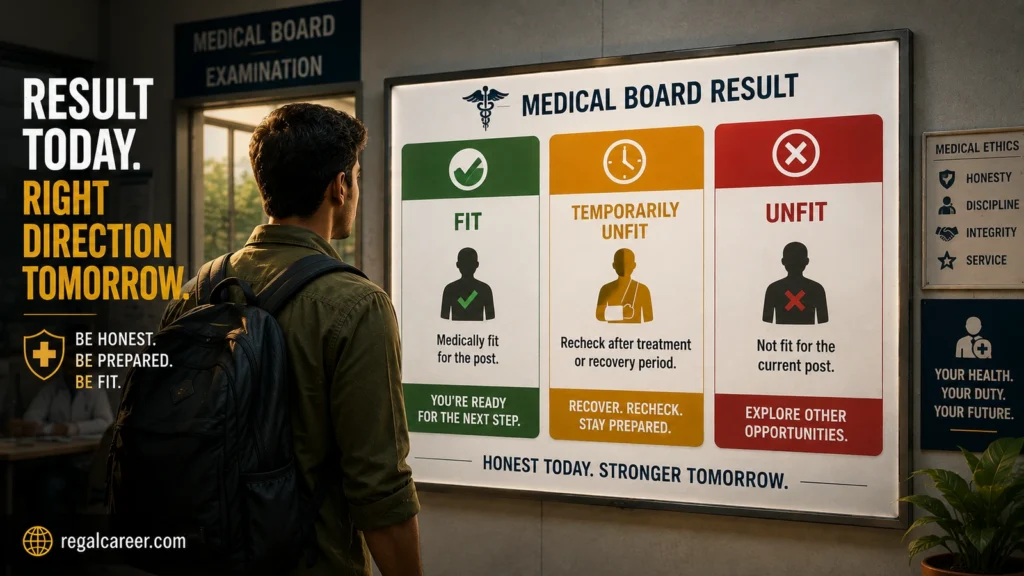
21. Fit, Temporarily Unfit and Unfit: Understand the Difference
These outcomes should not be treated as synonyms.
Fit
You meet the prescribed medical standard for the relevant service/post.
Temporarily Unfit
The medical authority considers the current condition incompatible with appointment for now, but the governing rules allow a period for recovery/treatment and re-examination.
The Civil Services Examination 2025 rules published in the Gazette say a candidate declared Temporarily Unfit can be given an opportunity for re-examination within the specified period. On re-examination, a final fitness decision should be made.
Unfit
The board determines that the candidate does not satisfy the applicable standard.
This may or may not be reviewable, depending on the recruitment rules.
IMPORTANT
If you receive an adverse result, ask for or carefully read the official communication. The words Temporarily Unfit, Unfit, Unfit for Specific Services, Review permitted, or Appeal permitted can lead to very different next steps.
22. What Is a Detailed Medical Examination (DME)?
DME is commonly used in recruitments such as CAPF/Assam Rifles and other services with detailed medical screening.
It is the substantive medical assessment against the recruitment medical standard.
A candidate can qualify the written/PET/PST stage and still need to pass DME.
SSC’s April 2026 corrigendum confirms that revised MHA medical-examination guidance applies to DME/RME for Constable (GD) in CAPFs/SSF and Rifleman (GD) in Assam Rifles Examination 2026.
23. What Is a Review Medical Examination (RME)?
RME is a review process available in recruitments whose rules provide it.
It is not the same as going to your own doctor and bringing a fitness certificate.
MHA’s revised uniform guidelines provide a formal RME mechanism for CAPFs/Assam Rifles recruitment.
The exact:
- consent process;
- time limit;
- review board;
- permitted documents;
- finality of decision
must be taken from the current recruitment instructions.
WARNING
Do not assume every government recruitment provides RME simply because CAPF recruitment does.
24. Railway Medical Appeal: Recruitment-Specific Rules Matter
Railway rules also provide procedures for reconsideration/medical appeal in specified circumstances.
The Indian Railway Medical Manual includes provisions for reconsideration of adverse medical reports, and Railway Board has issued policy instructions dealing with appeals by candidates declared medically unfit.
Recent Railway CENs can also state a specific medical-appeal opportunity and whether the appeal result is final.
Therefore, if you are declared medically unfit in a Railway recruitment:
- read the medical result/communication;
- check the current CEN;
- check the permitted appeal period;
- use the prescribed authority/process;
- do not rely on an unofficial representation sent to the wrong office.
The Indian Railway Medical Manual, Chapter 5 is the key official reference.
25. Can a Private Doctor Overrule the Government Medical Board?
No—not by themselves.
A private or Government doctor’s certificate may sometimes provide evidence for a permitted review or appeal.
But the prescribed recruitment medical examination controls the appointment decision.
The Civil Services medical rules make this clear: candidates may get themselves examined beforehand to understand their health, but only the prescribed medical examination is valid for determining appointment fitness.
If you disagree with the board
Do not simply submit:
> “My doctor says I am fit.”
Instead:
- obtain the recorded unfitness reason if the rules provide it;
- read the review/appeal procedure;
- obtain relevant specialist evidence if permitted;
- submit it through the prescribed process and deadline.
26. What If You Are Declared Medically Unfit?
Use this sequence.
PROCESS
01
Read the exact result
Identify whether it says Unfit, Temporarily Unfit, Unfit for a specific service, or another status.
02
Identify the reason
Vision, hearing, medical category, physical condition, laboratory finding or other recorded issue.
03
Re-open the recruitment rules
Find the actual medical standard that applies to your post.
04
Check review rights
RME, re-examination, medical appeal or no review.
05
Note the deadline
Medical-review periods can be short.
06
Use the prescribed route
Do not rely only on email/social media/general grievance channels.
07
Obtain supporting medical evidence if allowed
It should address the specific reason, not simply say “fit.”
08
Attend the review/re-examination
The authorized board’s decision controls under the recruitment rules.
27. Temporarily Unfit: What Should You Do?
If the official result says Temporarily Unfit, do not panic and do not self-treat based on an internet list.
Read:
- the condition/reason;
- period allowed;
- whether treatment is permitted/expected;
- re-examination date/process.
The Gazette Civil Services rules provide examples of temporary conditions that can result in temporary unfitness under those regulations and allow re-examination within the prescribed period.
Those examples should not be copied blindly to other recruitments, but they show why temporary unfitness is different from final unfitness.
28. Should You Get a Pre-Medical Check Before Recruitment Medical?
It can be useful for awareness—especially when the post has strict standards.
You may choose to check:
- current spectacle prescription;
- known hearing issue;
- documented chronic condition;
- post-specific physical measurements;
- previous surgery records.
But a pre-check is not a substitute for the recruitment board.
The goal is to understand your health and gather legitimate records, not to “game” the medical.
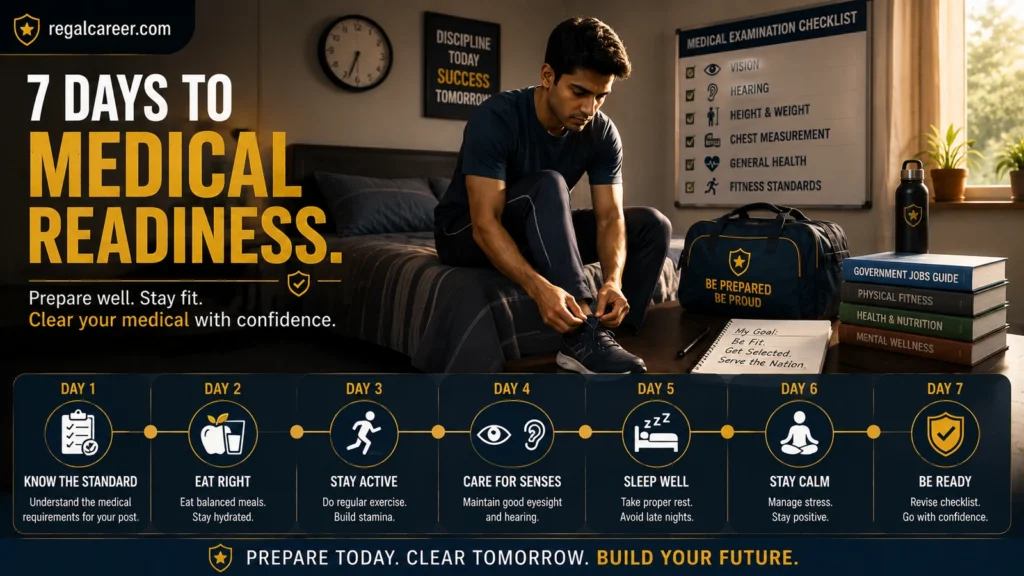
29. Seven Days Before Medical: Safe Readiness Checklist
PROCESS
01
DAY -7 | Read the medical standard | Do not prepare against a generic internet list.
02
DAY -6 | Check call letter and venue | Note reporting time and required documents.
03
DAY -5 | Arrange spectacles/hearing aid/prescriptions | Use them normally where permitted.
04
DAY -4 | Organize relevant medical records | Only records relevant to the instructions or known condition.
05
DAY -3 | Continue normal prescribed treatment | Do not stop medicines unless your clinician instructs you.
06
DAY -2 | Sleep and hydrate normally | Avoid crash dieting, dehydration or unprescribed substances.
07
DAY -1 | Pack call letter, ID, photographs and requested reports | Keep a separate medical sleeve.
08
MEDICAL DAY | Report honestly and on time | Follow board instructions and complete every referred test.
30. What Not to Do Before a Government Medical Test
Do not:
- stop blood-pressure/diabetes/other prescribed medicines on your own;
- deliberately dehydrate;
- starve or crash diet;
- take unprescribed drugs to alter readings;
- hide relevant medical history when asked;
- use someone else’s spectacles, reports or identity;
- undergo last-minute elective surgery solely because a social-media video says it will “fix” eligibility;
- assume a temporary reading automatically means final rejection.
WARNING
Trying to manipulate the medical examination can harm your health and can also create integrity problems. Your goal is accurate assessment under the correct standard.
31. Common Government Job Medical Myths
Myth 1: Every government job needs 6/6 eyesight
False. Standards vary by post.
Myth 2: Spectacles always cause rejection
False. Many notified categories permit corrected vision subject to conditions.
Myth 3: Flat foot means rejection from all government jobs
False. It matters only where the applicable medical standard treats it as disqualifying or functionally incompatible.
Myth 4: PwBD candidates cannot pass medical
False. PwBD eligibility and post-specific functional/medical requirements operate together.
Myth 5: If I fail medical, I always get RME
False. Review rights depend on the recruitment.
Myth 6: A private doctor’s fitness certificate cancels the board’s decision
False. It may support a review where allowed, but the authorized board decides under the rules.
Myth 7: Passing DV means medical is only a formality
False. Recruitment notices can make medical fitness an essential condition after DV.
Myth 8: I should stop my regular medication before medical
Unsafe and incorrect unless your treating clinician specifically directs it.
Myth 9: Medical standards never change
False. Corrigenda and revised guidelines can change applicable procedures.
Myth 10: One Railway medical table applies to every CEN
False. Check the exact CEN and post category.
32. What Happens After You Are Declared Medically Fit?
Depending on the recruitment:
- final merit may be prepared;
- panel/recommendation may be issued;
- zone/post allocation may occur;
- background/character verification may continue;
- appointment letter may be issued;
- joining formalities may begin.
Do not interpret “Medical Fit” as an appointment letter unless the recruitment says the medical result itself completes selection.
For the next-stage logic, see the government job document verification guide and the government job selection process guide.
33. The Candidate Decision Tree
PROCESS
01
Do I know my exact post?
If no, identify the post/category first.
02
Is a medical standard notified?
Open the detailed notification/corrigenda.
03
Is it general or specialized?
Railway category, CAPF/DME, fire-service standard, civil-service rules, etc.
04
Which functions matter?
Vision, hearing, physical standards or general fitness.
05
Do I have a known condition?
Compare only against the actual notified standard.
06
Am I called for medical?
Follow the call letter and authorized venue.
07
What was the result?
Fit / Temporarily Unfit / Unfit / service-specific status.
08
Is review available?
Use only the prescribed RME/re-examination/appeal route.
09
Is the result final?
Wait for the official panel/appointment process.
Frequently Asked Questions
FAQ
What is a government job medical examination?
It is the authorized assessment used to determine whether a candidate meets the medical/fitness standard prescribed for the specific government post or service.
Is medical compulsory for every government job?
Many recruitments require some form of medical fitness before appointment, but the depth and standard vary. Some have a basic fitness certificate while others have a detailed board examination.
Does every government job require 6/6 eyesight?
No. Railway and other recruitments use different visual-acuity standards depending on the post.
Can I wear glasses in a government job medical?
It depends on the post. The cited RRB NTPC notice permits correction in A-3, B-2 and C-2 under stated conditions but not in A-2.
What is Railway A-2 medical standard?
In the cited NTPC CEN, A-2 requires 6/9, 6/9 distant vision without glasses, specified near vision and additional colour/binocular/night/myopic vision tests. Always verify the current CEN because standards and post mappings can differ.
What is Railway A-3 medical standard?
In the cited NTPC CEN, A-3 permits 6/9, 6/9 with or without glasses within the stated lens-power limit and also requires additional visual-function tests.
What is Railway B-2 medical standard?
In the cited NTPC CEN, B-2 uses 6/9, 6/12 distant vision with or without glasses within the specified lens-power limit plus near/field/binocular requirements where applicable.
Is LASIK allowed in Railway jobs?
The answer depends on the medical category and current CEN. Recent Railway notices distinguish categories and refer to Railway Board conditions, so never rely on a blanket old rule.
Is colour blindness allowed in government jobs?
It depends on the post. Some safety-sensitive categories require colour vision while many other posts do not apply the same standard.
Does flat foot cause rejection?
It can be disqualifying in some specialized services whose medical standards specifically say so. It is not a universal government-job rule.
What is DME?
Detailed Medical Examination is the formal medical assessment used in recruitments such as CAPF/Assam Rifles and other services with prescribed detailed medical standards.
What is RME?
Review Medical Examination is a formal review available under recruitments whose rules provide it, such as CAPF/Assam Rifles under MHA guidelines.
Do I always get RME if declared medically unfit?
No. Review rights are recruitment-specific.
What does Temporarily Unfit mean?
It means the applicable medical rules permit a period for recovery/treatment before re-examination. It is different from final unfitness.
Can a private doctor declare me fit after the government board says unfit?
A private doctor cannot directly override the recruitment board. Their report may support an official review where the recruitment rules allow one.
Can I appeal Railway medical unfitness?
Railway rules provide reconsideration/appeal mechanisms in specified situations, and recent CENs may prescribe a medical-appeal process. Follow the exact current CEN and Railway instructions.
Should I stop medicines before the medical test?
Do not stop prescribed medicines on your own. Continue treatment as directed by your clinician unless the official medical instructions or treating clinician tell you otherwise.
What documents should I take for medical?
Follow the medical call letter. Common items can include call letter, photo ID, photographs, spectacles and relevant prescribed medical reports.
Is medical examination after DV?
Often, but not always. Some recruitments schedule DV and medical together, while others place medical after PET/PST or interview.
If I pass medical, am I appointed?
Not necessarily. Final merit, panel, allocation, background verification or appointment formalities may still remain.
Can PwBD candidates be declared medically fit?
Yes. PwBD reservation/identified-post eligibility and the post’s functional/medical requirements must be read together; disability does not automatically mean medical unfitness.
What should I do immediately after an unfit result?
Read the official reason/status, identify the exact medical rule, check whether review/re-examination/appeal is available, note the deadline and use only the prescribed process.
OFFICIAL SOURCE
Always use the medical standard and call letter for your own recruitment. These official sources illustrate why standards differ:
- RRB NTPC Graduate CEN 05/2024 — Railway A-2, A-3, B-2 and C-2 medical standards
- Indian Railway Medical Manual — Chapter 5
- SSC April 2026 Corrigendum — revised medical-examination guidance for CAPF/SSF/Assam Rifles DME/RME
- MHA Revised Uniform Guidelines for Review Medical Examination in CAPFs & Assam Rifles
- VSSC Advertisement No. 331 — Sub Officer physical and detailed medical standards
- Civil Services Examination medical rules — Gazette of India
FINAL TAKEAWAY
Government job medical examination should not be approached as a frightening list of diseases or body measurements. It is a post-specific fitness assessment. Find the exact medical category attached to your post, read every current corrigendum, understand which visual/physical/medical functions actually apply and attend the authorized board honestly. If the result is adverse, distinguish Temporarily Unfit from Unfit and immediately check whether the recruitment provides re-examination, RME or medical appeal. The candidate who understands the correct standard is in a much stronger position than the candidate trying to satisfy every medical rule they found on the internet.
